Search
00
GBAF Logo
trophy
Top StoriesInterviewsBusinessFinanceBankingTechnologyInvestingTradingVideosAwardsMagazinesHeadlinesTrends

Subscribe to our newsletter

Get the latest news and updates from our team.

Global Banking & Finance Review®

Global Banking & Finance Review® - Subscribe to our newsletter

Company

    GBAF Logo
    • About Us
    • Profile
    • Privacy & Cookie Policy
    • Terms of Use
    • Contact Us
    • Advertising
    • Submit Post
    • Latest News
    • Research Reports
    • Press Release
    • Awards▾
      • About the Awards
      • Awards TimeTable
      • Submit Nominations
      • Testimonials
      • Media Room
      • Award Winners
      • FAQ
    • Magazines▾
      • Global Banking & Finance Review Magazine Issue 79
      • Global Banking & Finance Review Magazine Issue 78
      • Global Banking & Finance Review Magazine Issue 77
      • Global Banking & Finance Review Magazine Issue 76
      • Global Banking & Finance Review Magazine Issue 75
      • Global Banking & Finance Review Magazine Issue 73
      • Global Banking & Finance Review Magazine Issue 71
      • Global Banking & Finance Review Magazine Issue 70
      • Global Banking & Finance Review Magazine Issue 69
      • Global Banking & Finance Review Magazine Issue 66
    Top StoriesInterviewsBusinessFinanceBankingTechnologyInvestingTradingVideosAwardsMagazinesHeadlinesTrends

    Global Banking & Finance Review® is a leading financial portal and online magazine offering News, Analysis, Opinion, Reviews, Interviews & Videos from the world of Banking, Finance, Business, Trading, Technology, Investing, Brokerage, Foreign Exchange, Tax & Legal, Islamic Finance, Asset & Wealth Management.
    Copyright © 2010-2026 GBAF Publications Ltd - All Rights Reserved. | Sitemap | Tags | Developed By eCorpIT

    Editorial & Advertiser disclosure

    Global Banking & Finance Review® is an online platform offering news, analysis, and opinion on the latest trends, developments, and innovations in the banking and finance industry worldwide. The platform covers a diverse range of topics, including banking, insurance, investment, wealth management, fintech, and regulatory issues. The website publishes news, press releases, opinion and advertorials on various financial organizations, products and services which are commissioned from various Companies, Organizations, PR agencies, Bloggers etc. These commissioned articles are commercial in nature. This is not to be considered as financial advice and should be considered only for information purposes. It does not reflect the views or opinion of our website and is not to be considered an endorsement or a recommendation. We cannot guarantee the accuracy or applicability of any information provided with respect to your individual or personal circumstances. Please seek Professional advice from a qualified professional before making any financial decisions. We link to various third-party websites, affiliate sales networks, and to our advertising partners websites. When you view or click on certain links available on our articles, our partners may compensate us for displaying the content to you or make a purchase or fill a form. This will not incur any additional charges to you. To make things simpler for you to identity or distinguish advertised or sponsored articles or links, you may consider all articles or links hosted on our site as a commercial article placement. We will not be responsible for any loss you may suffer as a result of any omission or inaccuracy on the website.

    Home > Headlines > Russia could concede $300 billion in frozen assets as part of Ukraine war settlement, sources say
    Headlines

    Russia could concede $300 billion in frozen assets as part of Ukraine war settlement, sources say

    Published by Global Banking & Finance Review®

    Posted on February 21, 2025

    6 min read

    Last updated: January 26, 2026

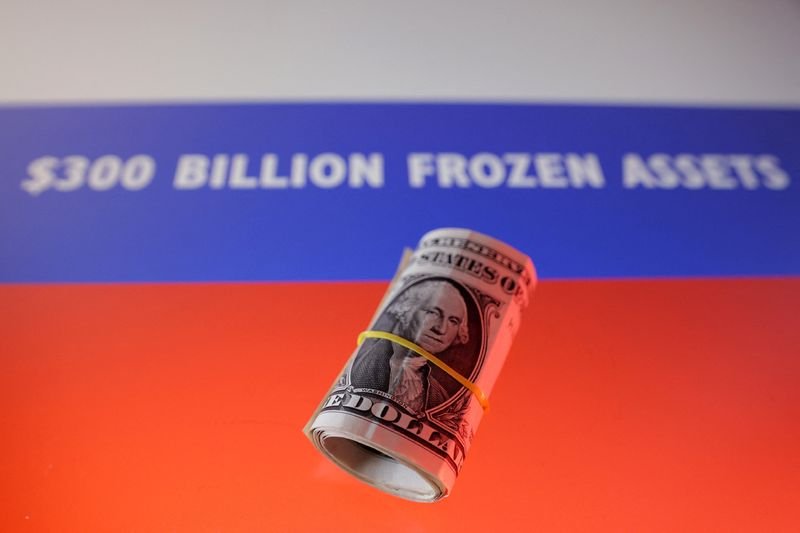
    This image illustrates the discussions around Russia's proposal to allocate $300 billion in frozen assets for Ukraine's reconstruction, highlighting the geopolitical implications of the ongoing war and potential U.S.-Russia negotiations.
    Image depicting the potential allocation of frozen Russian assets for Ukraine reconstruction - Global Banking & Finance Review
    Why waste money on news and opinion when you can access them for free?

    Take advantage of our newsletter subscription and stay informed on the go!

    Subscribe

    Tags:financial communityinternational financial institutionCapital MarketsInvestment management

    Quick Summary

    Russia might use $300 billion in frozen assets for Ukraine's reconstruction amid early peace talks with the U.S., focusing on areas under Russian control.

    Russia May Allocate $300 Billion in Frozen Assets for Ukraine Reconstruction

    MOSCOW (Reuters) - Russia could agree to using $300 billion of sovereign assets frozen in Europe for reconstruction in Ukraine but will insist that part of the money is spent on the one-fifth of the country that Moscow's forces control, three sources told Reuters.

    Russia and the United States held their first face-to-face talks on ending the Ukraine war on Feb. 18 in Saudi Arabia and both U.S. President Donald Trump and Russian President Vladimir Putin have said they hope to meet soon.  

    After Putin sent troops into Ukraine in 2022, the United States and its allies prohibited transactions with Russia's central bank and finance ministry, blocking $300-$350 billion of sovereign Russian assets, mostly European, U.S. and British government bonds held in a European securities depository.

    While discussions between Russia and the United States are at a very early stage, one idea being floated in Moscow is that Russia could propose using a large chunk of the frozen reserves for rebuilding Ukraine as part of a possible peace deal, according to three sources with knowledge of the matter.

    Swathes of eastern Ukraine have been devastated by the war and hundreds of thousands of soldiers killed or injured on both sides while millions of Ukrainians have fled to European countries or Russia. A year ago, the World Bank estimated reconstruction and recovery would cost $486 billion.

    The sources spoke to Reuters on condition of anonymity due to the sensitivity of the discussions and because discussions are only preliminary. The Kremlin declined to comment.

    The idea that Russia may agree to using the frozen money to help rebuild Ukraine has not been previously reported, and may give an insight into what Russia is willing to compromise on as Moscow and Washington seek to end the war, at a time when Trump is pushing for U.S. access to Ukrainian minerals to repay Washington's support.

    Russia's main demands to stop the fighting include a withdrawal of Kyiv's troops from Ukrainian territory Moscow claims and an end to Ukraine's ambitions to join NATO. Ukraine says Russia must withdraw from its territory, and wants security guarantees from the West. The Trump administration says Ukraine has unrealistic, "illusionary" goals.

    Reuters could not establish whether the idea of using the frozen funds was discussed between Russia and U.S. counterparts in the Saudi meeting.

    The Group of Seven stated in 2023 that the Russian sovereign funds will remain frozen until Russia pays for the damage it inflicted in Ukraine. Trump has said he would like Russia to return to the G7, a grouping of wealthy nations. 

    Russian Central Bank Governor Elvira Nabiullina said on Thursday the bank was not part of any talks on lifting sanctions or unfreezing of Russia's reserves. 

    Russia has previously said plans to use the funds in Ukraine amounted to robbery. 

    The Ukrainian foreign ministry and the White House did not immediately respond to requests for comment. The British Foreign Office declined to comment. 

    "Nothing about Ukraine and the EU can be decided without Ukraine and the EU," said Anitta Hipper, a spokesperson for the European Commission. She said the EU and member states were helping Ukraine strengthen its position ahead of any talks, including with a new round of sanctions on Russia. 

    Renaissance Capital lead analyst Oleg Kouzmin said the differences between the United States and Europe, which controls most of the assets, would complicate a lifting of the freeze.

    "It would require the European side to fully back the current stance of the U.S. aimed at dialog with Russia," Kouzmin said, calling such a scenario "very optimistic".

    TWO THIRD SPLIT?

    Russia's frozen sovereign assets have been the subject of intense debate in the West with some proposing it be essentially given to Ukraine through a complex "repatriation loan". 

    One source with knowledge of the discussions in Moscow said that Russia could accept up to two-thirds of the reserves going to the restoration of Ukraine under a peace deal, provided there were accountability guarantees.

    The rest could go to the Russian-controlled territories in eastern Ukraine that Russia now considers to be part of Russia, said the source. 

    Another source with knowledge of discussions said that Moscow would agree to using the money to rebuild Ukraine but that it was too early to say what the possible division might be. Two sources stressed that it was important to discuss which companies would get future contracts for reconstruction.

    A different source, close to the Kremlin but not directly involved in the discussions, said that Russia would still demand the lifting of the freeze on the assets as part of gradual sanctions relief.

    Several Western officials, especially in the German government and European Central Bank, have been reluctant to simply confiscate sovereign reserves, warning that such a move could face legal challenges and undermine the euro as a reserve currency.

    Russian officials have repeatedly warned that the state confiscation of assets goes against free market principles, destroys banking security and erodes faith in reserve currencies. In retaliation, Russia has drafted legislation to confiscate funds from companies and investors from so-called unfriendly states, those that have hit it with sanctions. The bill has not yet been voted in Russia's State Duma lower house.

    EUROPEAN FREEZE

    At the time the assets were frozen, Russia's central bank said it held around $207 billion in euro assets, $67 billion in U.S. dollar assets and $37 billion in British pound assets.

    It also had holdings comprising $36 billion of Japanese yen, $19 billion in Canadian dollars, $6 billion in Australian dollars and $1.8 billion in Singapore dollars. Its Swiss franc holdings were about $1 billion. 

    Russia reports its total gold and foreign exchange reserves as around $627 billion, including the frozen funds. The value of Russia's frozen assets fluctuates according to bond prices and currency movements. 

    The bank's biggest bond holdings were in the sovereign bonds of China, Germany, France, Britain, Austria and Canada. Russia's gold reserves were held in Russia.

    Around 159 billion euros of the assets were managed by Belgian clearing house Euroclear Bank as of early last year, Euroclear has said.

    While the freezing of the funds has angered Moscow, some of Russia's most outspoken war hawks have previously acknowledged Russia may eventually part with the frozen reserves, provided that the controlled territories stay within Russia.

    "I propose a solution. They pay this money towards our purchase of those territories, those lands that want to be with us," said Margarita Simonyan, head of the Russian state broadcaster RT, in 2023.

    The Russian-controlled territories of Ukraine account for about 1% of Russia's gross domestic product, but some economists believe that their share could grow quickly if they remain with Russia when the war ends. The regions already provide around 5% of Russia's grain harvest.

    (Reporting by Reuters; additional reporting by Philip Blenkinsop in Brussels, Sachin Ravikumar in London and Jarrett Renshaw in Washington; editing by Guy Faulconbridge and Frank Jack Daniel)

    Key Takeaways

    • •Russia may use $300 billion in frozen assets for Ukraine.
    • •Peace talks between Russia and the U.S. are in early stages.
    • •Russia wants part of the funds used in areas it controls.
    • •The World Bank estimates Ukraine's reconstruction at $486 billion.
    • •The G7 insists funds remain frozen until Russia pays for damages.

    Frequently Asked Questions about Russia could concede $300 billion in frozen assets as part of Ukraine war settlement, sources say

    1What amount of frozen assets is Russia considering for Ukraine?

    Russia could agree to using $300 billion of its sovereign assets frozen in Europe for reconstruction in Ukraine.

    2What are Russia's main demands to stop the fighting?

    Russia's main demands include the withdrawal of Kyiv's troops from territories Moscow claims and an end to Ukraine's ambitions to join NATO.

    3What has been the response from Western officials regarding the frozen assets?

    Several Western officials have expressed reluctance to simply confiscate sovereign reserves, warning that such actions could face legal challenges.

    4What conditions might Russia impose for the use of frozen funds?

    Russia may demand the lifting of the freeze on its assets as part of a gradual sanctions relief process.

    5How much of the frozen reserves might go to Ukraine under a peace deal?

    One source indicated that Russia could accept up to two-thirds of the frozen reserves being allocated to the restoration of Ukraine under a peace deal.

    More from Headlines

    Explore more articles in the Headlines category

    Image for Thousands protest in Berlin in solidarity with Iranian uprisings
    Thousands protest in Berlin in solidarity with Iranian uprisings
    Image for Farmers report 'catastrophic' damage to crops as Storm Marta hits Spain and Portugal
    Farmers report 'catastrophic' damage to crops as Storm Marta hits Spain and Portugal
    Image for French justice opens Epstein-linked probe against former culture minister
    French justice opens Epstein-linked probe against former culture minister
    Image for If US attacks, Iran says it will strike US bases in the region
    If US attacks, Iran says it will strike US bases in the region
    Image for Suspected saboteurs hit Italian rail network near Bologna, police say
    Suspected saboteurs hit Italian rail network near Bologna, police say
    Image for Olympics-Protesters to rally in Milan denouncing impact of Winter Games
    Olympics-Protesters to rally in Milan denouncing impact of Winter Games
    Image for Olympics-Biathlon-Winter Games bring tourism boost to biathlon hotbed of northern Italy
    Olympics-Biathlon-Winter Games bring tourism boost to biathlon hotbed of northern Italy
    Image for US pushes Russia and Ukraine to end war by summer, Zelenskiy says
    US pushes Russia and Ukraine to end war by summer, Zelenskiy says
    Image for Russia to interrogate two suspects over attempted killing of general, report says
    Russia to interrogate two suspects over attempted killing of general, report says
    Image for Russia launches massive attack on Ukraine's energy system, Zelenskiy says
    Russia launches massive attack on Ukraine's energy system, Zelenskiy says
    Image for Ukraine backs Pope's call for Olympic truce in war with Russia
    Ukraine backs Pope's call for Olympic truce in war with Russia
    Image for Russia launched 400 drones, 40 missiles to hit Ukraine's energy sector, Zelenskiy says
    Russia launched 400 drones, 40 missiles to hit Ukraine's energy sector, Zelenskiy says
    View All Headlines Posts
    Previous Headlines PostExclusive-U.S. piles pressure on Iraq to resume Kurdish oil exports, sources say
    Next Headlines PostEuropean military supplier KNDS considers IPO as defence sector booms, sources say