Search
00
GBAF Logo
trophy
Top StoriesInterviewsBusinessFinanceBankingTechnologyInvestingTradingVideosAwardsMagazinesHeadlinesTrends

Subscribe to our newsletter

Get the latest news and updates from our team.

Global Banking & Finance Review®

Global Banking & Finance Review® - Subscribe to our newsletter

Company

    GBAF Logo
    • About Us
    • Profile
    • Privacy & Cookie Policy
    • Terms of Use
    • Contact Us
    • Advertising
    • Submit Post
    • Latest News
    • Research Reports
    • Press Release
    • Awards▾
      • About the Awards
      • Awards TimeTable
      • Submit Nominations
      • Testimonials
      • Media Room
      • Award Winners
      • FAQ
    • Magazines▾
      • Global Banking & Finance Review Magazine Issue 79
      • Global Banking & Finance Review Magazine Issue 78
      • Global Banking & Finance Review Magazine Issue 77
      • Global Banking & Finance Review Magazine Issue 76
      • Global Banking & Finance Review Magazine Issue 75
      • Global Banking & Finance Review Magazine Issue 73
      • Global Banking & Finance Review Magazine Issue 71
      • Global Banking & Finance Review Magazine Issue 70
      • Global Banking & Finance Review Magazine Issue 69
      • Global Banking & Finance Review Magazine Issue 66
    Top StoriesInterviewsBusinessFinanceBankingTechnologyInvestingTradingVideosAwardsMagazinesHeadlinesTrends

    Global Banking & Finance Review® is a leading financial portal and online magazine offering News, Analysis, Opinion, Reviews, Interviews & Videos from the world of Banking, Finance, Business, Trading, Technology, Investing, Brokerage, Foreign Exchange, Tax & Legal, Islamic Finance, Asset & Wealth Management.
    Copyright © 2010-2026 GBAF Publications Ltd - All Rights Reserved. | Sitemap | Tags | Developed By eCorpIT

    Editorial & Advertiser disclosure

    Global Banking & Finance Review® is an online platform offering news, analysis, and opinion on the latest trends, developments, and innovations in the banking and finance industry worldwide. The platform covers a diverse range of topics, including banking, insurance, investment, wealth management, fintech, and regulatory issues. The website publishes news, press releases, opinion and advertorials on various financial organizations, products and services which are commissioned from various Companies, Organizations, PR agencies, Bloggers etc. These commissioned articles are commercial in nature. This is not to be considered as financial advice and should be considered only for information purposes. It does not reflect the views or opinion of our website and is not to be considered an endorsement or a recommendation. We cannot guarantee the accuracy or applicability of any information provided with respect to your individual or personal circumstances. Please seek Professional advice from a qualified professional before making any financial decisions. We link to various third-party websites, affiliate sales networks, and to our advertising partners websites. When you view or click on certain links available on our articles, our partners may compensate us for displaying the content to you or make a purchase or fill a form. This will not incur any additional charges to you. To make things simpler for you to identity or distinguish advertised or sponsored articles or links, you may consider all articles or links hosted on our site as a commercial article placement. We will not be responsible for any loss you may suffer as a result of any omission or inaccuracy on the website.

    Home > Headlines > Atomic scientists adjust 'Doomsday Clock' closer than ever to midnight
    Headlines

    Atomic scientists adjust 'Doomsday Clock' closer than ever to midnight

    Published by Global Banking & Finance Review®

    Posted on January 28, 2025

    4 min read

    Last updated: January 27, 2026

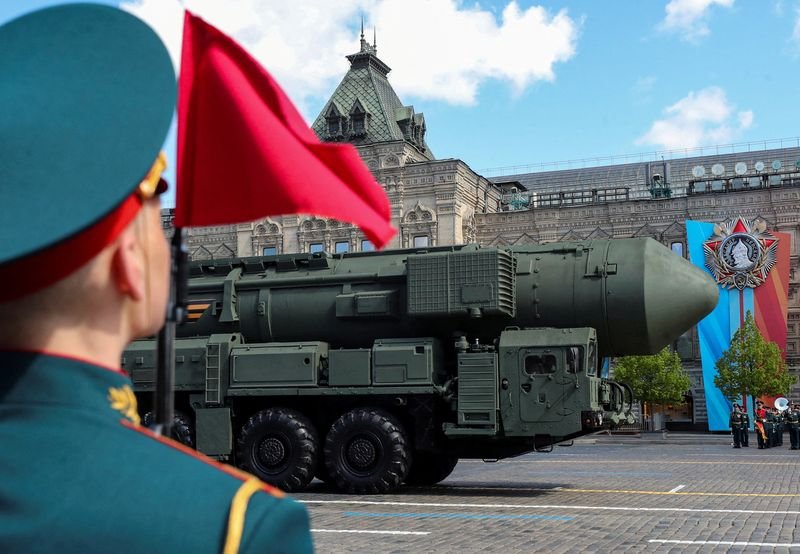
    The image illustrates the Doomsday Clock positioned at 89 seconds to midnight, reflecting heightened global risks from nuclear threats, climate change, and military AI, as discussed in the article.
    Doomsday Clock set at 89 seconds to midnight amid global tensions - Global Banking & Finance Review
    Why waste money on news and opinion when you can access them for free?

    Take advantage of our newsletter subscription and stay informed on the go!

    Subscribe

    Tags:Climate ChangeArtificial Intelligencefinancial community

    Quick Summary

    The Doomsday Clock is now 89 seconds to midnight, highlighting nuclear threats and global tensions, including AI and climate change.

    Doomsday Clock Set at 89 Seconds to Midnight Amid Global Tensions

    By Will Dunham

    WASHINGTON (Reuters) - Atomic scientists on Tuesday moved their "Doomsday Clock" closer to midnight than ever before, citing Russian nuclear threats amid its invasion of Ukraine, tensions in other world hot spots, military applications of artificial intelligence and climate change as factors underlying the risks of global catastrophe.

    The Bulletin of the Atomic Scientists set the clock to 89 seconds before midnight - the theoretical point of annihilation. That is one second closer than it was set last year. The Chicago-based nonprofit created the clock in 1947 during the Cold War tensions that followed World War Two to warn the public about how close humankind was to destroying the world.

    "The factors shaping this year's decision - nuclear risk, climate change, the potential misuse of advances in biological science and a variety of other emerging technologies such as artificial intelligence - were not new in 2024. But we have seen insufficient progress in addressing the key challenges, and in many cases this is leading to increasingly negative and worrisome effects," said Daniel Holz, chair of the Bulletin's Science and Security Board.

    "Setting the Doomsday Clock at 89 seconds to midnight is a warning to all world leaders," Holz added.

    Russia's 2022 invasion of Ukraine launched Europe's bloodiest conflict since World War Two.

    "The war in Ukraine continues to loom as a large source of nuclear risk. That conflict could escalate to include nuclear weapons at any moment due to a rash decision or through accident and miscalculation," Holz said.

    Russian President Vladimir Putin in November lowered the threshold for a nuclear strike in response to a broader range of conventional attacks, a move the Kremlin described as a signal to the West amid a war in which Ukraine has received arms supplied by the United States and its allies. Russia's updated doctrine set a framework for conditions under which Putin could order a strike from the world's biggest nuclear arsenal.

    Russia said in October that it will not discuss signing a new treaty with the United States to replace the New Strategic Arms Reduction Treaty limiting each side's strategic nuclear weapons that expires in 2026 because Moscow believes it needs to be broadened and expanded to cover other countries.

    "Russian aggression in Ukraine, including repeated use of nuclear threats since the war began, has been disturbing. In addition, Russia's recent backtracking from important arms control treaties is an alarming sign of increasing nuclear risk," Holz said.

    The Middle East has been another source of instability with the Israel-Gaza war and broader regional hostilities involving countries including Iran. Nuclear-armed China has stepped up military pressure near Taiwan, sending warships and planes into the waters and air space around the island that Beijing views as its own territory. Nuclear-armed North Korea continues with tests of various ballistic missiles.

    "We are watching closely and hope that the ceasefire in Gaza will hold. Tensions in the Middle East including with Iran are still dangerously unstable," Holz said. "There are other potential hot spots around the world, including Taiwan and North Korea. Any of these could turn into a conflagration involving nuclear powers, with unpredictable and potentially devastating outcomes."

    Artificial intelligence made rapid gains in capability and popularity in 2024, prompting increasing concern among some experts about its military applications and its risks to global security. Governments have addressed the matter in fits and starts. In the United States, for instance, then-President Joe Biden in October signed an executive order intended to reduce the risks that artificial intelligence poses to national security, the economy and public health or safety. His successor Donald Trump last week revoked it.

    "Advances in AI are beginning to show up on the battlefield in tentative but worrisome ways, and of particular concern is the future possibility of AI applications to nuclear weapons. In addition, AI is increasingly disrupting the world's information ecosystem. AI-fueled disinformation and misinformation will only add to this dysfunction," Holz said.

    Last year was the hottest in recorded history, according to scientists at the U.N. World Meteorological Organization. The last 10 years were the 10 hottest on record, it said.

    "While there has been impressive growth in wind and solar energy, the world is still falling short of what is necessary to prevent the worse aspects of climate change," Holz said.

    The Bulletin was founded in 1945 by scientists including Albert Einstein and J. Robert Oppenheimer.

    (Reporting by Will Dunham; Editing by Daniel Wallis)

    Key Takeaways

    • •Doomsday Clock set at 89 seconds to midnight.
    • •Nuclear threats from Russia cited as a major risk.
    • •Global tensions include AI and climate change.
    • •Middle East and Taiwan are potential conflict zones.
    • •AI's military applications raise security concerns.

    Frequently Asked Questions about Atomic scientists adjust 'Doomsday Clock' closer than ever to midnight

    1What is the current setting of the Doomsday Clock?

    The Doomsday Clock is currently set at 89 seconds to midnight, the closest it has ever been.

    2What factors contributed to the adjustment of the Doomsday Clock?

    Factors include nuclear risks from the Ukraine conflict, climate change, and the misuse of emerging technologies like artificial intelligence.

    3How has Russia's actions influenced global nuclear risk?

    Russia's invasion of Ukraine and its nuclear threats have significantly increased global nuclear risk, with concerns about potential escalation.

    4What role does artificial intelligence play in global security?

    Experts are increasingly concerned about the military applications of artificial intelligence and its potential risks to global security.

    5What are the implications of climate change according to the article?

    Despite growth in renewable energy, the world is still falling short of necessary measures to prevent severe climate change impacts.

    More from Headlines

    Explore more articles in the Headlines category

    Image for Olympics-Protesters to rally in Milan denouncing impact of Winter Games
    Olympics-Protesters to rally in Milan denouncing impact of Winter Games
    Image for Olympics-Biathlon-Winter Games bring tourism boost to biathlon hotbed of northern Italy
    Olympics-Biathlon-Winter Games bring tourism boost to biathlon hotbed of northern Italy
    Image for US wants Russia, Ukraine to end war by summer, Zelenskiy says
    US wants Russia, Ukraine to end war by summer, Zelenskiy says
    Image for Russia to interrogate two suspects over attempted killing of general, report says
    Russia to interrogate two suspects over attempted killing of general, report says
    Image for Russia launches massive attack on Ukraine's energy system, Zelenskiy says
    Russia launches massive attack on Ukraine's energy system, Zelenskiy says
    Image for Ukraine backs Pope's call for Olympic truce in war with Russia
    Ukraine backs Pope's call for Olympic truce in war with Russia
    Image for Russia launched 400 drones, 40 missiles to hit Ukraine's energy sector, Zelenskiy says
    Russia launched 400 drones, 40 missiles to hit Ukraine's energy sector, Zelenskiy says
    Image for The Kyiv family, with its pets and pigs, defying Russia and the cold
    The Kyiv family, with its pets and pigs, defying Russia and the cold
    Image for Not Italy's Devil's Island: Sardinia bristles at mafia inmate plan
    Not Italy's Devil's Island: Sardinia bristles at mafia inmate plan
    Image for Two Polish airports reopen after NATO jets activated over Russian strikes on Ukraine
    Two Polish airports reopen after NATO jets activated over Russian strikes on Ukraine
    Image for Exclusive-US plans initial payment towards billions owed to UN-envoy Waltz
    Exclusive-US plans initial payment towards billions owed to UN-envoy Waltz
    Image for Trump says good talks ongoing on Ukraine
    Trump says good talks ongoing on Ukraine
    View All Headlines Posts
    Previous Headlines PostUkraine's Zelenskiy says he discussed US contacts with Israel's Netanyahu
    Next Headlines PostRussian state 'military' bank in talks to buy electronics giant, newspapers say