Headlines
Mass Shootings Horrify the Balkans. But Illegal Guns Still Thrive
Published by Global Banking & Finance Review®
Posted on February 3, 2025
6 min readLast updated: January 26, 2026
Add as preferred source on Google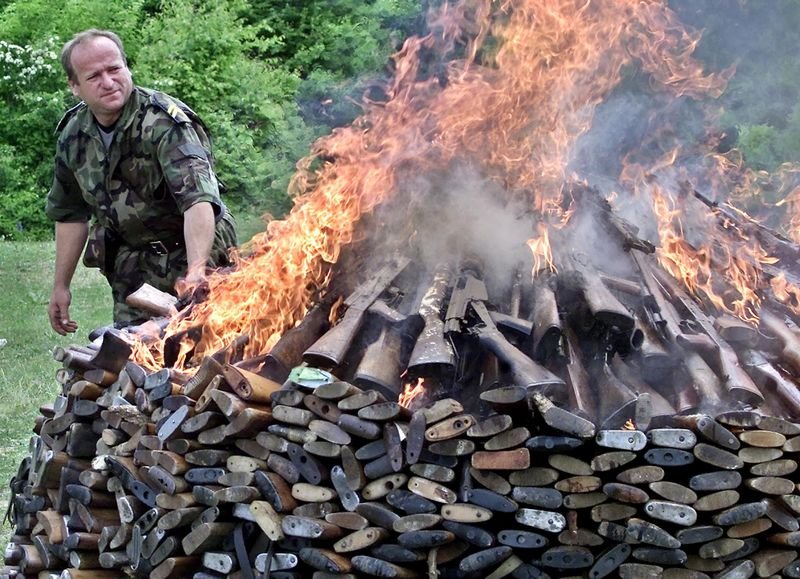
Published by Global Banking & Finance Review®
Posted on February 3, 2025
6 min readLast updated: January 26, 2026
Add as preferred source on GoogleIllegal guns persist in the Balkans despite new controls. Cultural factors and past conflicts contribute to the challenge of reducing gun violence.
By Aleksandar Vasovic and Edward McAllister
CETINJE, Montenegro (Reuters) - Vesna Pejovic vowed to reduce gun violence in Montenegro after her daughter and two grandsons were killed in a mass shooting in the town of Cetinje in 2022. Then came news on Jan. 1 that drained what optimism she had left.
A brawl in a tavern had triggered another rampage across the country's picturesque old capital in which a gunman killed 13 people with an illegal firearm then shot himself.
"We had to relive all our horrors all over again," said Pejovic, 63, who for three years has lobbied politicians to enact stricter gun controls in the small Balkan country.
"We are devastated again as we've failed to gain anything, despite striving for it with our hearts and souls."
Montenegro's Prime Minister Milojko Spajic announced stricter gun control measures following the shooting, including tougher tests to obtain licences. He also gave the owners of illegal weapons two months to freely hand them over.
But the limited impact of previous gun control measures in the Western Balkans highlights just how hard it is to eradicate violence across a region littered with millions of firearms left over from regional conflicts, and where the culture of weapon ownership runs centuries deep.
Even when governments pass stricter laws, many cash-strapped countries do not have the resources or sometimes the will to enforce the legislation, three experts said, in part because the gun trade is run by powerful criminal gangs.
Inaction, they say, stokes insecurity in the region and potentially in the neighbouring European Union where Balkan weapons often end up.
"It's important not only to have good legislation, but also to be able to maintain and enforce your legislation," said Nils Duquet, director of the Brussels-based Flemish Peace Institute, an independent research body hosted by the Flemish Parliament.
"Fighting illegal firearms is a very difficult task, and I think a lot still has to be done," he said.
Montenegro already has a years-old gun amnesty program in which tens of thousands of pieces were surrendered. Some of them were used to make a monument named The Bird of Peace in the capital Podgorica.
Still, the program did little to stop access to the illegal market. Since the 2022 shooting, Pejovic has lobbied for tougher gun control legislation. She helped introduce what was called Marko's and Masan's Law, after her dead grandsons. It was never passed, although a draft of tougher legislation was proposed last month.
"Acquiring a firearm here is akin to buying bread in a shop," Pejovic said.
DEATH RATES
The breakup of Yugoslavia in the 1990s triggered a series of bloody ethnic conflicts that left 6 million surplus firearms in the Western Balkans, a region comprising Montenegro, Serbia, Kosovo, Bosnia and Herzegovina, Albania and North Macedonia.
The latest data from the Small Arms Survey, a Switzerland-based project, suggests only about half those have been collected or destroyed.
By Jan. 27, three weeks after Prime Minister Spajic's request to hand over illegal weapons, Montenegrins had surrendered 1,535 weapons.
This followed a similar move in Serbia in 2023 in which, according to police, civilians handed over 82,000 pieces of weapons, over 4 million rounds of ammunition and around 26,000 pieces of explosive ordnance, in the wake of two mass shootings. Bosnia has had a similar program in recent years.
Experts laud those efforts, but the statistics raise doubts about their success.
In Montenegro, up to 100,000 illegal weapons are estimated to still be in circulation, according to Djordjije Vukicevic, vice president of the Independent Police Union of Montenegro.
Annual gun-related incidents in the region - which include accidents, suicides, threats and violent crimes - rose more than 70% between 2019 and 2024, according to data from SEESAC, a UN- and EU-backed regional gun-control initiative.
Over the same period, gun-related deaths, excluding suicides, have remained relatively steady between 100 and 150 per year, the data show.
Death rates from gun crime in the Western Balkans are at least 30% higher than those in the largest EU countries, according to data from the United Nations Office on Drugs and Crime (UNODC).
The black market for Balkan weapons also impacts other regions. Balkans weapons are often sought after across the world because they are cheaper, according to UNODC.
"The fact that the firearms produced in the Western Balkans jurisdictions were used in several terrorist attacks in 2015 and 2016 in Europe and continue to be used across the region in various criminal contexts is a cause of concern," UNODC told Reuters in a written response to questions.
Some changes may help. In November, Western Balkans countries agreed to harmonise gun laws with the European Union and clamp down on illicit weapons.
Under the UN-backed Hermes project launched in 2023, Bosnia has strengthened postal and customs checks that have intercepted firearms destined for countries as far afield as Japan and the United States, said Davor Ilic, expert advisor for the prevention of smuggling and offences at Bosnia's Indirect Tax Administration.
"Efforts to reduce illegal weapons have shown measurable and positive results, but the problem of smuggling and illicit trade persists," Ilic said.
GUN CULTURE
Montenegro, with a population of 616,000, is a growing tourist destination for wealthy Europeans attracted by its mountains, valleys and Adriatic coastline.
It also loves weapons.
The strong gun culture stems from centuries of wars with Turks, Venetians, and Austrians. Today it ranks third globally in gun ownership per capita, with 39.1 firearms per 100 people, data from the Small Arms Survey show.
In 1910, to bolster his small army and deter invaders, Montenegrin King Nikola Petrovic mandated that all male citizens purchase a Gasser-pattern revolver, later known as the Montenegrin Revolver. The gun became part of traditional attire.
The affinity with guns is evident everywhere. Next to the taverna where the Jan. 1 shooting began, stands a church fence made of ancient musket barrels seized from Turks in the 19th century.
Across the street, two cannons guard the entry to the former royal military barracks. Antique guns adorn the walls of living rooms, restaurants and bars across town.
Arms controls are unpopular.
"My generation ... grew up in homes where weapons were an integral part of the household," said Velimir Rakocevic, a Podgorica-based lecturer of criminology.
That culture is echoed across much of the region. In Kosovo, where there are hundreds of thousands of illegal weapons, police say gun violence worsens in summer when people celebrate at weddings by firing bullets into the air.
A mural painted on the outside of a police station in the capital Pristina depicts a wedding scene where a man on a dance floor is shooting into the starry sky as a child looks on.
"Celebrate with heart not with weapons," the caption reads.
(Reporting by Aleksandar Vasovic in Cetinje and Edward McAllister in Athens; Additional reporting by Fatos Bytyci in Pristina and Stevo Vasiljevic in Cetinje; Editing by Daniel Flynn)
The article discusses the persistence of illegal guns in the Balkans despite new gun control measures.
Montenegro has implemented stricter gun control measures and a gun amnesty program.
Cultural factors and surplus firearms from past regional conflicts contribute to the issue.
Explore more articles in the Headlines category