Search
00
GBAF Logo
trophy
Top StoriesInterviewsBusinessFinanceBankingTechnologyInvestingTradingVideosAwardsMagazinesHeadlinesTrends

Subscribe to our newsletter

Get the latest news and updates from our team.

Global Banking and Finance Review

Global Banking and Finance Review - Subscribe to our newsletter

Company

    GBAF Logo
    • About Us
    • Profile
    • Privacy & Cookie Policy
    • Terms of Use
    • Contact Us
    • Advertising
    • Submit Post
    • Latest News
    • Research Reports
    • Press Release
    • Awards▾
      • About the Awards
      • Awards TimeTable
      • Submit Nominations
      • Testimonials
      • Media Room
      • Award Winners
      • FAQ
    • Magazines▾
      • Global Banking & Finance Review Magazine Issue 79
      • Global Banking & Finance Review Magazine Issue 78
      • Global Banking & Finance Review Magazine Issue 77
      • Global Banking & Finance Review Magazine Issue 76
      • Global Banking & Finance Review Magazine Issue 75
      • Global Banking & Finance Review Magazine Issue 73
      • Global Banking & Finance Review Magazine Issue 71
      • Global Banking & Finance Review Magazine Issue 70
      • Global Banking & Finance Review Magazine Issue 69
      • Global Banking & Finance Review Magazine Issue 66
    Top StoriesInterviewsBusinessFinanceBankingTechnologyInvestingTradingVideosAwardsMagazinesHeadlinesTrends

    Global Banking & Finance Review® is a leading financial portal and online magazine offering News, Analysis, Opinion, Reviews, Interviews & Videos from the world of Banking, Finance, Business, Trading, Technology, Investing, Brokerage, Foreign Exchange, Tax & Legal, Islamic Finance, Asset & Wealth Management.
    Copyright © 2010-2026 GBAF Publications Ltd - All Rights Reserved. | Sitemap | Tags | Developed By eCorpIT

    Editorial & Advertiser disclosure

    Global Banking and Finance Review is an online platform offering news, analysis, and opinion on the latest trends, developments, and innovations in the banking and finance industry worldwide. The platform covers a diverse range of topics, including banking, insurance, investment, wealth management, fintech, and regulatory issues. The website publishes news, press releases, opinion and advertorials on various financial organizations, products and services which are commissioned from various Companies, Organizations, PR agencies, Bloggers etc. These commissioned articles are commercial in nature. This is not to be considered as financial advice and should be considered only for information purposes. It does not reflect the views or opinion of our website and is not to be considered an endorsement or a recommendation. We cannot guarantee the accuracy or applicability of any information provided with respect to your individual or personal circumstances. Please seek Professional advice from a qualified professional before making any financial decisions. We link to various third-party websites, affiliate sales networks, and to our advertising partners websites. When you view or click on certain links available on our articles, our partners may compensate us for displaying the content to you or make a purchase or fill a form. This will not incur any additional charges to you. To make things simpler for you to identity or distinguish advertised or sponsored articles or links, you may consider all articles or links hosted on our site as a commercial article placement. We will not be responsible for any loss you may suffer as a result of any omission or inaccuracy on the website.

    Home > Headlines > Explainer-How do Germany's federal elections work?
    Headlines

    Explainer-How do Germany's federal elections work?

    Published by Global Banking and Finance Review

    Posted on February 22, 2025

    4 min read

    Last updated: January 26, 2026

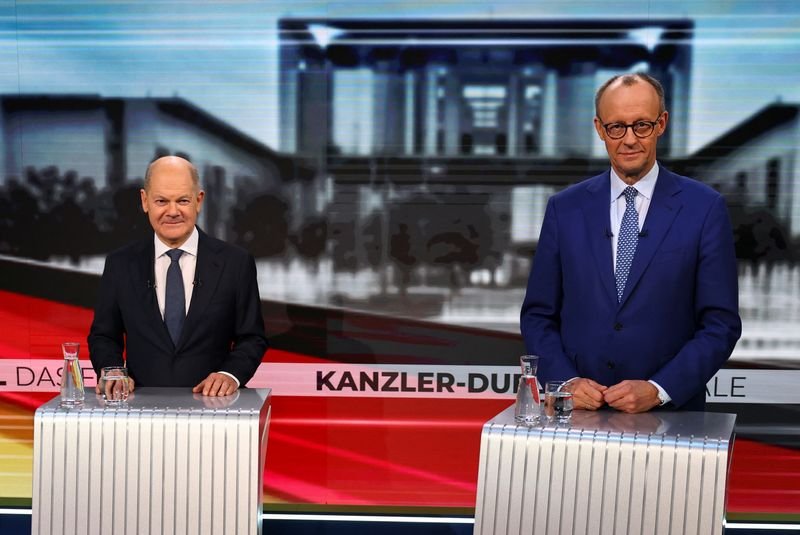
    A detailed image showing a voting booth setup in Germany, relevant to the article explaining the hybrid voting system used in the federal elections and its impact on parliamentary representation.
    Voting booth during Germany's federal elections, illustrating the hybrid voting system - Global Banking & Finance Review
    Why waste money on news and opinion when you can access them for free?

    Take advantage of our newsletter subscription and stay informed on the go!

    Subscribe

    Tags:financial crisiseconomic growthGovernment fundingfinancial markets

    Quick Summary

    Germany's federal elections use a hybrid system. A new law fixes parliament seats, and the 5% threshold impacts party representation.

    Explaining Germany's Federal Election System

    By Thomas Escritt

    BERLIN (Reuters) - Germans go to the polls on Sunday in a snap election called after the collapse of Chancellor Olaf Scholz's three-way coalition. This is how Germany's election system works:

    WHAT IS GERMANY'S HYBRID VOTING SYSTEM?

    Germany's reformed voting system aims to blend British- or American-style single-member constituencies with the proportionality characteristic of most continental European countries.

    Under the old system, proportionality was ensured by topping up parliament with extra seats after winners were found in each of 299 constituencies. This ensured parties held seats in line with their share of the vote, regardless of the distribution of constituency seats.

    In 2021, that led to a parliament of 735 seats, one of the largest legislatures in the world. 

    A new law, introduced in 2023, fixes parliament at 630 seats - between Britain's lower House of Commons and Turkey's National Assembly in world rankings - and prioritises proportionality over individual member seats.

    Now, if a party wins a share of seats that is greater in proportion to their share of the national vote, some constituencies will be left vacant, starting with those where the winning candidates have the narrowest margin of victory.

    The change may hurt parties that are traditionally strong in single-member constituencies - in particular the Christian Social Union (CSU), the Bavarian sister party of the Christian Democrats (CDU) whose leader Friedrich Merz is tipped to become the next chancellor after the election.

    HOW DOES THE 5% THRESHOLD WORK?

    Under rules designed to prevent the kind of chaotic and fragmented parliaments that in the 1930s helped fuel the disastrous rise to power of Adolf Hitler's Nazis, parties must in general get 5% of the national vote to enter parliament.

    But under a rule that had been scrapped in the new law before being restored by a court ruling, parties that win three constituency seats are entitled to seats corresponding to their vote share even if it is below 5%.

    In 2021, that saved the Left party, which, thanks to three members with strong regional bases in eastern Germany, got 39 seats.

    The combination of the 5% threshold, the three-seat exception, and an unusually competitive party landscape with many smaller parties jostling for position makes for a particularly unpredictable result this time.

    Polls put the neo-liberal Free Democrats, whose departure from Chancellor Olaf Scholz's three-way coalition precipitated the snap election, on about 4-5%, while the Left is seen on 6-7% and its splinter party, the upstart Sahra Wagenknecht Alliance(BSW), on 4-5%.

    The Free Voters, strong rivals to the CSU in Bavaria, are far short of the 5% threshold nationally but have a chance of winning three member constituencies, which would put them in the Bundestag for the first time.

    HOW COULD PARLIAMENT LOOK?

    With a highly competitive party landscape and a complex electoral system, the parliament could comprise anywhere from four to eight parties. The first scenario would yield the most consolidated Bundestag since 2017, while the latter would mark the most diverse in modern German history.

    That means the distribution of power in the new parliament is extremely hard to predict and that Merz will most likely need a coalition partner - either Scholz's Social Democrats or the Greens or maybe both - to build a majority government.

    The far-right Alternative for Germany (AfD), currently in second place in most polls on around 20%, is unlikely to be part of any coalition government as all other parties have ruled out working with a party they regard as undemocratic.

    (Reporting by Thomas Escritt and Riham Alkousaa; Editing by Bernadette Baum, Gareth Jones and Hugh Lawson)

    Key Takeaways

    • •Germany uses a hybrid voting system combining single-member constituencies and proportional representation.
    • •A new law fixes the parliament at 630 seats, prioritizing proportionality.
    • •The 5% threshold prevents fragmented parliaments, with exceptions for parties winning three constituencies.
    • •The election outcome is unpredictable due to a competitive party landscape.
    • •The AfD is unlikely to join any coalition despite being second in polls.

    Frequently Asked Questions about Explainer-How do Germany's federal elections work?

    1What is the main topic?

    The main topic is how Germany's federal elections work, including the voting system and party dynamics.

    2What is Germany's hybrid voting system?

    It combines single-member constituencies with proportional representation to ensure fair party representation.

    3How does the 5% threshold affect elections?

    Parties must get 5% of the national vote to enter parliament, with exceptions for those winning three constituencies.

    More from Headlines

    Explore more articles in the Headlines category

    Image for Queen's University Belfast cuts ties with US politician Mitchell over Epstein files
    Queen's University Belfast cuts ties with US politician Mitchell over Epstein files
    Image for UK police review reports of alleged misconduct by Mandelson after Epstein files release
    UK police review reports of alleged misconduct by Mandelson after Epstein files release
    Image for Russia says foreign forces in Ukraine would be 'legitimate targets'
    Russia says foreign forces in Ukraine would be 'legitimate targets'
    Image for Swiss National Bank Chairman says current situation not easy for policy
    Swiss National Bank Chairman says current situation not easy for policy
    Image for Recycling body opposes EU scrap aluminium export curbs
    Recycling body opposes EU scrap aluminium export curbs
    Image for Czech leader urges EU to overhaul carbon trading schemes to curb energy costs
    Czech leader urges EU to overhaul carbon trading schemes to curb energy costs
    Image for US cuts tariffs on India to 18%, India agrees to end Russian oil purchases
    US cuts tariffs on India to 18%, India agrees to end Russian oil purchases
    Image for Small drone fell on Polish army base, military police say
    Small drone fell on Polish army base, military police say
    Image for South African white separatists claim land acquired from Zulu king then lost to British
    South African white separatists claim land acquired from Zulu king then lost to British
    Image for Portugal counts multi‑billion‑euro damage after Storm Kristin tears off roofs
    Portugal counts multi‑billion‑euro damage after Storm Kristin tears off roofs
    Image for Ukraine's Zelenskiy says dignified, lasting peace realistic, ahead of talks
    Ukraine's Zelenskiy says dignified, lasting peace realistic, ahead of talks
    Image for LVMH champagne arm settles dispute with workers over bonuses, union says
    LVMH champagne arm settles dispute with workers over bonuses, union says
    View All Headlines Posts
    Previous Headlines PostDancing in Damascus: Syrians cling to culture under Islamists' rule
    Next Headlines PostPope Francis in critical condition after health deteriorates, Vatican says