Search
00
GBAF Logo
trophy
Top StoriesInterviewsBusinessFinanceBankingTechnologyInvestingTradingVideosAwardsMagazinesHeadlinesTrends

Subscribe to our newsletter

Get the latest news and updates from our team.

Global Banking & Finance Review®

Global Banking & Finance Review® - Subscribe to our newsletter

Company

    GBAF Logo
    • About Us
    • Profile
    • Privacy & Cookie Policy
    • Terms of Use
    • Contact Us
    • Advertising
    • Submit Post
    • Latest News
    • Research Reports
    • Press Release
    • Awards▾
      • About the Awards
      • Awards TimeTable
      • Submit Nominations
      • Testimonials
      • Media Room
      • Award Winners
      • FAQ
    • Magazines▾
      • Global Banking & Finance Review Magazine Issue 79
      • Global Banking & Finance Review Magazine Issue 78
      • Global Banking & Finance Review Magazine Issue 77
      • Global Banking & Finance Review Magazine Issue 76
      • Global Banking & Finance Review Magazine Issue 75
      • Global Banking & Finance Review Magazine Issue 73
      • Global Banking & Finance Review Magazine Issue 71
      • Global Banking & Finance Review Magazine Issue 70
      • Global Banking & Finance Review Magazine Issue 69
      • Global Banking & Finance Review Magazine Issue 66
    Top StoriesInterviewsBusinessFinanceBankingTechnologyInvestingTradingVideosAwardsMagazinesHeadlinesTrends

    Global Banking & Finance Review® is a leading financial portal and online magazine offering News, Analysis, Opinion, Reviews, Interviews & Videos from the world of Banking, Finance, Business, Trading, Technology, Investing, Brokerage, Foreign Exchange, Tax & Legal, Islamic Finance, Asset & Wealth Management.
    Copyright © 2010-2026 GBAF Publications Ltd - All Rights Reserved. | Sitemap | Tags | Developed By eCorpIT

    Editorial & Advertiser disclosure

    Global Banking & Finance Review® is an online platform offering news, analysis, and opinion on the latest trends, developments, and innovations in the banking and finance industry worldwide. The platform covers a diverse range of topics, including banking, insurance, investment, wealth management, fintech, and regulatory issues. The website publishes news, press releases, opinion and advertorials on various financial organizations, products and services which are commissioned from various Companies, Organizations, PR agencies, Bloggers etc. These commissioned articles are commercial in nature. This is not to be considered as financial advice and should be considered only for information purposes. It does not reflect the views or opinion of our website and is not to be considered an endorsement or a recommendation. We cannot guarantee the accuracy or applicability of any information provided with respect to your individual or personal circumstances. Please seek Professional advice from a qualified professional before making any financial decisions. We link to various third-party websites, affiliate sales networks, and to our advertising partners websites. When you view or click on certain links available on our articles, our partners may compensate us for displaying the content to you or make a purchase or fill a form. This will not incur any additional charges to you. To make things simpler for you to identity or distinguish advertised or sponsored articles or links, you may consider all articles or links hosted on our site as a commercial article placement. We will not be responsible for any loss you may suffer as a result of any omission or inaccuracy on the website.

    Home > Investing > There’s no such thing as a bad market, just an unprepared trader
    Investing

    There’s no such thing as a bad market, just an unprepared trader

    Published by Jessica Weisman-Pitts

    Posted on December 5, 2022

    5 min read

    Last updated: February 2, 2026

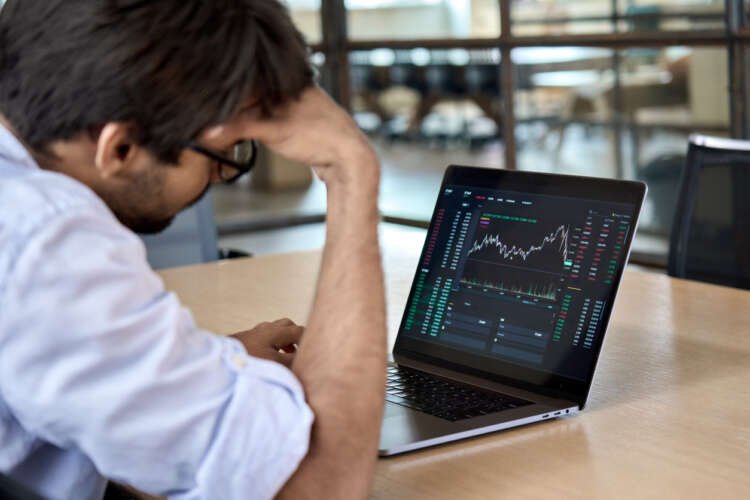
    A stressed businessman reviews trading data on a digital screen, symbolizing the challenges of day trading in volatile markets. This image relates to the article's theme of preparedness for traders amid geopolitical instability and market fluctuations.
    Stressed trader analyzing stock market volatility during winter - Global Banking & Finance Review
    Why waste money on news and opinion when you can access them for free?

    Take advantage of our newsletter subscription and stay informed on the go!

    Subscribe

    Tags:trading platformrisk managementfinancial managementInvestment Strategies

    By Marc Despallieres, Chief Strategy and Trading Officer at Vantage

    Alfred Wainwright once said, “There’s no such thing as bad weather, only unsuitable clothing.”

    It’s a good lesson to keep in mind as we in the northern hemisphere stare down the barrel of winter. It’s an even better one for day traders to remember as they face up to ongoing market volatility amidst continued geopolitical instability, a global energy crisis, and the nosediving euro.

    No, I’m not telling them to rug up. I’m telling them to prepare. Because there’s no such thing as a ‘bad market’, just an underprepared trader.

    The thermal under-layer: sufficient resourcing

    A bit like underwear, sufficient resourcing is the kind of foundational layer all traders should really be wearing every day, but in periods of market volatility it needs to be even thicker. Thermal, if you will.

    There’s no shame in playing it safe, especially for those still new to day trading. Studies show that 70-90% of day traders lose money when they first start out.

    Traders can do this in a range of ways; first and foremost, by limiting their capital to only what they can afford to lose. They can also spread out risk by diversifying across at least two or three assets, positions, and time horizons.

    Successful traders don’t make decisions for emotional reasons. They should stick to set targets and avoid getting carried away by the upward trend of signals of the stock they are following.

    Suit up: research

    You can’t go outside in winter in just your underwear. Similarly, traders can’t trade successfully during turbulent times without significant investment in research to fill out the broader market context in which they are operating.

    Before starting out, traders must gain an understanding of market fundamentals. Knowing what makes the markets move may help them identify trends, generate trade ideas and seize opportunities.

    Before trading any instrument or asset, they should make sure they have done their due diligence to understand what makes each one move. Learning how to read charts and using technical analysis could also be beneficial when it comes to timing the entry and exit points of a trade. Depending on your technical strategy, using corresponding technical indicators improve entry and exit decisions. For example, the Relative Strength Index (RSI) serves as an indicator that checks for a stock’s health.

    Another key piece of research is picking the right platform – one that will enable them to make and execute decisions quickly and accurately with minimal fees. Since most of decisions are time-sensitive, traders should look for platforms backed by brokers with deep liquidity pools.

    Warm pyjamas: don’t leave positions exposed after trading hours

    Even overnight, you still need to be protected from the cold. So it goes with traders and risk. Traders may want to consider closing all their open positions on or before the end of the day trading period, as leaving them open overnight may expose them to potential risks and losses that could incur after the market closes.

    Let’s say a trader leaves an open position for ABZ company stock. The company gets involved in an unethical scandal and its stock price plummets overnight. Their failure to exit that position during the end of their trading day could possibly cause them a massive loss.

    Umbrella: stop-loss orders

    No matter how well-dressed you might be, it’s always worthwhile having an umbrella on hand as a first line of defence. Similarly, no matter how solid the position one takes in a trade, it is ideal to always set up a stop-loss order – a risk management tool which can reduce the loss a trader can suffer within any given period.

    If they trade without stop-loss orders, they are likely to be exposed to much bigger losses if and when trades go wrong. In some cases, losses may even exceed invested capital.

    Surviving the colder months

    At the end of the day, it’s not viable for traders to shut up shop and hibernate throughout market volatility in hope of calmer weather on the horizon. With so many factors at play contributing to the turbulence, this could be the new normal for a long while to come.

    Similarly, they shouldn’t throw themselves blindly into the blizzard. With a cautious, considered approach, traders can learn to not just survive the economic winter but come out on top.

    ——————————————————————–

    About the author:

    Marc Despallieres is Chief Strategy & Trading Officer at Vantage – a global, multi-asset broker headquartered in Sydney, Australia. Vantage provides a state-of-the-art platform for trading CFDs on Forex, Commodities, Indices, Shares, Cryptocurrencies and ETF. In his current role, Marc is instrumental in directing Vantage’s short and long-term strategic initiatives, and guiding the business in its ambitious expansion goals in both emerging and developed markets. He has over 30 years of experience in the financial services industry, supporting banks, brokers and professional traders, and connecting them to the most advanced technology, liquidity, brokerage infrastructure, clearing, and services in the market for institutional trading. Marc joined Vantage in August 2019, with plans to continually enhance Vantage’s product offerings and promote greater innovation in customer experience and service excellence.

    Frequently Asked Questions about There’s no such thing as a bad market, just an unprepared trader

    1What is market volatility?

    Market volatility refers to the rate at which the price of a security increases or decreases for a given set of returns. It indicates the level of risk associated with a security's price changes.

    2What is a stop-loss order?

    A stop-loss order is a risk management tool used by traders to limit potential losses. It automatically sells a security when its price falls to a specified level.

    3What is risk management in trading?

    Risk management in trading involves identifying, assessing, and prioritizing risks followed by coordinated efforts to minimize, monitor, and control the probability of unfortunate events.

    4What is diversification in trading?

    Diversification in trading is the practice of spreading investments across various financial instruments, industries, and other categories to reduce risk.

    More from Investing

    Explore more articles in the Investing category

    Image for Understanding the Factors Shaping Bitcoin’s Current Market Conditions
    Understanding the Factors Shaping Bitcoin’s Current Market Conditions
    Image for Understanding Investment Management Consulting Services in the U.S. Market
    Understanding Investment Management Consulting Services in the U.S. Market
    Image for The Role of DST Sponsors and Service Providers in Delaware Statutory Trusts
    The Role of DST Sponsors and Service Providers in Delaware Statutory Trusts
    Image for Understanding Self-Directed IRA Structures and Platform Models
    Understanding Self-Directed IRA Structures and Platform Models
    Image for 1031 Exchanges and Delaware Statutory Trusts: What Investors Need to Know
    1031 Exchanges and Delaware Statutory Trusts: What Investors Need to Know
    Image for Excellence in Innovation – Strategic Investment & Economic Transformation Egypt 2025
    Excellence in Innovation – Strategic Investment & Economic Transformation Egypt 2025
    Image for What Is the Average Pension Pot in the UK? (By Age)
    What Is the Average Pension Pot in the UK? (By Age)
    Image for From Money Printing to Market Surge: The Macro Forces Driving Crypto in 2026
    From Money Printing to Market Surge: The Macro Forces Driving Crypto in 2026
    Image for  Millennials Aren’t Ignoring Retirement. They’re Rebuilding It.
    Millennials Aren’t Ignoring Retirement. They’re Rebuilding It.
    Image for BridgeWise Launches FixedWise, the First AI Solution Bringing Granular Bond Intelligence to the European Market
    BridgeWise Launches FixedWise, the First AI Solution Bringing Granular Bond Intelligence to the European Market
    Image for Why Financial Advisors Are Rethinking Gold Allocations
    Why Financial Advisors Are Rethinking Gold Allocations
    Image for From Opaque to Investable: Yaniv Bertele's Blueprint for Transparent Alternatives
    From Opaque to Investable: Yaniv Bertele's Blueprint for Transparent Alternatives
    View All Investing Posts
    Previous Investing PostHow market data can help corporate treasurers navigate FX uncertainty
    Next Investing PostNow, more than ever, how do we fairly democratise and provide access to crypto investing