Search
00
GBAF Logo
trophy
Top StoriesInterviewsBusinessFinanceBankingTechnologyInvestingTradingVideosAwardsMagazinesHeadlinesTrends

Subscribe to our newsletter

Get the latest news and updates from our team.

Global Banking and Finance Review

Global Banking & Finance Review

Company

    GBAF Logo
    • About Us
    • Profile
    • Privacy & Cookie Policy
    • Terms of Use
    • Contact Us
    • Advertising
    • Submit Post
    • Latest News
    • Research Reports
    • Press Release
    • Awards▾
      • About the Awards
      • Awards TimeTable
      • Submit Nominations
      • Testimonials
      • Media Room
      • Award Winners
      • FAQ
    • Magazines▾
      • Global Banking & Finance Review Magazine Issue 79
      • Global Banking & Finance Review Magazine Issue 78
      • Global Banking & Finance Review Magazine Issue 77
      • Global Banking & Finance Review Magazine Issue 76
      • Global Banking & Finance Review Magazine Issue 75
      • Global Banking & Finance Review Magazine Issue 73
      • Global Banking & Finance Review Magazine Issue 71
      • Global Banking & Finance Review Magazine Issue 70
      • Global Banking & Finance Review Magazine Issue 69
      • Global Banking & Finance Review Magazine Issue 66
    Top StoriesInterviewsBusinessFinanceBankingTechnologyInvestingTradingVideosAwardsMagazinesHeadlinesTrends

    Global Banking & Finance Review® is a leading financial portal and online magazine offering News, Analysis, Opinion, Reviews, Interviews & Videos from the world of Banking, Finance, Business, Trading, Technology, Investing, Brokerage, Foreign Exchange, Tax & Legal, Islamic Finance, Asset & Wealth Management.
    Copyright © 2010-2025 GBAF Publications Ltd - All Rights Reserved.

    ;
    Editorial & Advertiser disclosure

    Global Banking and Finance Review is an online platform offering news, analysis, and opinion on the latest trends, developments, and innovations in the banking and finance industry worldwide. The platform covers a diverse range of topics, including banking, insurance, investment, wealth management, fintech, and regulatory issues. The website publishes news, press releases, opinion and advertorials on various financial organizations, products and services which are commissioned from various Companies, Organizations, PR agencies, Bloggers etc. These commissioned articles are commercial in nature. This is not to be considered as financial advice and should be considered only for information purposes. It does not reflect the views or opinion of our website and is not to be considered an endorsement or a recommendation. We cannot guarantee the accuracy or applicability of any information provided with respect to your individual or personal circumstances. Please seek Professional advice from a qualified professional before making any financial decisions. We link to various third-party websites, affiliate sales networks, and to our advertising partners websites. When you view or click on certain links available on our articles, our partners may compensate us for displaying the content to you or make a purchase or fill a form. This will not incur any additional charges to you. To make things simpler for you to identity or distinguish advertised or sponsored articles or links, you may consider all articles or links hosted on our site as a commercial article placement. We will not be responsible for any loss you may suffer as a result of any omission or inaccuracy on the website.

    Home > Investing > Solvency II – MoneyMate addressing the issues of Look-Through Transparency for the Asset Management, Fund Administration and Insurance Industries
    Investing

    Solvency II – MoneyMate addressing the issues of Look-Through Transparency for the Asset Management, Fund Administration and Insurance Industries

    Solvency II – MoneyMate addressing the issues of Look-Through Transparency for the Asset Management, Fund Administration and Insurance Industries

    Published by Gbaf News

    Posted on September 28, 2012

    Featured image for article about Investing

    John Dowdall, Global Business Development

    Background
    The introduction of the Solvency II regulation brings to an unprecedented level the data requirements that asset managers already face from a myriad of regulations and legislation. John Dowdall

    The Directive seeks to harmonise the capital adequacy requirements for insurance firms operating in the European Union. While it is of European origin, Solvency II has wide-ranging implications and ramifications that reverberate deeply into the global asset management community.

    This tsunami of regulation has proven one thing: the old order model no longer fits. In the past sourcing fund data involved throwing bodies at the problem and creating a swathe of manual and semi-automated processes built around a veritable cottage industry of Excel macros and Access databases. Now though, the level of data being required and the sensitivity of that data, in combination with incredibly tight turnarounds means that the old order thinking no longer fits.

    Faced with Solvency II, one of the greatest regulatory shakeups in the history of European financial oversight, the insurance business is turning to its asset management service providers for help. The regulation is asking end investors to develop ‘look-through’ transparency over their investments, in order to deliver an accurate assessment of the capital required to mitigate against risks.

    Insurers are already spending hundreds of millions of pounds complying with Solvency II. Developing a system that enables them to look-through fund-of-fund data to identify the ultimate asset will require unprecedented levels of data standardisation, data licensing alterations and data transfer processes.

    Beyond the technical challenges and the costs, asset managers are being asked to disclose their holdings data, which can ultimately reveal the investment strategy they are employing. This in turn exposes the fund to front-running and strategy-free-riding, neither of which is in the interest of the existing investors or indeed of the fund manager.

    While Solvency II is designed to ensure that insurance companies understand the risk within both the asset and liability sides of their balance sheet with a view to defining the correct amount of capital that should be set aside to mitigate these risks and avoid systemic risk in the industry, it may well cause systemic risk in certain areas of capital markets and funds.

    From an asset manager’s perspective, this regulation is not something that they are required to comply with. However, the onus is being put on them to enable their largest investor to comply. This requires them to provide their holdings data in a timely manner to insurance investors. Providing this in a delayed manner 15 or 30 days after month end will not suffice, so their IPR & investment strategy is being looked for between day 1 and 3 at the start of the month.

    Should they not be able to do this, the investment made by the insurer is considered by the regulation as non-transparent or a ‘black box’ investment. This would require the insurer to set aside 49% in capital to retain the investment, or divest and seek a more transparent product. The risk to asset managers’ assets under management is considerable.

    To provide some scope of what is at risk, one only has to look at the size of the European insurance investment portfolio, €7.5 trillion (2010). The scale of this investment, and the possibility that insurers will change their investment strategy and move away from investment products like funds, should they not be willing or able to provide the required transparency, is significant.

    Research carried out earlier this year by Blackrock and the Economist Intelligence Unit where they surveyed 233 European insurance organisations, who themselves represent more than half of the total European insurance investment portfolio (approx. €3.75 trillion), stated that 92% of respondents felt that the inability to gain access to look-through would hamper their ability to invest in certain products.

    It should be noted that it is not only asset managers that will be affected by this, as any loss in AUM for them also will affect third party administrators’ and service providers’ assets under administration as well as anyone who earns basis points fees in the funds industry. The question is: what are all these organisations doing to address this issue and protect their business?Utility-Diagram
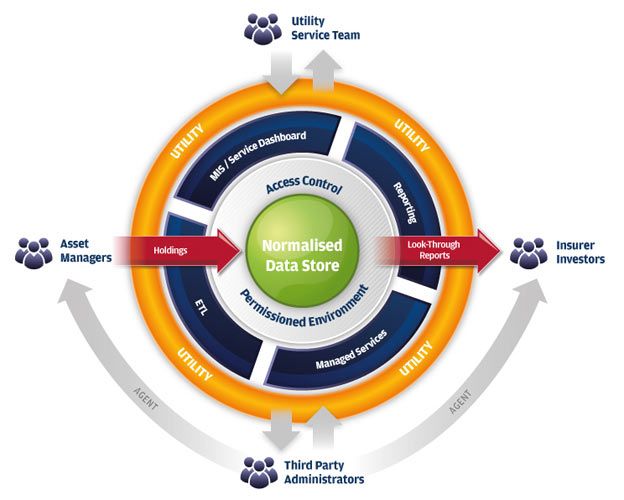
    MoneyMate has a solution.
    Asset managers and their administrators need some method to be able to protect AUM & AUA, while protecting investment strategy and retaining control of their data. A utility that provides asset managers with the ability to permission which firms gets their data and retain control is required.

    MoneyMate has launched a Solvency II “Look-Through and Reporting Utility” which establishes data connectivity between asset managers and insurers to facilitate an effective response to the stringent reporting demands of Solvency II. The look-through and reporting utility will enable buy-side participants to provide holdings data to insurance investors in a permissioned  and controlled environment.

    It is also important that asset managers get something in return. Today, asset managers have only a partial view of who their investors are. They can understand to some extent what exposure they have to insurance investors who invest as a direct investor, but have little or no transparency of insurers who invest indirectly via other funds, products or through platforms. A utility that provides asset managers with the identification of their ultimate investor will allow them to make strategic decisions. If able to identify which insurers have invested in their funds that would have a high capital requirement, say 30%, they can now engage those investors and introduce them to other funds they have designed to be Solvency II friendly with a lower capital requirement (5-10%) which have a similar risk-adjusted IRR. This ability allows asset managers retain their existing mandates and provides insurers with a level of service not currently available.

    Benefits the fund industry will receive due to this collaboration:

    • Utility will enable asset managers to protect investment strategies while ensuring that their funds are Solvency II friendly
    • Utility provides data connectivity between asset managers, third party administrators and insurers to facilitate an effective response to the stringent reporting demands of Solvency II
    • Enables insurers and their service providers  to gain access to transparent, granular data from a single source and in a standardised format
    • A single repository, accessible for hundreds of asset managers, providing look-through even across complex investment structures including fund-of-funds.

    MoneyMate will support this launch at an event in London on 18th October, where we will provide further information about how the utility works. To register for the event, go to: www.moneymate.com/SolvencyIIevent.aspx
    Related Posts
    Why Financial Advisors Are Rethinking Gold Allocations
    Why Financial Advisors Are Rethinking Gold Allocations
    From Opaque to Investable: Yaniv Bertele's Blueprint for Transparent Alternatives
    From Opaque to Investable: Yaniv Bertele's Blueprint for Transparent Alternatives
    Private Equity Needs AI Advocates
    Private Equity Needs AI Advocates
    Understanding the Global Impact of Rising Medical Insurance Premiums on the Middle Class
    Understanding the Global Impact of Rising Medical Insurance Premiums on the Middle Class
    The New Model Driving Creative Investment in University Innovation
    The New Model Driving Creative Investment in University Innovation
    The return of tangible assets in modern portfolios
    The return of tangible assets in modern portfolios
    Retro Bikes And Insurance: What You Should Know?
    Retro Bikes And Insurance: What You Should Know?
    Top Stocks Powering the AI Boom in 2025
    Top Stocks Powering the AI Boom in 2025
    How often should you update your estate plan? The events that demand a refresh
    How often should you update your estate plan? The events that demand a refresh
    Top 5 Mutual Funds in the UAE: Performance, Features, and How to Invest
    Top 5 Mutual Funds in the UAE: Performance, Features, and How to Invest
    How One Investor Learned to Find Value Through a Wider Lens
    How One Investor Learned to Find Value Through a Wider Lens
    Freedom Holding Corp’s Global Rise: Why Institutional Investors Are Betting Big
    Freedom Holding Corp’s Global Rise: Why Institutional Investors Are Betting Big

    Why waste money on news and opinions when you can access them for free?

    Take advantage of our newsletter subscription and stay informed on the go!

    Subscribe

    Previous Investing PostWHAT YOU SHOULD KNOW ABOUT CERTIFICATE OF DEPOSITS
    Next Investing PostGlobal savings in the shadow of the crisis

    More from Investing

    Explore more articles in the Investing category

    Pro Visionary Helps Australians Strengthen Their Financial Resilience Through Licensed Wealth Strategies

    Pro Visionary Helps Australians Strengthen Their Financial Resilience Through Licensed Wealth Strategies

    How ZenInvestor Is Breaking Down Barriers to Financial Literacy and Empowering Everyday Investors Nationwide

    How ZenInvestor Is Breaking Down Barriers to Financial Literacy and Empowering Everyday Investors Nationwide

    Edward L. Shugrue III on Returning to the Office: A Cultural Shift and Investment Opportunity

    Edward L. Shugrue III on Returning to the Office: A Cultural Shift and Investment Opportunity

    How Private Capital Can Build Public Good

    How Private Capital Can Build Public Good

    Private Equity Has a Major Speed and Capacity Problem

    Private Equity Has a Major Speed and Capacity Problem

    Navigating AI Investing Tools: Wealth Management Disruption Ahead

    Navigating AI Investing Tools: Wealth Management Disruption Ahead

    MTF Trading Explained: What It Is, How It Works, and Key Benefits

    MTF Trading Explained: What It Is, How It Works, and Key Benefits

    Private Equity Has Trust Issues With AI

    Private Equity Has Trust Issues With AI

    Merifund Capital Management on FTSE 100 Gains

    Merifund Capital Management on FTSE 100 Gains

    Sycamine Capital Management sets outlook on Japan equities

    Sycamine Capital Management sets outlook on Japan equities

    Claiming Back German Pension Contributions: What You Need to Know

    Claiming Back German Pension Contributions: What You Need to Know

    Institutional Crypto Adoption: Navigating the Maze of Regulation, Investor Access, and Operational Complexity

    Institutional Crypto Adoption: Navigating the Maze of Regulation, Investor Access, and Operational Complexity

    View All Investing Posts