Search
00
GBAF Logo
trophy
Top StoriesInterviewsBusinessFinanceBankingTechnologyInvestingTradingVideosAwardsMagazinesHeadlinesTrends

Subscribe to our newsletter

Get the latest news and updates from our team.

Global Banking and Finance Review

Global Banking and Finance Review - Subscribe to our newsletter

Company

    GBAF Logo
    • About Us
    • Profile
    • Privacy & Cookie Policy
    • Terms of Use
    • Contact Us
    • Advertising
    • Submit Post
    • Latest News
    • Research Reports
    • Press Release
    • Awards▾
      • About the Awards
      • Awards TimeTable
      • Submit Nominations
      • Testimonials
      • Media Room
      • Award Winners
      • FAQ
    • Magazines▾
      • Global Banking & Finance Review Magazine Issue 79
      • Global Banking & Finance Review Magazine Issue 78
      • Global Banking & Finance Review Magazine Issue 77
      • Global Banking & Finance Review Magazine Issue 76
      • Global Banking & Finance Review Magazine Issue 75
      • Global Banking & Finance Review Magazine Issue 73
      • Global Banking & Finance Review Magazine Issue 71
      • Global Banking & Finance Review Magazine Issue 70
      • Global Banking & Finance Review Magazine Issue 69
      • Global Banking & Finance Review Magazine Issue 66
    Top StoriesInterviewsBusinessFinanceBankingTechnologyInvestingTradingVideosAwardsMagazinesHeadlinesTrends

    Global Banking & Finance Review® is a leading financial portal and online magazine offering News, Analysis, Opinion, Reviews, Interviews & Videos from the world of Banking, Finance, Business, Trading, Technology, Investing, Brokerage, Foreign Exchange, Tax & Legal, Islamic Finance, Asset & Wealth Management.
    Copyright © 2010-2026 GBAF Publications Ltd - All Rights Reserved. | Sitemap | Tags | Developed By eCorpIT

    Editorial & Advertiser disclosure

    Global Banking and Finance Review is an online platform offering news, analysis, and opinion on the latest trends, developments, and innovations in the banking and finance industry worldwide. The platform covers a diverse range of topics, including banking, insurance, investment, wealth management, fintech, and regulatory issues. The website publishes news, press releases, opinion and advertorials on various financial organizations, products and services which are commissioned from various Companies, Organizations, PR agencies, Bloggers etc. These commissioned articles are commercial in nature. This is not to be considered as financial advice and should be considered only for information purposes. It does not reflect the views or opinion of our website and is not to be considered an endorsement or a recommendation. We cannot guarantee the accuracy or applicability of any information provided with respect to your individual or personal circumstances. Please seek Professional advice from a qualified professional before making any financial decisions. We link to various third-party websites, affiliate sales networks, and to our advertising partners websites. When you view or click on certain links available on our articles, our partners may compensate us for displaying the content to you or make a purchase or fill a form. This will not incur any additional charges to you. To make things simpler for you to identity or distinguish advertised or sponsored articles or links, you may consider all articles or links hosted on our site as a commercial article placement. We will not be responsible for any loss you may suffer as a result of any omission or inaccuracy on the website.

    Home > Finance > Japan unveils $200 billion in new spending to ease inflation pain
    Finance

    Japan unveils $200 billion in new spending to ease inflation pain

    Published by Jessica Weisman-Pitts

    Posted on October 28, 2022

    3 min read

    Last updated: February 3, 2026

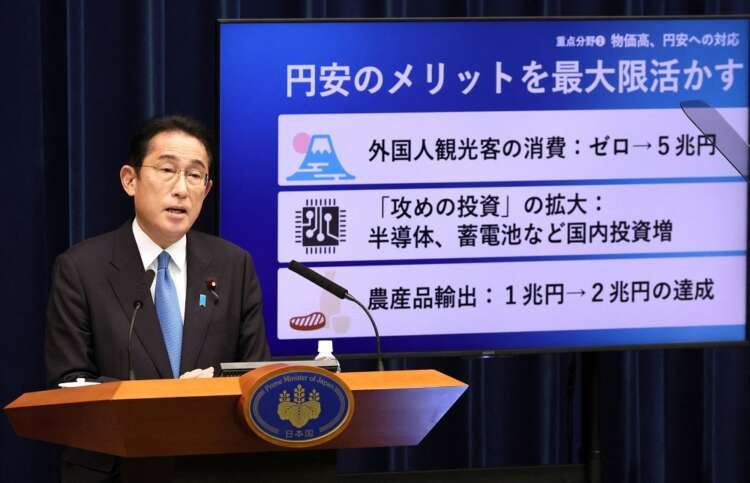
    Japanese Prime Minister Fumio Kishida speaks at a press conference in Tokyo, unveiling a $200 billion economic stimulus to combat inflation. This package aims to alleviate rising costs and support households amid economic challenges.
    Japanese Prime Minister Fumio Kishida announces $200 billion economic stimulus - Global Banking & Finance Review
    Why waste money on news and opinion when you can access them for free?

    Take advantage of our newsletter subscription and stay informed on the go!

    Subscribe

    Tags:GDPmonetary policyfinancial managementeconomic growth

    By Leika Kihara and Daniel Leussink

    TOKYO (Reuters) -Japan said on Friday it would spend $200 billion on an economic stimulus package meant to tame inflation and cushion the economic blow from rising raw material costs.

    The government’s announcement came hours after the central kept interest rates ultra-low, a double-barrelled signal that Tokyo will continue pouring massive fiscal and monetary stimulus into the world’s third-biggest economy while other economies are tightening policy.

    Fiscal spending under the package will total 39 trillion yen ($260 billion), funded by an extra budget of 29.6 trillion yen ($201 billion). The government expects the spending to boost Japan’s gross domestic product (GDP) by 4.6%.

    “We’ll ensure Japan doesn’t experience the kind of 10% inflation seen in the United States and Europe,” Prime Minister Fumio Kishida told a news conference. “We decided to directly target energy prices, which are the main factors behind recent rising inflation.”

    With his approval ratings plunging to levels that could make it difficult for him to carry out his agenda, Kishida has been under strong pressure from ruling party lawmakers to ramp up spending to ease the pain on households and retailers.

    The stimulus includes subsidies to cut household electricity bills 20% from January to September. It will issue coupons to families with newborns and extend a subsidy to curb gasoline prices.

    These and other steps will suppress Japan’s consumer price inflation by around 1.2 percentage points between January and September next year, according to a government estimate.

    TRUST IN YEN QUESTIONED

    Takahide Kiuchi, executive economist at Nomura Research Institute, warned that ramping up spending when the economy is in fairly good shape could pose a danger for Japan, which has the biggest public debt among major economies.

    “The Bank of Japan’s extraordinary monetary easing and the government’s expansionary fiscal spending create a policy mix that erodes market trust in the yen,” said Kiuchi, a former BOJ board member. “This could accelerate unwelcome yen falls.”

    Finance Minister Shunichi Suzuki said the government will compile an extra budget in time to pass it through parliament by the end of this year.

    Consumers expressed doubts about the impact of the measures, with some calling for more drastic steps such as reducing the 10% consumption tax.

    “If it goes back to 3%, the economy will very much be stimulated, but I think they can aim for 8%,” said Takashi Sato, a 55-year-old company executive. “Ideally, I would like it to be 5% because then we would probably see GDP growth.”

    Analysts expect the government to issue bonds to fund some of the spending, adding to Japan’s already huge debt pile.

    Kishida defended the BOJ’s ultra-loose monetary policy, which has been blamed for raising import costs by pushing the yen to 32-year lows.

    “Monetary policy must be decided taking into account not just currency moves, but economic and price developments as well as the impact on public’s interest rate burden,” the prime minister said.

    Even as the BOJ has stuck with its zero-rate policy, encouraging a weaker yen as the Federal Reserve raises U.S. rates, the government has intervened in the currency market to support the yen.

    ($1 = 147.8100 yen)

    (Reporting by Leika Kihara and Daniel Leussink, Additional reporting by Yoshifumi Takemoto, Tetsushi Kajimoto, Rikako Maruyama and Kohei Miyazaki; Editing by Christopher Cushing and Ana Nicolaci da Costa)

    Frequently Asked Questions about Japan unveils $200 billion in new spending to ease inflation pain

    1What is GDP?

    Gross Domestic Product (GDP) measures the total economic output of a country, representing the value of all goods and services produced over a specific time period.

    2What is monetary policy?

    Monetary policy refers to the actions taken by a country's central bank to control the money supply and interest rates to achieve macroeconomic goals such as controlling inflation and stabilizing currency.

    3What is inflation?

    Inflation is the rate at which the general level of prices for goods and services rises, eroding purchasing power. It is typically measured by the Consumer Price Index (CPI).

    More from Finance

    Explore more articles in the Finance category

    Image for Sony lifts earnings targets after strong quarter, but PlayStation 5 sales slide
    Sony lifts earnings targets after strong quarter, but PlayStation 5 sales slide
    Image for Qualcomm, Arm bear brunt of memory shortage as smartphone chip sales disappoint
    Qualcomm, Arm bear brunt of memory shortage as smartphone chip sales disappoint
    Image for Instagram recovers after brief outage disrupts US users
    Instagram recovers after brief outage disrupts US users
    Image for Asia shares slump as global tech selloff spooks investors, silver tumbles again
    Asia shares slump as global tech selloff spooks investors, silver tumbles again
    Image for Dollar recovers as central bank decisions loom
    Dollar recovers as central bank decisions loom
    Image for Oil prices fall as US, Iran agree to talks, easing conflict concerns
    Oil prices fall as US, Iran agree to talks, easing conflict concerns
    Image for UN chief calls New START expiration 'grave moment'
    UN chief calls New START expiration 'grave moment'
    Image for Bank of England set to hold rates pending clearer picture on inflation
    Bank of England set to hold rates pending clearer picture on inflation
    Image for Ukraine energy minister warns of more power cuts, possible Russian attacks
    Ukraine energy minister warns of more power cuts, possible Russian attacks
    Image for Boeing plans to move 787 engineering work to South Carolina, union says
    Boeing plans to move 787 engineering work to South Carolina, union says
    Image for Choppy markets threaten ECB's 'good place' but rates still firmly on hold
    Choppy markets threaten ECB's 'good place' but rates still firmly on hold
    Image for Australia's Maas Group to sell construction materials division for up to $1.2 billion
    Australia's Maas Group to sell construction materials division for up to $1.2 billion
    View All Finance Posts
    Previous Finance PostGlobal equity funds receive inflows for first time in 10 weeks
    Next Finance PostHow Financial Services can be successful when it comes to ESG risk