
Fifty-eight percent of bStocks trading volume originated from emerging markets during the first 15 days. Across Binance's direct stock offering, more than 80% of trading volume similarly came from emerging economies. Achieving that geographic reach through traditional financial infrastructure would typically require years of localized brokerage expansion, banking partnerships, and regulatory integration. For tokenized securities, it took just two weeks.
This accelerated adoption points directly to a severe structural gap in global market infrastructure. Where entry barriers fall, participation appears to increase rapidly, suggesting that investor demand may have been constrained more by market access than by a lack of interest.
"A billion dollars in 30 days is a sign of the demand that's been waiting decades for a door to walk through," says Shunyet Jan, Head of Spot & Derivatives Business at Binance. "The walls that kept most of the world out of U.S. stocks were never as solid as they looked. We built this for the hundreds of millions of people who never had a way in."
The early trading data offers one of the first opportunities to test that thesis at scale. Rather than reflecting a sudden surge in investor interest, the concentration of activity across emerging markets suggests that lowering structural barriers may unlock demand that has long existed but remained inaccessible through traditional financial infrastructure.
Tokenization has become an increasingly important area of development across global financial markets. Institutions including the World Economic Forum, Boston Consulting Group, McKinsey, and major exchanges have highlighted the potential for tokenized assets to expand market access, improve settlement efficiency, and support greater participation in capital markets, although adoption remains dependent on regulatory frameworks and investor protection measures.
The Cost of Accessing US Equities From Outside the US
Gaining access to the US stock market requires navigating numerous administrative hurdles. According to Binance Research, placing a $1,000 investment through traditional channels creates a round-trip friction cost of approximately $130.
This financial leakage stems from bank foreign exchange spreads, cross-border wire fees, mandatory account minimums, market data subscriptions, and multi-day settlement delays. Conversely, using stablecoins eliminates an average of 3.6% and roughly $40 per transaction in off-ramp expenses for international participants.
Viewed collectively, these costs illustrate Jan's broader point. The primary barriers to global equity participation have often been operational and economic rather than a lack of investor demand. When those frictions fall dramatically, participation can expand far more quickly than traditional financial models have historically assumed.
The World Bank’s Financial Inclusion overview confirms these barriers. Data shows 65% of adults in low-income economies lack access to a basic transaction account, while the average cost of sending money across borders remains high at around 6%. These frictions compound exponentially when emerging-market investors attempt to purchase foreign equities through standard banking rails.
A Consistent Pattern Across Two Products
This geographic concentration is not an isolated event. Binance's direct stock trading platform reveals a nearly identical trend. This geographic concentration is not an isolated event. Binance's direct stock trading platform reveals a nearly identical pattern. More than 80% of trading volume during the first week originated from emerging markets, while approximately 93% of all users came from those same regions. Just as notable, one in four investors using the platform is under the age of 25, suggesting the infrastructure is reaching a generation that has historically had limited access to international capital markets.
The consistency across both direct stocks and tokenized securities suggests these results reflect structural demand rather than product-specific novelty.
Traditional frameworks continue to struggle with this demographic. The Bank for International Settlements Bulletin No. 85 documents that while global account ownership reached 76% in 2021, actual use of financial services lags significantly behind access improvements, particularly in emerging market economies.
The Alliance for Financial Inclusion noted in a January 2024 report that expanding access to modern services requires an enabling policy environment, yet for excluded groups, policy alone is not enough. The geographic data suggests crypto-native infrastructure provides the functional pathway that traditional environments have not yet constructed.
What the Numbers Mean at Entry-Point Scale
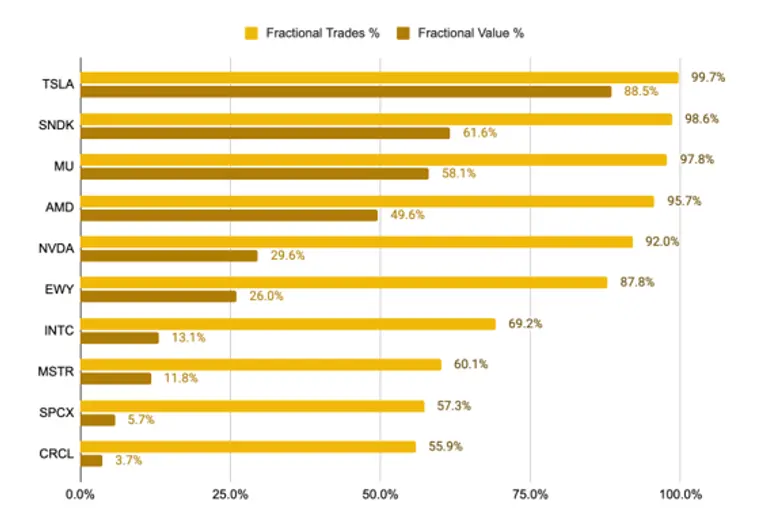
Examining trade sizes provides additional insight into how new investors engage with these markets. Tokenized Tesla trades are 99.65% fractional, with a median transaction size of just $14.57. Across Binance's broader direct stock offering, nearly 40% of trades during the first week were placed for less than US$100, with investment minimums starting at just US$5.
Rather than immediately deploying large amounts of capital, users appear to be entering global equity markets incrementally, matching investment sizes to local purchasing power while lowering the financial risk of participation.
A Credolab report on financial inclusion identifies the high cost of financial services and physical distance from service providers as primary barriers preventing market entry. Tokenized securities operating on digital ledgers neutralize both issues. They remove the need for physical brokerage branches and allow entry points starting at $5, matching local purchasing power.
The financial toll of traditional exclusion is massive. An August 2022 report by the JEC found that financially underserved and unbanked Americans spent an estimated $189 billion in fees and interest on alternative financial products. If friction costs reach that magnitude within a developed economy, the global figure for cross-border equity access friction is orders of magnitude larger.
Rethinking the Addressable Market
Current estimates count approximately 700 million brokerage accounts globally, representing roughly 11% of adults. Meanwhile, the World Bank Findex 2025 reports that 86% of adults globally own a mobile phone and 79% have a financial account. Despite this high connectivity, equity market participation outside the United States broadly sits below 20%. This gap between phone ownership and equity participation persists due to legacy infrastructure constraints.
Industry research suggests that tokenization has the potential to reshape capital markets over the coming decade, although estimates vary depending on regulatory developments, institutional adoption, and market infrastructure. Organisations including Boston Consulting Group (BCG), McKinsey & Company, Citi, and the World Economic Forum have identified tokenized assets as an area with significant long-term growth potential, citing opportunities to improve market efficiency, broaden investor participation, and expand access to traditionally less accessible asset classes.
Within this broader context, Binance Research projects that crypto exchanges could collectively channel up to US$2 trillion in incremental capital and bring approximately 300 million new investors into global equity markets by 2031. While this represents one market outlook rather than a consensus forecast, it illustrates the scale of opportunity that many participants believe tokenization could create if adoption continues to expand.
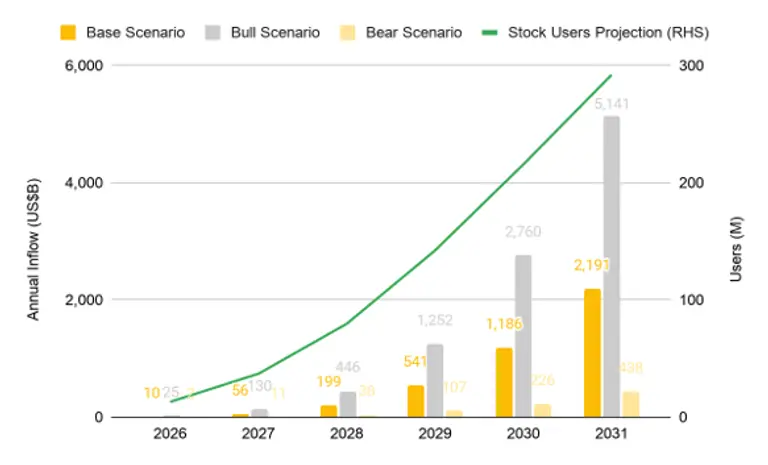
While tokenized securities remain at an early stage of development, they are prompting broader discussions about the future of global capital markets. As regulatory frameworks mature and market infrastructure evolves, financial institutions, exchanges, and policymakers will continue to assess how digital assets can expand investor participation while maintaining market integrity, transparency, and investor protection.