Search
00
GBAF Logo
trophy
Top StoriesInterviewsBusinessFinanceBankingTechnologyInvestingTradingVideosAwardsMagazinesHeadlinesTrends

Subscribe to our newsletter

Get the latest news and updates from our team.

Global Banking and Finance Review

Global Banking and Finance Review - Subscribe to our newsletter

Company

    GBAF Logo
    • About Us
    • Profile
    • Privacy & Cookie Policy
    • Terms of Use
    • Contact Us
    • Advertising
    • Submit Post
    • Latest News
    • Research Reports
    • Press Release
    • Awards▾
      • About the Awards
      • Awards TimeTable
      • Submit Nominations
      • Testimonials
      • Media Room
      • Award Winners
      • FAQ
    • Magazines▾
      • Global Banking & Finance Review Magazine Issue 79
      • Global Banking & Finance Review Magazine Issue 78
      • Global Banking & Finance Review Magazine Issue 77
      • Global Banking & Finance Review Magazine Issue 76
      • Global Banking & Finance Review Magazine Issue 75
      • Global Banking & Finance Review Magazine Issue 73
      • Global Banking & Finance Review Magazine Issue 71
      • Global Banking & Finance Review Magazine Issue 70
      • Global Banking & Finance Review Magazine Issue 69
      • Global Banking & Finance Review Magazine Issue 66
    Top StoriesInterviewsBusinessFinanceBankingTechnologyInvestingTradingVideosAwardsMagazinesHeadlinesTrends

    Global Banking & Finance Review® is a leading financial portal and online magazine offering News, Analysis, Opinion, Reviews, Interviews & Videos from the world of Banking, Finance, Business, Trading, Technology, Investing, Brokerage, Foreign Exchange, Tax & Legal, Islamic Finance, Asset & Wealth Management.
    Copyright © 2010-2026 GBAF Publications Ltd - All Rights Reserved. | Sitemap | Tags | Developed By eCorpIT

    Editorial & Advertiser disclosure

    Global Banking and Finance Review is an online platform offering news, analysis, and opinion on the latest trends, developments, and innovations in the banking and finance industry worldwide. The platform covers a diverse range of topics, including banking, insurance, investment, wealth management, fintech, and regulatory issues. The website publishes news, press releases, opinion and advertorials on various financial organizations, products and services which are commissioned from various Companies, Organizations, PR agencies, Bloggers etc. These commissioned articles are commercial in nature. This is not to be considered as financial advice and should be considered only for information purposes. It does not reflect the views or opinion of our website and is not to be considered an endorsement or a recommendation. We cannot guarantee the accuracy or applicability of any information provided with respect to your individual or personal circumstances. Please seek Professional advice from a qualified professional before making any financial decisions. We link to various third-party websites, affiliate sales networks, and to our advertising partners websites. When you view or click on certain links available on our articles, our partners may compensate us for displaying the content to you or make a purchase or fill a form. This will not incur any additional charges to you. To make things simpler for you to identity or distinguish advertised or sponsored articles or links, you may consider all articles or links hosted on our site as a commercial article placement. We will not be responsible for any loss you may suffer as a result of any omission or inaccuracy on the website.

    Home > Finance > GENPACT’S GLOBAL BUSINESS VOLATILITY AND ADAPTATION INDEX HAS RISEN, DRIVEN BY ACQUISITIONS, EXPANSIONS AND LEADERSHIP CHANGES
    Finance

    GENPACT’S GLOBAL BUSINESS VOLATILITY AND ADAPTATION INDEX HAS RISEN, DRIVEN BY ACQUISITIONS, EXPANSIONS AND LEADERSHIP CHANGES

    Published by Gbaf News

    Posted on February 25, 2014

    5 min read

    Last updated: January 22, 2026

    This image depicts a graph showing the increase in Genpact's Volatility and Adaptation Index, reflecting recent trends in acquisitions and leadership changes in the finance sector.
    Graph illustrating Genpact's Volatility and Adaptation Index rise in finance - Global Banking & Finance Review
    Why waste money on news and opinion when you can access them for free?

    Take advantage of our newsletter subscription and stay informed on the go!

    Subscribe

    Genpact year-long tracking study shows retail banking and life sciences as the most affected industries

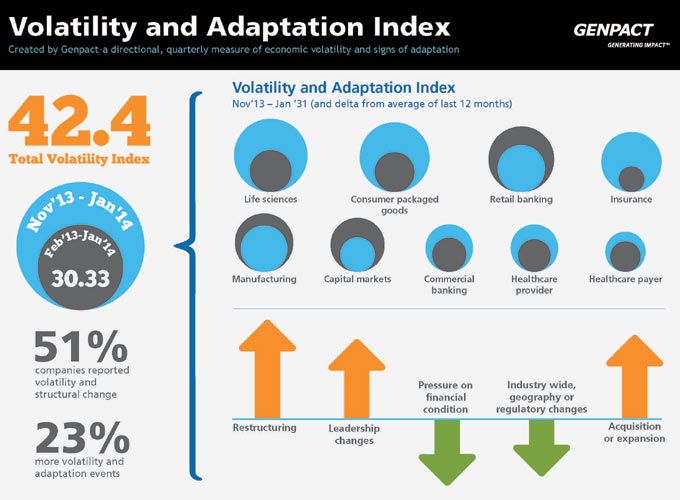
    The events that signal economic volatility and business’s attempts to adapt rose again in the past three months, reaching a high point over the past year, according to the Genpact Volatility and Adaption Index (VAI). The total VAI score for the three-month period ending on January 31 was up nine percent compared to the previous three months and 40 percent above the average of the last 12 months, with half of all companies manifesting some form of volatility and change. The full VAI report is available at http://www.genpact.com/home/volatility-adaptation-index.

    “In 2014, with a slightly more positive economic environment following a very rough period, we can expect to see more companies trying to adapt with acquisitions, expansions and leadership changes. This trend was especially noticeable in the life sciences, insurance and consumer packaged goods (CPG) industries the last three months,” said Gianni Giacomelli, senior vice president and Chief Marketing Officer.  “While overall volatility continues to be high, it is promising to see that much of the more recent activity is related to growth and structural adjustments, as opposed to much of the past year which was linked to financial stress.”

    Genpact launched the VAI in early 2013 and has just collected the first full year of data and completed the related analysis. It monitors a sample of over 600 large global companies for volatility events, such as changes in the industry, regulatory landscape or financial environment, as well as related adaptation measures including acquisitions or geographic expansions, corporate restructuring and leadership changes.  Sector scores take into account both the average number of volatility events and the percentage of companies displaying those events. The overall VAI score is then computed through a weighted average of each of the sector scores.

    While overall volatility increased greatly over the last 12 months, there continues to be a significant variance between the different vertical industries including:

    • The insurance sector had the sharpest increase the past three months, largely a result of an increase in transparency in reporting and increased regulations.
    • Life sciences remains among the most volatile and changing industries while healthcare has surprisingly been among the least, indicating that so far the uncertainty surrounding the impact of the Affordable Care Act is having a more immediate impact on pharmaceutical and medical device companies than on healthcare providers.
    • Retail banking continued to be the most volatile and changing industry all year while commercial banking was one of the least volatile, suggesting retail banking has been significantly more challenged by both the banking industry’s cost pressures as well as the issues related to regulatory compliance.

    “Volatility at an aggregate level tends to be correlated with the broad macro business environment, but there are considerable differences within specific industries,” Giacomelli added. “For example, we’ve seen series of spikes and drops experienced by the insurance sector, which is not overly surprising given the industry’s exposure to random – although possibly more frequent – costly catastrophic events, particularly in the property and casualty segment. At the same time, capital markets appear to be stabilizing, although firms have yet to put in place new regulatory compliance mechanisms or complete the business model evolution that many expect – indicating it may only be a lull for the sector rather than a stabilization.”

    The overall VAI score for the 12 months concluded at the end of January 2014 was 30.3. Over 60 percent of the score  is attributable to acquisitions, expansions and leadership changes (often signs of adaptation) while less than 25 percent was due to worsening financial conditions (signs of stress), a significant decrease from earlier periods that were measured.

    The VAI’s results are corroborated by Genpact’s own operational measurements derived from the sample of processes and operations the company transforms or manages on behalf of clients as part of transformation and outsourcing agreements. For example, mortgage operations fluctuations in banks, and life sciences’ and CPG’s keen interest in operations transformation services highlight volatility in those sectors.

    About the Volatility and Adaptation Index (VAI)
    The Volatility and Adaptation Index, created by Genpact, is a directional, quarterly measure of volatility and signs of adaptation. It was developed through an extensive analysis of nearly 600 large, global enterprises across a wide range of industries.  These analyses were “trued up” based on the operational data derived from Genpact’s business process transformation, management and outsourcing footprint across the same industries – from mortgage and procurement to finance and accounting (F&A) and credit card processing – driven by its proprietary, analytics-driven Smart Enterprise Processes (SEPSM) framework. The VAI will be updated each quarter.

    About Genpact
    Genpact Limited (NYSE: G) is a global leader in transforming and running business processes and operations, including those that are complex and industry-specific.  Our mission is to help clients become more competitive by making their enterprises more intelligent through becoming more adaptive, innovative, globally effective and connected to their own clients. Genpact stands for Generating Impact – visible in tighter cost management as well as better management of risk, regulations and growth for hundreds of long-term clients including more than 100 of the Fortune Global 500. Our approach is distinctive – we offer an unbiased, agile combination of smarter processes, crystallized in our Smart Enterprise Processes (SEPSM) proprietary framework, along with analytics and technology, which limits upfront investments and enhances future adaptability.  We have global critical mass – 63,600+ employees in 24 countries with key management and corporate offices in New York City – while remaining flexible and collaborative, and a management team that drives client partnerships personally. Our history is unique – behind our single-minded passion for process and operational excellence is the Lean and Six Sigma heritage of a former General Electric division that has served GE businesses for more than 15 years.  For more information, visit www.genpact.com.  Follow Genpact on Twitter, Facebook, and LinkedIn.
    Volatility and Adaptation Index

    Volatility and Adaptation Index

    More from Finance

    Explore more articles in the Finance category

    Image for TomTom sees lower to steady revenue in 2026, followed by growth in 2027
    TomTom sees lower to steady revenue in 2026, followed by growth in 2027
    Image for Novo Nordisk's shock 2026 guidance points to obesity battle heating up
    Novo Nordisk's shock 2026 guidance points to obesity battle heating up
    Image for Infineon boosts investment to meet demand from AI data centres
    Infineon boosts investment to meet demand from AI data centres
    Image for Novartis expects low single-digit decline in 2026 operating profit
    Novartis expects low single-digit decline in 2026 operating profit
    Image for Russian services sector sees strongest growth in a year, VAT hike fuels inflation
    Russian services sector sees strongest growth in a year, VAT hike fuels inflation
    Image for UBS quarterly profit beats expectations, plans more buybacks
    UBS quarterly profit beats expectations, plans more buybacks
    Image for Credit Agricole's profit falls 39% on Banco BPM charge, higher costs
    Credit Agricole's profit falls 39% on Banco BPM charge, higher costs
    Image for Germany's Uniper downplays increasing reliance on US LNG, stresses diversification
    Germany's Uniper downplays increasing reliance on US LNG, stresses diversification
    Image for Equinor Q4 profit falls, but less than expected
    Equinor Q4 profit falls, but less than expected
    Image for UBS reports Q4 net profit of $1.2 billion, beating expectations
    UBS reports Q4 net profit of $1.2 billion, beating expectations
    Image for Eni sees 2026 LNG market 'finely balanced' on thin supply, Asian demand
    Eni sees 2026 LNG market 'finely balanced' on thin supply, Asian demand
    Image for Analysis-Ultra-low bond spread unity still out of reach for euro area
    Analysis-Ultra-low bond spread unity still out of reach for euro area
    View All Finance Posts
    Previous Finance PostNEARLY ONE-THIRD OF U.S. EXPATS CONFUSED BY U.S. TAX FILING REQUIREMENTS
    Next Finance PostSELF-EMPLOYED BRITAIN: IS THE COUNTRY’S SELF-EMPLOYED WORKFORCE GETTING BETTER AT MANAGING FINANCES?