Search
00
GBAF Logo
trophy
Top StoriesInterviewsBusinessFinanceBankingTechnologyInvestingTradingVideosAwardsMagazinesHeadlinesTrends

Subscribe to our newsletter

Get the latest news and updates from our team.

Global Banking & Finance Review®

Global Banking & Finance Review® - Subscribe to our newsletter

Company

    GBAF Logo
    • About Us
    • Advertising and Sponsorship
    • Profile & Readership
    • Contact Us
    • Latest News
    • Privacy & Cookies Policies
    • Terms of Use
    • Advertising Terms
    • Issue 81
    • Issue 80
    • Issue 79
    • Issue 78
    • Issue 77
    • Issue 76
    • Issue 75
    • Issue 74
    • Issue 73
    • Issue 72
    • Issue 71
    • Issue 70
    • View All
    • About the Awards
    • Awards Timetable
    • Awards Winners
    • Submit Nominations
    • Testimonials
    • Media Room
    • FAQ
    • Asset Management Awards
    • Brand of the Year Awards
    • Business Awards
    • Cash Management Banking Awards
    • Banking Technology Awards
    • CEO Awards
    • Customer Service Awards
    • CSR Awards
    • Deal of the Year Awards
    • Corporate Governance Awards
    • Corporate Banking Awards
    • Digital Transformation Awards
    • Fintech Awards
    • Education & Training Awards
    • ESG & Sustainability Awards
    • ESG Awards
    • Forex Banking Awards
    • Innovation Awards
    • Insurance & Takaful Awards
    • Investment Banking Awards
    • Investor Relations Awards
    • Leadership Awards
    • Islamic Banking Awards
    • Real Estate Awards
    • Project Finance Awards
    • Process & Product Awards
    • Telecommunication Awards
    • HR & Recruitment Awards
    • Trade Finance Awards
    • The Next 100 Global Awards
    • Wealth Management Awards
    • Travel Awards
    • Years of Excellence Awards
    • Publishing Principles
    • Ownership & Funding
    • Corrections Policy
    • Editorial Code of Ethics
    • Diversity & Inclusion Policy
    • Fact Checking Policy
    Original content: Global Banking and Finance Review - https://www.globalbankingandfinance.com

    A global financial intelligence and recognition platform delivering authoritative insights, data-driven analysis, and institutional benchmarking across Banking, Capital Markets, Investment, Technology, and Financial Infrastructure.

    Copyright © 2010-2026 - All Rights Reserved. | Sitemap | Tags

    Editorial & Advertiser disclosure

    Global Banking & Finance Review® is an online platform offering news, analysis, and opinion on the latest trends, developments, and innovations in the banking and finance industry worldwide. The platform covers a diverse range of topics, including banking, insurance, investment, wealth management, fintech, and regulatory issues. The website publishes news, press releases, opinion and advertorials on various financial organizations, products and services which are commissioned from various Companies, Organizations, PR agencies, Bloggers etc. These commissioned articles are commercial in nature. This is not to be considered as financial advice and should be considered only for information purposes. It does not reflect the views or opinion of our website and is not to be considered an endorsement or a recommendation. We cannot guarantee the accuracy or applicability of any information provided with respect to your individual or personal circumstances. Please seek Professional advice from a qualified professional before making any financial decisions. We link to various third-party websites, affiliate sales networks, and to our advertising partners websites. When you view or click on certain links available on our articles, our partners may compensate us for displaying the content to you or make a purchase or fill a form. This will not incur any additional charges to you. To make things simpler for you to identity or distinguish advertised or sponsored articles or links, you may consider all articles or links hosted on our site as a commercial article placement. We will not be responsible for any loss you may suffer as a result of any omission or inaccuracy on the website.

    1. Home
    2. >Finance
    3. >DELINQUENT BALANCE GROWTH: WHAT YOU NEED TO KNOW
    Finance

    Delinquent Balance Growth: What You Need to Know

    Published by Gbaf News

    Posted on January 18, 2014

    5 min read

    Last updated: January 22, 2026

    Add as preferred source on Google

    An illustration depicting the rise of shisha tobacco culture and its influence on social gatherings, cafes, and restaurants, highlighting its global market growth as discussed in the FMI study.
    Shisha tobacco culture growth and global impact on cafes and social gatherings - Global Banking & Finance Review
    Why waste money on news and opinion when you can access them for free?

    Take advantage of our newsletter subscription and stay informed on the go!

    Subscribe

    The UK is on the gradual road to recovery as it moves steadily out of recession. FICO recently conducted research on UK credit card trends, which demonstrated a reduction in the growth of delinquent balances relative to the growth of current balances, due to cardholders making more timely payments.

    The results of the research showed a decrease in the ratio for all delinquent cycles, which suggests an upturn in performance writes Daniel Melo, Senior Director, Fair Isaac Advisors, FICO.

    The chart below tracks the growth of 1, 2 and 3 cycle balances to the growth of current balances:

    Average X Cycle Balance growth rate (%)
    ______________________________________

    Average Current Balance growth rate (%)

    Values over 1 means delinquent balances are growing at a faster rate than current balances.

    The results show a decrease in the ratio for all cycles delinquent, suggesting an upturn in the performance. The sample includes over 16 million UK-issued credit cards.
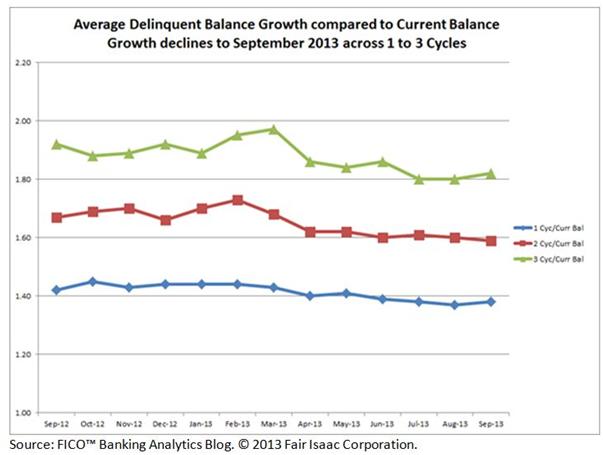
     

    The ratio of 2 Cycle Balance growth to Current Balance growth reached its lowest point over the two-year period in September 2013, with the other ratios at their lowest in August. Year on year, the ratio of 3 Cycle Balance growth to Current Balance growth experienced the largest drop, 5.21%.

    Here’s a bit more information on how these numbers break down:
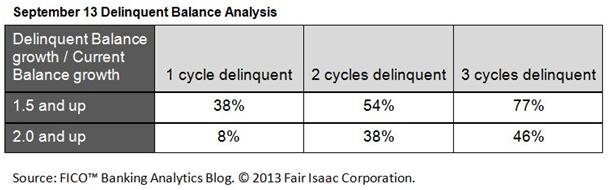
    This data suggests that card issuers should concentrate their collections activities on high-risk, high-balance accounts, while encouraging the growth of current account balances by undertaking pre collections activity.

    Daniel Melo

    Daniel Melo

    When reviewing accounts at the vintage and delinquency levels, New accounts (<12 months on book) represented the only cohort that showed a growth in the ratio at 2 cycles, but also showed the largest positive change annually for 1 and 3 cycles. Previously, a report from the FICO Benchmark Service expressed concern over increases in New account spending and a decrease in percentage payments to balance, which could indicate future troubles for those accounts. FICO recommends issuers review their treatment of new accounts at 1 cycle, based on balance. Reviewing the performance of accounts against the origination objectives will highlight whether the New account are showing expected results or falling below them, which in turn can help with validating or adjusting originations criteria and cut-off scores.

    Industry standard is to treat accounts the same once they mature past the ‘young’ stage, normally 6 months on book, but our data suggests further segmentation and targeted treatment may improve delinquency results.

    Veteran accounts (>5 years on book) heavily influence the overall average and have the largest delinquent balances compared to the current balances. This can in part be explained by higher limits, since accounts have had longer to qualify for limit increases. Card issuers may want to consider reviewing performance at the vintage level, in case differing treatment is necessary dependent on the longevity of the account.

    The UK is on the gradual road to recovery as it moves steadily out of recession. FICO recently conducted research on UK credit card trends, which demonstrated a reduction in the growth of delinquent balances relative to the growth of current balances, due to cardholders making more timely payments.

    The results of the research showed a decrease in the ratio for all delinquent cycles, which suggests an upturn in performance writes Daniel Melo, Senior Director, Fair Isaac Advisors, FICO.

    The chart below tracks the growth of 1, 2 and 3 cycle balances to the growth of current balances:

    Average X Cycle Balance growth rate (%)
    ______________________________________

    Average Current Balance growth rate (%)

    Values over 1 means delinquent balances are growing at a faster rate than current balances.

    The results show a decrease in the ratio for all cycles delinquent, suggesting an upturn in the performance. The sample includes over 16 million UK-issued credit cards.


    The ratio of 2 Cycle Balance growth to Current Balance growth reached its lowest point over the two-year period in September 2013, with the other ratios at their lowest in August. Year on year, the ratio of 3 Cycle Balance growth to Current Balance growth experienced the largest drop, 5.21%.

    Here’s a bit more information on how these numbers break down:

    This data suggests that card issuers should concentrate their collections activities on high-risk, high-balance accounts, while encouraging the growth of current account balances by undertaking pre collections activity.

    Daniel Melo

    Daniel Melo

    When reviewing accounts at the vintage and delinquency levels, New accounts (<12 months on book) represented the only cohort that showed a growth in the ratio at 2 cycles, but also showed the largest positive change annually for 1 and 3 cycles. Previously, a report from the FICO Benchmark Service expressed concern over increases in New account spending and a decrease in percentage payments to balance, which could indicate future troubles for those accounts. FICO recommends issuers review their treatment of new accounts at 1 cycle, based on balance. Reviewing the performance of accounts against the origination objectives will highlight whether the New account are showing expected results or falling below them, which in turn can help with validating or adjusting originations criteria and cut-off scores.

    Industry standard is to treat accounts the same once they mature past the ‘young’ stage, normally 6 months on book, but our data suggests further segmentation and targeted treatment may improve delinquency results.

    Veteran accounts (>5 years on book) heavily influence the overall average and have the largest delinquent balances compared to the current balances. This can in part be explained by higher limits, since accounts have had longer to qualify for limit increases. Card issuers may want to consider reviewing performance at the vintage level, in case differing treatment is necessary dependent on the longevity of the account.

    More from Finance

    Explore more articles in the Finance category

    Image for Barclays pulls back on asset-based lending after MFS, Tricolor collapse, Bloomberg News reports
    Barclays Pulls Back on Asset-Based Lending After Mfs, Tricolor Collapse, Bloomberg News Reports
    Image for German chemical union delays wage hikes as war worsens business outlook
    German Chemical Union Delays Wage Hikes as War Worsens Business Outlook
    Image for Germany renews push for sugar tax and energy drinks ban for children
    Germany Renews Push for Sugar Tax and Energy Drinks Ban for Children
    Image for Bank of England's Greene says she was not close to raising rates this month
    Bank of England's Greene Says She Was Not Close to Raising Rates This Month
    Image for UK review urges cap on overseas political donations and pause on crypto
    UK Review Urges Cap on Overseas Political Donations and Pause on Crypto
    Image for 5 Smart Tips to Save on Fees When You Send Money Abroad
    5 Smart Tips to Save on Fees When You Send Money Abroad
    Image for Spain's Sanchez says global citizens shouldn't pay for fallout of Iran war
    Spain's Sanchez Says Global Citizens Shouldn't Pay for Fallout of Iran War
    Image for Aer Lingus sees serious risk of US retaliation over Dublin airport cap
    Aer Lingus Sees Serious Risk of US Retaliation Over Dublin Airport Cap
    Image for Hapag-Lloyd faces $40-50 million costs weekly due to Iran war, CEO tells ntv
    Hapag-Lloyd Faces $40-50 Million Costs Weekly Due to Iran War, CEO Tells Ntv
    Image for Endesa CEO to leave position after 12 years
    Endesa CEO to Leave Position After 12 Years
    Image for UK and Turkey sign multi-billion-pound air defence deal
    UK and Turkey Sign Multi-Billion-Pound Air Defence Deal
    Image for ECB still set to hold interest rates through 2026, most economists say: Reuters poll
    ECB Still Set to Hold Interest Rates Through 2026, Most Economists Say: Reuters Poll
    View All Finance Posts
    Previous Finance PostSynthelis Raises Eur 610,000
    Next Finance PostLeading Financial Institutions to Support Zapp Mobile Payments for the Good of the UK Consumer and Economy