Search
00
GBAF Logo
trophy
Top StoriesInterviewsBusinessFinanceBankingTechnologyInvestingTradingVideosAwardsMagazinesHeadlinesTrends

Subscribe to our newsletter

Get the latest news and updates from our team.

Global Banking & Finance Review®

Global Banking & Finance Review® - Subscribe to our newsletter

Company

    GBAF Logo
    • About Us
    • Profile
    • Privacy & Cookie Policy
    • Terms of Use
    • Contact Us
    • Advertising
    • Submit Post
    • Latest News
    • Research Reports
    • Press Release
    • Awards▾
      • About the Awards
      • Awards TimeTable
      • Submit Nominations
      • Testimonials
      • Media Room
      • Award Winners
      • FAQ
    • Magazines▾
      • Global Banking & Finance Review Magazine Issue 79
      • Global Banking & Finance Review Magazine Issue 78
      • Global Banking & Finance Review Magazine Issue 77
      • Global Banking & Finance Review Magazine Issue 76
      • Global Banking & Finance Review Magazine Issue 75
      • Global Banking & Finance Review Magazine Issue 73
      • Global Banking & Finance Review Magazine Issue 71
      • Global Banking & Finance Review Magazine Issue 70
      • Global Banking & Finance Review Magazine Issue 69
      • Global Banking & Finance Review Magazine Issue 66
    Top StoriesInterviewsBusinessFinanceBankingTechnologyInvestingTradingVideosAwardsMagazinesHeadlinesTrends

    Global Banking & Finance Review® is a leading financial portal and online magazine offering News, Analysis, Opinion, Reviews, Interviews & Videos from the world of Banking, Finance, Business, Trading, Technology, Investing, Brokerage, Foreign Exchange, Tax & Legal, Islamic Finance, Asset & Wealth Management.
    Copyright © 2010-2026 GBAF Publications Ltd - All Rights Reserved. | Sitemap | Tags | Developed By eCorpIT

    Editorial & Advertiser disclosure

    Global Banking & Finance Review® is an online platform offering news, analysis, and opinion on the latest trends, developments, and innovations in the banking and finance industry worldwide. The platform covers a diverse range of topics, including banking, insurance, investment, wealth management, fintech, and regulatory issues. The website publishes news, press releases, opinion and advertorials on various financial organizations, products and services which are commissioned from various Companies, Organizations, PR agencies, Bloggers etc. These commissioned articles are commercial in nature. This is not to be considered as financial advice and should be considered only for information purposes. It does not reflect the views or opinion of our website and is not to be considered an endorsement or a recommendation. We cannot guarantee the accuracy or applicability of any information provided with respect to your individual or personal circumstances. Please seek Professional advice from a qualified professional before making any financial decisions. We link to various third-party websites, affiliate sales networks, and to our advertising partners websites. When you view or click on certain links available on our articles, our partners may compensate us for displaying the content to you or make a purchase or fill a form. This will not incur any additional charges to you. To make things simpler for you to identity or distinguish advertised or sponsored articles or links, you may consider all articles or links hosted on our site as a commercial article placement. We will not be responsible for any loss you may suffer as a result of any omission or inaccuracy on the website.

    Home > Investing > China’s yuan slides to four-month low on Trump’s tariff promise
    Investing

    China’s yuan slides to four-month low on Trump’s tariff promise

    Published by Uma Rajagopal

    Posted on November 26, 2024

    3 min read

    Last updated: January 28, 2026

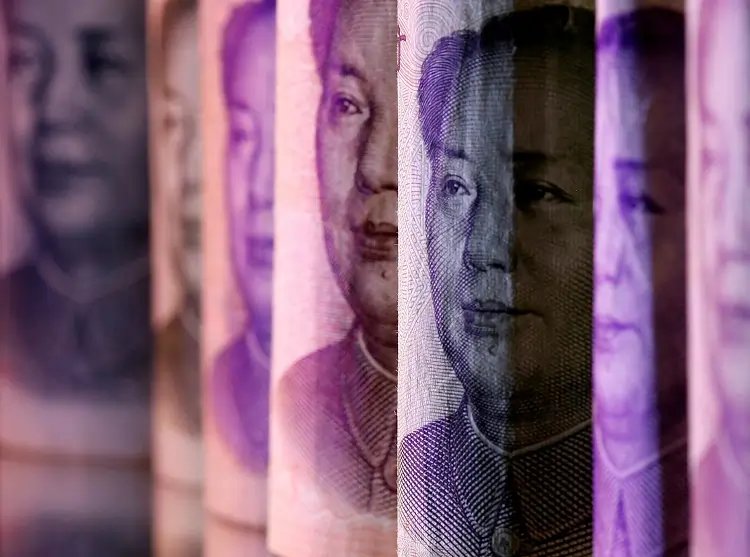
    This image illustrates the recent decline of China's yuan against the U.S. dollar following President Trump's tariff announcements. The currency's drop to a four-month low is significant for global investing trends and reflects ongoing trade tensions.
    Graph depicting the yuan's decline against the dollar amid Trump's tariff announcement - Global Banking & Finance Review
    Why waste money on news and opinion when you can access them for free?

    Take advantage of our newsletter subscription and stay informed on the go!

    Subscribe

    Tags:foreign currencyfinancial marketsInvestment strategy

    Quick Summary

    SHANGHAI (Reuters) – The yuan fell against the U.S. dollar to its weakest in nearly four months after U.S. President-elect Donald Trump said he would impose a 25% tariff on all products from Mexico and Canada, and an additional 10% tariff on goods from China.

    SHANGHAI (Reuters) – The yuan fell against the U.S. dollar to its weakest in nearly four months after U.S. President-elect Donald Trump said he would impose a 25% tariff on all products from Mexico and Canada, and an additional 10% tariff on goods from China.

    Offshore yuan dropped roughly 0.3% on the news to 7.2730 per dollar, its lowest since July 30, while onshore yuan also fell after the market opening.

    The directional impact is clear for the yuan – weaker – but Chinese authorities will be nervous about devaluing too much and encouraging outflows,” said Ben Bennett, head of investment strategy for Asia at LGIM.

    Prior to the market opening, the People’s Bank of China (PBOC) set the midpoint rate, around which the yuan is allowed to trade in a 2% band, at 7.1910 per dollar, which was 450 pips firmer than the Reuters’ estimate.

    The effectiveness of the fixing as a tool to manage yuan depreciation expectations is limited, said analysts at Nomura in a note.

    We believe that, if onshore spot USD/CNY rises above the 7.30 level, market activity will shift where USD demand strengthens versus sellers,” the Nomura analysts said, adding that this will present a challenge to authorities if they don’t allow the yuan fixing to get weaker.

    Nomura suggested to go long dollar against the offshore yuan.

    The spot yuan opened at 7.2524 per dollar and was last trading 105 pips lower than the previous late session close at 7.2553 as of 0239 GMT.

    Actual tariff announcements and negotiations will drive the yuan in coming quarters, said Liang Ding, an analyst at research firm Macro Hive.

    “Given the ‘promise made, promise kept’ rhetoric of the Trump campaign, markets may begin to price in additional risk premia related to the second trade war as Trump’s inauguration approaches,” Ding said.

    During Trump’s first term as president, the yuan weakened about 5% against the dollar after the initial round of U.S. tariffs on Chinese goods in 2018, and fell another 1.5% a year later when trade tensions escalated.

    As part of his pitch to boost American manufacturing during the recent election campaign, Trump said he would impose tariffs of 60% or more on goods from China.

    The proposed tariffs, as well as other policies such as tax cuts, are seen as inflationary and likely to keep U.S. interest rates relatively high, hurting currencies of U.S. trading partners.

    The dollar’s six-currency index was 0.075% lower at 107.27.

    LEVELS AT 02:39 GMT

    INSTRUMENT CURRENT UP/DOWN( % DAY’S DAY’S

    vs USD -) VS. CHANGE HIGH LOW

    PREVIOUS YR-TO-

    CLOSE % DATE

    Spot yuan 7.2553 -0.21 -2.12 7.2466 7.2568

    <CNY=CFXS

    Offshore 7.2629 -0.24 -1.91 7.2518 7.273

    yuan spot

    (Reporting by Shanghai Newsroom; Editing by Edwina Gibbs and Lincoln Feast.)

    Frequently Asked Questions about China’s yuan slides to four-month low on Trump’s tariff promise

    1What is the yuan?

    The yuan is the official currency of China, also known as the renminbi (RMB). It is used in domestic and international trade and is a key currency in the global financial system.

    2What is currency depreciation?

    Currency depreciation refers to a decrease in the value of a currency relative to other currencies. It can result from various economic factors, including trade policies and market conditions.

    3What is the People’s Bank of China (PBOC)?

    The People’s Bank of China (PBOC) is the central bank of China, responsible for monetary policy, financial stability, and regulating the financial system.

    4What is the midpoint rate in currency trading?

    The midpoint rate is the central value set by a central bank for a currency pair, around which the currency is allowed to trade within a specified band.

    More from Investing

    Explore more articles in the Investing category

    Image for Understanding the Factors Shaping Bitcoin’s Current Market Conditions
    Understanding the Factors Shaping Bitcoin’s Current Market Conditions
    Image for Understanding Investment Management Consulting Services in the U.S. Market
    Understanding Investment Management Consulting Services in the U.S. Market
    Image for The Role of DST Sponsors and Service Providers in Delaware Statutory Trusts
    The Role of DST Sponsors and Service Providers in Delaware Statutory Trusts
    Image for Understanding Self-Directed IRA Structures and Platform Models
    Understanding Self-Directed IRA Structures and Platform Models
    Image for 1031 Exchanges and Delaware Statutory Trusts: What Investors Need to Know
    1031 Exchanges and Delaware Statutory Trusts: What Investors Need to Know
    Image for Excellence in Innovation – Strategic Investment & Economic Transformation Egypt 2025
    Excellence in Innovation – Strategic Investment & Economic Transformation Egypt 2025
    Image for What Is the Average Pension Pot in the UK? (By Age)
    What Is the Average Pension Pot in the UK? (By Age)
    Image for From Money Printing to Market Surge: The Macro Forces Driving Crypto in 2026
    From Money Printing to Market Surge: The Macro Forces Driving Crypto in 2026
    Image for  Millennials Aren’t Ignoring Retirement. They’re Rebuilding It.
    Millennials Aren’t Ignoring Retirement. They’re Rebuilding It.
    Image for BridgeWise Launches FixedWise, the First AI Solution Bringing Granular Bond Intelligence to the European Market
    BridgeWise Launches FixedWise, the First AI Solution Bringing Granular Bond Intelligence to the European Market
    Image for Why Financial Advisors Are Rethinking Gold Allocations
    Why Financial Advisors Are Rethinking Gold Allocations
    Image for From Opaque to Investable: Yaniv Bertele's Blueprint for Transparent Alternatives
    From Opaque to Investable: Yaniv Bertele's Blueprint for Transparent Alternatives
    View All Investing Posts
    Previous Investing PostAnalysis-Investors say they know how to trade Trump 2.0
    Next Investing PostEuropean stocks off two-week highs as energy stocks weigh