Search
00
GBAF Logo
trophy
Top StoriesInterviewsBusinessFinanceBankingTechnologyInvestingTradingVideosAwardsMagazinesHeadlinesTrends

Subscribe to our newsletter

Get the latest news and updates from our team.

Global Banking & Finance Review®

Global Banking & Finance Review® - Subscribe to our newsletter

Company

    GBAF Logo
    • About Us
    • Profile
    • Privacy & Cookie Policy
    • Terms of Use
    • Contact Us
    • Advertising
    • Submit Post
    • Latest News
    • Research Reports
    • Press Release
    • Awards▾
      • About the Awards
      • Awards TimeTable
      • Submit Nominations
      • Testimonials
      • Media Room
      • Award Winners
      • FAQ
    • Magazines▾
      • Global Banking & Finance Review Magazine Issue 79
      • Global Banking & Finance Review Magazine Issue 78
      • Global Banking & Finance Review Magazine Issue 77
      • Global Banking & Finance Review Magazine Issue 76
      • Global Banking & Finance Review Magazine Issue 75
      • Global Banking & Finance Review Magazine Issue 73
      • Global Banking & Finance Review Magazine Issue 71
      • Global Banking & Finance Review Magazine Issue 70
      • Global Banking & Finance Review Magazine Issue 69
      • Global Banking & Finance Review Magazine Issue 66
    Top StoriesInterviewsBusinessFinanceBankingTechnologyInvestingTradingVideosAwardsMagazinesHeadlinesTrends

    Global Banking & Finance Review® is a leading financial portal and online magazine offering News, Analysis, Opinion, Reviews, Interviews & Videos from the world of Banking, Finance, Business, Trading, Technology, Investing, Brokerage, Foreign Exchange, Tax & Legal, Islamic Finance, Asset & Wealth Management.
    Copyright © 2010-2026 GBAF Publications Ltd - All Rights Reserved. | Sitemap | Tags | Developed By eCorpIT

    Editorial & Advertiser disclosure

    Global Banking & Finance Review® is an online platform offering news, analysis, and opinion on the latest trends, developments, and innovations in the banking and finance industry worldwide. The platform covers a diverse range of topics, including banking, insurance, investment, wealth management, fintech, and regulatory issues. The website publishes news, press releases, opinion and advertorials on various financial organizations, products and services which are commissioned from various Companies, Organizations, PR agencies, Bloggers etc. These commissioned articles are commercial in nature. This is not to be considered as financial advice and should be considered only for information purposes. It does not reflect the views or opinion of our website and is not to be considered an endorsement or a recommendation. We cannot guarantee the accuracy or applicability of any information provided with respect to your individual or personal circumstances. Please seek Professional advice from a qualified professional before making any financial decisions. We link to various third-party websites, affiliate sales networks, and to our advertising partners websites. When you view or click on certain links available on our articles, our partners may compensate us for displaying the content to you or make a purchase or fill a form. This will not incur any additional charges to you. To make things simpler for you to identity or distinguish advertised or sponsored articles or links, you may consider all articles or links hosted on our site as a commercial article placement. We will not be responsible for any loss you may suffer as a result of any omission or inaccuracy on the website.

    Home > Finance > Accounts Payable fraud: Do you know who’s accessing your finances?
    Finance

    Accounts Payable fraud: Do you know who’s accessing your finances?

    Published by Jessica Weisman-Pitts

    Posted on June 14, 2022

    5 min read

    Last updated: February 6, 2026

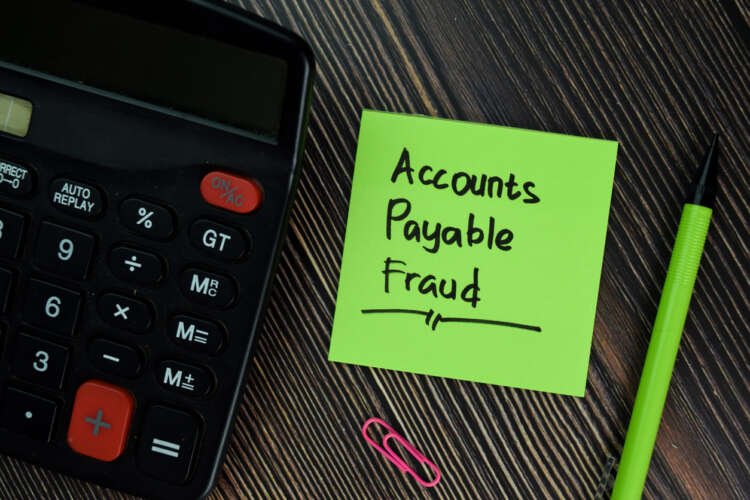
    An office desk with sticky notes highlighting key concepts of accounts payable fraud, emphasizing the importance of safeguarding financial processes amidst rising scam techniques.
    Sticky notes detailing accounts payable fraud concepts on an office desk - Global Banking & Finance Review
    Why waste money on news and opinion when you can access them for free?

    Take advantage of our newsletter subscription and stay informed on the go!

    Subscribe

    Tags:Fraudcybersecuritypaymentsfinancial managementrisk management

    By Mark Blakemore, CFO at Compleat Software

    The use of social engineering and phishing attacks on accounts payable (AP) departments are rising according to a report by the European Payments Council, and they remain one of the most instrumental ways to infiltrate a company’s finances.

    Fraud techniques have greatly evolved over the past couple of years. Scam phone calls, text messages, emails, and even fake websites and social media posts are tricking employees to hand over personal information that can be used to authorise payments.

    Hidden behind anonymity, the pandemic offered the perfect way to trick employees. Impersonation scams have skyrocketed, with criminals posing as banks, government bodies, and even health officials to trick people out of their money.

    Fraudsters have now shifted their focus from complicated, large-scale computer systems to company executives and employees. As a result, authorised push payments (APP) fraud – tricking people into sending money by posing as a genuine payee – increased 71 percent during H1 2021, with more than £750 million stolen through fraud.

    Businesses need to get a better handle on their accounts payable processes, or risk losing millions to fraudsters.

    Where does the fraud challenge stem from?

    All accounts payable departments will receive a suspicious invoice every now and then, but as fraudsters become more sophisticated in style and technique, the need for tighter cybersecurity procedures in accounting departments remains.

    And although fraudsters have long made the finance and accounts payable department their prime target, a couple of recent updates (or lack of) have combined to increase the risk of fraud to new levels.

    The first is a reluctance to digitise old-fashioned processes, and the reliance on manual processes significantly increases the risk of human error creeping in. Staff working in different locations from each other hasn’t helped either, as team leaders are unable to physically keep an eye on staff in case they get tricked by someone posing as a fake vendor or overpayments.

    Linked to this, and very much a long-standing issue for finance teams, is a distinct lack of visibility into the accounts payable process. Many finance leaders don’t have access to real-time data and insight into what their team is working on, leaving them stranded whenever fraud does take place.

    There are also plenty of businesses nationwide that are sending and receiving paper invoices, again opening themselves up to risk. According to one study, 31% of UK businesses are still faxing paperwork, while 39% are posting invoices and 9% continue to accept paper cheques.

    These problems are rooted in manual, paper-based processes. The more we rely on them, the greater the risk of inaccuracies, human error, and fraud.

    How can businesses fight back?

    If humans are one of the root causes of the issue, it makes sense to try and take the load off. We’re not machines able to log, scan, and analyse masses of data, but perhaps machines could help tighten up processes and defences.

    The majority (61%) of CFOs agree that digitalising AP processes would help increase visibility in the finance department. The same report goes on to add that companies that utilise automation in their accounts payable department feel confident in their ability to prevent fraud.

    If humans were one of the root causes of fraud, automation is the safety net businesses need to keep them secure. Technologies powered by artificial intelligence (AI) and machine learning (ML) are providing organisations with tools that can automatically detect fraudulent activity as well as decreasing the likelihood of it ever happening in the first place.

    For example, when receiving an invoice from what looks like a genuine supplier, systems can instantly analyse information such as bank details, address, and amount requested against previous financial documents. If one tiny detail doesn’t match up, payment is refused until it’s resolved.

    Then there’s the issue of access. As fraud can also take place from internal staff, businesses are using platforms to move away from simply stashing finance documents in a filing cabinet or digital folder to only granting access to records to those who need it.

    But employees can also be a company’s greatest line of defence, especially as the vast majority (61%) of fraudsters are caught by employee tips. Arming accounts payable staff with technology that can provide detailed insight into the AP process and sniff out suspicious activity before it becomes a problem is a must.

    Fighting fire with fire

    Humans can’t be perfect all of the time, but highlighting and preventing fraud isn’t a 9 to 5 kind of job. Automation in the accounts payable department can be a powerful weapon in giving businesses the confidence that they will be protected even if they become a target.

    Having employees working in several different locations and with manual processes means businesses cannot hope to defend themselves against a new, constant wave of fraudulent activity – both inside and outside of the organisation.

    It only takes one convincing email or misplaced document for fraud to take place, and businesses need to make sure they free themselves from risk with technology that can act as their best defender.

    Frequently Asked Questions about Accounts Payable fraud: Do you know who’s accessing your finances?

    1What is accounts payable?

    Accounts payable refers to the money a company owes its suppliers for goods and services received but not yet paid for. It is a liability on the company's balance sheet.

    2What is fraud?

    Fraud is a wrongful or criminal deception intended to result in financial or personal gain. It can occur in various forms, including identity theft and financial scams.

    3What are phishing attacks?

    Phishing attacks are fraudulent attempts to obtain sensitive information, such as usernames and passwords, by disguising as a trustworthy entity in electronic communications.

    4What are authorized push payment (APP) scams?

    APP scams occur when fraudsters trick individuals into authorizing payments to them, often by impersonating legitimate businesses or individuals.

    5What is cybersecurity?

    Cybersecurity is the practice of protecting systems, networks, and programs from digital attacks. It involves measures to safeguard sensitive information from unauthorized access.

    More from Finance

    Explore more articles in the Finance category

    Image for French miner Eramet's finance chief steps aside temporarily, days after CEO ouster
    French miner Eramet's finance chief steps aside temporarily, days after CEO ouster
    Image for Ukraine's Zelenskiy calls for faster action on air defence, repairs to grid
    Ukraine's Zelenskiy calls for faster action on air defence, repairs to grid
    Image for Goldman Sachs teams up with Anthropic to automate banking tasks with AI agents, CNBC reports
    Goldman Sachs teams up with Anthropic to automate banking tasks with AI agents, CNBC reports
    Image for Analysis-Hims' $49 weight-loss pill rattles investor case for cash-pay obesity market
    Analysis-Hims' $49 weight-loss pill rattles investor case for cash-pay obesity market
    Image for Analysis-Glencore to focus on short-term disposals as Rio deal remains elusive
    Analysis-Glencore to focus on short-term disposals as Rio deal remains elusive
    Image for Belgium's Agomab Therapeutics valued at $716 million as shares fall in Nasdaq debut
    Belgium's Agomab Therapeutics valued at $716 million as shares fall in Nasdaq debut
    Image for Big Tech's quarter in four charts: AI splurge and cloud growth
    Big Tech's quarter in four charts: AI splurge and cloud growth
    Image for EU hikes tariffs on Chinese ceramics to 79% to counter dumping 
    EU hikes tariffs on Chinese ceramics to 79% to counter dumping 
    Image for AI trade splinters as investors get more selective
    AI trade splinters as investors get more selective
    Image for EU extends tariff suspension on $109.8 billion of US imports for six months
    EU extends tariff suspension on $109.8 billion of US imports for six months
    Image for Dog food maker Ollie acquired by Spain’s Agrolimen
    Dog food maker Ollie acquired by Spain’s Agrolimen
    Image for Salzgitter to take over HKM steel joint venture, end clash with Thyssenkrupp
    Salzgitter to take over HKM steel joint venture, end clash with Thyssenkrupp
    View All Finance Posts
    Previous Finance PostGlobal AML Trends 2022: Where do we stand?
    Next Finance PostThe battle against financial terrorism demands every tool in the box