Search
00
GBAF Logo
trophy
Top StoriesInterviewsBusinessFinanceBankingTechnologyInvestingTradingVideosAwardsMagazinesHeadlinesTrends

Subscribe to our newsletter

Get the latest news and updates from our team.

Global Banking and Finance Review

Global Banking and Finance Review - Subscribe to our newsletter

Company

    GBAF Logo
    • About Us
    • Profile
    • Privacy & Cookie Policy
    • Terms of Use
    • Contact Us
    • Advertising
    • Submit Post
    • Latest News
    • Research Reports
    • Press Release
    • Awards▾
      • About the Awards
      • Awards TimeTable
      • Submit Nominations
      • Testimonials
      • Media Room
      • Award Winners
      • FAQ
    • Magazines▾
      • Global Banking & Finance Review Magazine Issue 79
      • Global Banking & Finance Review Magazine Issue 78
      • Global Banking & Finance Review Magazine Issue 77
      • Global Banking & Finance Review Magazine Issue 76
      • Global Banking & Finance Review Magazine Issue 75
      • Global Banking & Finance Review Magazine Issue 73
      • Global Banking & Finance Review Magazine Issue 71
      • Global Banking & Finance Review Magazine Issue 70
      • Global Banking & Finance Review Magazine Issue 69
      • Global Banking & Finance Review Magazine Issue 66
    Top StoriesInterviewsBusinessFinanceBankingTechnologyInvestingTradingVideosAwardsMagazinesHeadlinesTrends

    Global Banking & Finance Review® is a leading financial portal and online magazine offering News, Analysis, Opinion, Reviews, Interviews & Videos from the world of Banking, Finance, Business, Trading, Technology, Investing, Brokerage, Foreign Exchange, Tax & Legal, Islamic Finance, Asset & Wealth Management.
    Copyright © 2010-2026 GBAF Publications Ltd - All Rights Reserved. | Sitemap | Tags | Developed By eCorpIT

    Editorial & Advertiser disclosure

    Global Banking and Finance Review is an online platform offering news, analysis, and opinion on the latest trends, developments, and innovations in the banking and finance industry worldwide. The platform covers a diverse range of topics, including banking, insurance, investment, wealth management, fintech, and regulatory issues. The website publishes news, press releases, opinion and advertorials on various financial organizations, products and services which are commissioned from various Companies, Organizations, PR agencies, Bloggers etc. These commissioned articles are commercial in nature. This is not to be considered as financial advice and should be considered only for information purposes. It does not reflect the views or opinion of our website and is not to be considered an endorsement or a recommendation. We cannot guarantee the accuracy or applicability of any information provided with respect to your individual or personal circumstances. Please seek Professional advice from a qualified professional before making any financial decisions. We link to various third-party websites, affiliate sales networks, and to our advertising partners websites. When you view or click on certain links available on our articles, our partners may compensate us for displaying the content to you or make a purchase or fill a form. This will not incur any additional charges to you. To make things simpler for you to identity or distinguish advertised or sponsored articles or links, you may consider all articles or links hosted on our site as a commercial article placement. We will not be responsible for any loss you may suffer as a result of any omission or inaccuracy on the website.

    Home > Headlines > Exclusive-Russian oil refining rises as US sanctions target crude exports - sources
    Headlines

    Exclusive-Russian oil refining rises as US sanctions target crude exports - sources

    Published by Global Banking and Finance Review

    Posted on January 27, 2025

    3 min read

    Last updated: January 27, 2026

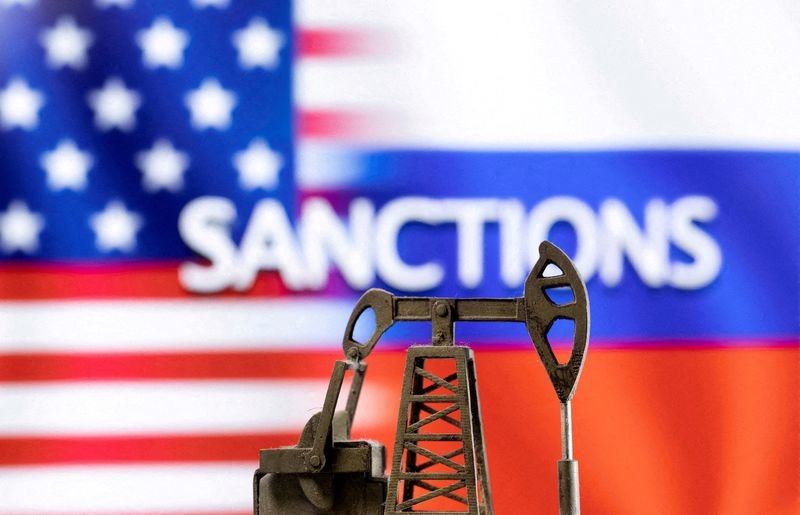
    This image depicts the increase in Russian oil refining operations as the country adapts to US sanctions targeting crude exports. It highlights the strategic shifts in fuel production and export dynamics in response to geopolitical challenges.
    Graph illustrating the rise in Russian oil refining amidst US sanctions - Global Banking & Finance Review
    Why waste money on news and opinion when you can access them for free?

    Take advantage of our newsletter subscription and stay informed on the go!

    Subscribe

    Tags:oil and gasenergy marketInternational tradefinancial markets

    Quick Summary

    Russian refineries boost crude processing as US sanctions complicate exports. The G7 price cap allows limited fuel exports, impacting global markets.

    Russian Oil Refining Increases Amidst US Sanctions on Exports

    MOSCOW (Reuters) - Russian refineries are processing more crude oil in the hope of boosting fuel exports after new U.S. sanctions on Russian tankers and traders made exports of unprocessed crude more difficult, two industry sources said and data showed.

    Russia has been trying to adapt to Western sanctions imposed in response to the invasion of Ukraine since 2022 by buying new fleet, re-routing oil exports to Asia from Europe and finding new fuel customers in Africa and Latin America.

    The latest U.S. sanctions imposed on the Russian oil industry in January have made crude exports to key Asian customers in India and China more costly and complex.

    Russian refining runs rose by 2%, or by 108,000 barrels, to 754,800 metric tons a day on Jan 15-19 from the first week of the year, according to the sources.

    It was also up 1.2% from the average for January 2024.

    The sources asked not be named because they were not authorised to speak publicly.

    Russia has slightly wider options for fuel exports compared with crude oil thanks to a G7 price cap.

    Under the cap, Moscow can use Western fleet and shipping services if it sells crude at prices below $60 per barrel and diesel at below $100 per barrel.

    The price cap of $60 per barrel is lower than the current price of Russia's flagship Urals blend of around $70.

    Traders say for the time being the price cap imposed on products that trade at a premium to crude, principally diesel - which stands at $100 per barrel - still leaves room for a profit. Russian diesel currently trades at around $75 per barrel.

    They also note vessel availability is higher for fuel than for crude.

    VESSELS

    Russia's efforts to boost refining are complicated by Ukrainian drone attacks and the overheating economy.

    Top Russian oil producer Rosneft has also said refinery modernisation plans may have to be abandoned.

    Still, the sources said Russian refineries were producing as much as they could betting on higher chances of finding vessels to export fuel after crude tankers had been sanctioned.

    "We have to utilise oil processing as much as we can in order to use (the sanctioned) oil," an industry source said,

    The sanctions, announced by the Biden administration in early January just before new U.S. President Donald Trump took office, targeted some 180 tankers involved in transporting mostly Russian oil and much lower volumes of fuel.

    In 2024, those tankers carried around 1.5 million barrels of crude oil per day and just 200,000 barrels per day of refined products, according to analysis from Morgan Stanley.

    The sanctions also targeted Russian oil firms Surgutneftegaz and Gazprom Neft.

    Surgutneftegaz's Kirishi oil refinery in Western Russia raised oil processing by almost 8% on Jan 1-21 from Dec. 1-27, according to one of the sources.

    Russia is one of the world's largest seaborne exporters of diesel and fuel oil. Western officials have said they do not seek to fully stop Russian exports but want to reduce revenues so Moscow stops the war in Ukraine.

    (Reporting by Reuters; editing by Jason Neely, Barbara Lewis and Jane Merriman)

    Key Takeaways

    • •Russian refineries increase crude processing amid US sanctions.
    • •US sanctions target Russian crude exports, complicating trade.
    • •G7 price cap allows limited fuel export options for Russia.
    • •Russian diesel trades below the G7 price cap, ensuring profit.
    • •Sanctions impact Russian oil firms and tanker availability.

    Frequently Asked Questions about Exclusive-Russian oil refining rises as US sanctions target crude exports - sources

    1What has caused an increase in Russian oil refining?

    Russian refineries are processing more crude oil to boost fuel exports after new U.S. sanctions targeted crude exports, making it more complex and costly.

    2What are the current refining trends in Russia?

    Russian refining runs rose by 2% to 754,800 metric tons a day, indicating an effort to maximize oil processing amid sanctions.

    3How do the G7 price caps affect Russian oil exports?

    The G7 price cap allows Russia to use Western fleets for crude sales below $60 per barrel, while diesel can be sold below $100 per barrel, providing some flexibility for exports.

    4What challenges does the Russian oil industry face?

    The industry is complicated by Ukrainian drone attacks and an overheating economy, which may hinder refinery modernization plans.

    5What is the significance of the sanctions on Russian oil firms?

    The sanctions specifically targeted firms like Surgutneftegaz and Gazprom Neft, affecting their operations and export capabilities.

    More from Headlines

    Explore more articles in the Headlines category

    Image for Recycling body opposes EU scrap aluminium export curbs
    Recycling body opposes EU scrap aluminium export curbs
    Image for Czech leader urges EU to overhaul carbon trading schemes to curb energy costs
    Czech leader urges EU to overhaul carbon trading schemes to curb energy costs
    Image for US cuts tariffs on India to 18%, India agrees to end Russian oil purchases
    US cuts tariffs on India to 18%, India agrees to end Russian oil purchases
    Image for Small drone fell on Polish army base, military police say
    Small drone fell on Polish army base, military police say
    Image for South African white separatists claim land acquired from Zulu king then lost to British
    South African white separatists claim land acquired from Zulu king then lost to British
    Image for Portugal counts multi‑billion‑euro damage after Storm Kristin tears off roofs
    Portugal counts multi‑billion‑euro damage after Storm Kristin tears off roofs
    Image for Ukraine's Zelenskiy says dignified, lasting peace realistic, ahead of talks
    Ukraine's Zelenskiy says dignified, lasting peace realistic, ahead of talks
    Image for LVMH champagne arm settles dispute with workers over bonuses, union says
    LVMH champagne arm settles dispute with workers over bonuses, union says
    Image for Spain performs pioneering face transplant from donor who requested assisted dying
    Spain performs pioneering face transplant from donor who requested assisted dying
    Image for Doctors in England vote to extend strike mandate by six months, union says
    Doctors in England vote to extend strike mandate by six months, union says
    Image for EU efforts to diversify critical raw material imports fail so far, auditors say
    EU efforts to diversify critical raw material imports fail so far, auditors say
    Image for Explainer-Olympics-Can transgender athletes compete at the Milano Cortina Winter Games?
    Explainer-Olympics-Can transgender athletes compete at the Milano Cortina Winter Games?
    View All Headlines Posts
    Previous Headlines PostRussia's Ryzan oil refinery halts operations after drone strikes, sources say
    Next Headlines PostUK detects human case of bird flu