Search
00
GBAF Logo
trophy
Top StoriesInterviewsBusinessFinanceBankingTechnologyInvestingTradingVideosAwardsMagazinesHeadlinesTrends

Subscribe to our newsletter

Get the latest news and updates from our team.

Global Banking and Finance Review

Global Banking and Finance Review - Subscribe to our newsletter

Company

    GBAF Logo
    • About Us
    • Profile
    • Privacy & Cookie Policy
    • Terms of Use
    • Contact Us
    • Advertising
    • Submit Post
    • Latest News
    • Research Reports
    • Press Release
    • Awards▾
      • About the Awards
      • Awards TimeTable
      • Submit Nominations
      • Testimonials
      • Media Room
      • Award Winners
      • FAQ
    • Magazines▾
      • Global Banking & Finance Review Magazine Issue 79
      • Global Banking & Finance Review Magazine Issue 78
      • Global Banking & Finance Review Magazine Issue 77
      • Global Banking & Finance Review Magazine Issue 76
      • Global Banking & Finance Review Magazine Issue 75
      • Global Banking & Finance Review Magazine Issue 73
      • Global Banking & Finance Review Magazine Issue 71
      • Global Banking & Finance Review Magazine Issue 70
      • Global Banking & Finance Review Magazine Issue 69
      • Global Banking & Finance Review Magazine Issue 66
    Top StoriesInterviewsBusinessFinanceBankingTechnologyInvestingTradingVideosAwardsMagazinesHeadlinesTrends

    Global Banking & Finance Review® is a leading financial portal and online magazine offering News, Analysis, Opinion, Reviews, Interviews & Videos from the world of Banking, Finance, Business, Trading, Technology, Investing, Brokerage, Foreign Exchange, Tax & Legal, Islamic Finance, Asset & Wealth Management.
    Copyright © 2010-2026 GBAF Publications Ltd - All Rights Reserved. | Sitemap | Tags | Developed By eCorpIT

    Editorial & Advertiser disclosure

    Global Banking and Finance Review is an online platform offering news, analysis, and opinion on the latest trends, developments, and innovations in the banking and finance industry worldwide. The platform covers a diverse range of topics, including banking, insurance, investment, wealth management, fintech, and regulatory issues. The website publishes news, press releases, opinion and advertorials on various financial organizations, products and services which are commissioned from various Companies, Organizations, PR agencies, Bloggers etc. These commissioned articles are commercial in nature. This is not to be considered as financial advice and should be considered only for information purposes. It does not reflect the views or opinion of our website and is not to be considered an endorsement or a recommendation. We cannot guarantee the accuracy or applicability of any information provided with respect to your individual or personal circumstances. Please seek Professional advice from a qualified professional before making any financial decisions. We link to various third-party websites, affiliate sales networks, and to our advertising partners websites. When you view or click on certain links available on our articles, our partners may compensate us for displaying the content to you or make a purchase or fill a form. This will not incur any additional charges to you. To make things simpler for you to identity or distinguish advertised or sponsored articles or links, you may consider all articles or links hosted on our site as a commercial article placement. We will not be responsible for any loss you may suffer as a result of any omission or inaccuracy on the website.

    Home > Finance > Russia's railways grapple with Asia pivot, sanctions and labour shortages
    Finance

    Russia's railways grapple with Asia pivot, sanctions and labour shortages

    Published by Global Banking and Finance Review

    Posted on January 24, 2025

    5 min read

    Last updated: January 27, 2026

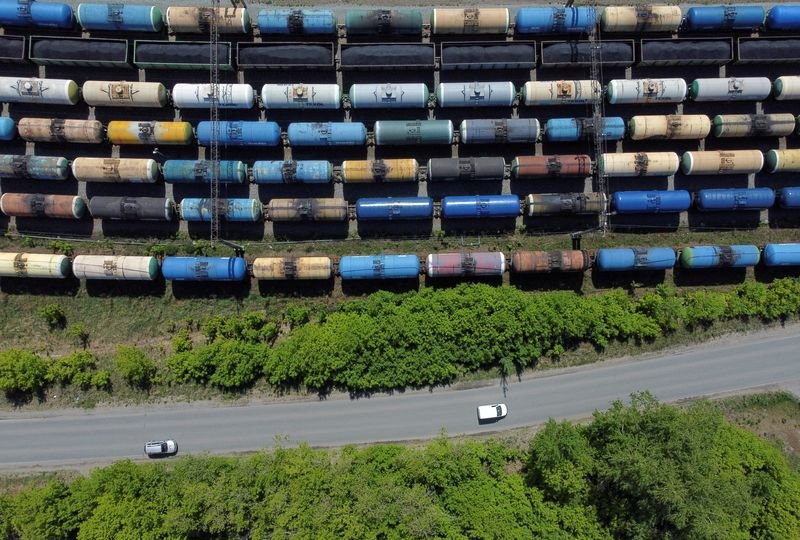
    An overview of Russian Railways navigating significant challenges due to sanctions, labor shortages, and a shift towards Asia in trade. This image highlights the impact on cargo transportation, reflecting the ongoing issues in the finance and transportation sectors.
    Cargo trains operating on Russia's railways amidst sanctions and labor shortages - Global Banking & Finance Review
    Why waste money on news and opinion when you can access them for free?

    Take advantage of our newsletter subscription and stay informed on the go!

    Subscribe

    Quick Summary

    Russian Railways faces cargo volume declines due to Asia pivot, sanctions, and labor shortages, impacting industrial output and coal exports.

    Russia's Railways Face Challenges with Asia Pivot and Sanctions

    By Gleb Stolyarov and Anastasia Lyrchikova

    MOSCOW (Reuters) - Russian Railways' cargo volumes slumped to a 15-year low in 2024, with labour and locomotive shortages exacerbating capacity woes as Moscow redirects trade flows to Asia from Europe while fighting on in Ukraine, data showed and six sources said.      

        Industrial output and railway cargo volumes usually go hand in hand. But while military production spurs the steady growth of factory output, cargoes are lagging, suggesting that Russia's industrial machine is struggling to keep pace with intense growth efforts.

    President Vladimir Putin has grown increasingly concerned about distortions in Russia's wartime economy, Reuters reported on Thursday.

    In 2024, Russian Railways transported 1.18 billion tons of cargo, data published this month showed, down 4.1% year-on-year and its lowest since 2009, when Russia was reeling from the global financial crash. Even in 2020 during the pandemic, Russia experienced greater cargo volumes.

    Six railway and industry sources, who spoke to Reuters on condition of anonymity due to the sensitivity of the matter, cited the network's eastern capacity shortfall, sanctions, labour shortages and reduced investment among reasons for problems with cargo transportation.

    Russian Railways put the decrease down to external factors and said it had significantly improved the network's efficiency by reducing choke points overloaded with empty, privately-operated railcars, while raising wages had helped overcome a shortage of around 3,000 drivers and assistants.

    The energy and transport ministries did not respond to requests for comment.

    One of the sources cited sanctions reducing access to spare parts and a shortage of locomotive crews as problems.

    "(The crews) have all gone either to the special military operation (the conflict in Ukraine) or the defence industry, and there is simply no one to drive the trains," the person said.

    'STANDSTILL'

    Another source pointed to the military impact on cargoes.

    "The system used to work just fine, but everything has changed - cargoes go east, defence now takes priority and the railroads just can't cope," the person said.

    The priority of military cargoes, which can theoretically create logistics problems across the whole system, is not widely discussed, said CentroCreditBank economist Yevgeny Suvorov.

    Russian Railways is facing a huge jump in interest payments this year - as the central bank has jacked up borrowing costs in an effort to tame soaring inflation - and the company is cutting investment by around 40%.

    A railways source said Russian Railways had missed volume targets for the vast Baikal-Amur Mainline and Trans-Siberian railroads, which are under expansion.

    Russian Railways transported around 150 million tons along those eastern routes in 2024, that person said, short of the planned 162 million tons.

    Russian Railways said it had ensured that capacity on those routes had reached 180 million tons, but did not specify the volume of goods transported.

    According to a government document seen by Reuters, the 180-million-ton target has been set for this year. That means the capacity of those routes will not increase in 2025, the source said, adding that modernisation work was "at a standstill".

    COAL SQUEEZED

    One industry under pressure is coal. Washington has put most of Russia's major coal companies, including Suek and Mechel, under sanctions. With U.S., EU and British bans on Russia's coal imports in place, more than 80% of its exports now go to Asia.

    Exports fell by 6% last year under pressure from Western sanctions, infrastructure disruptions and profitability issues, the International Energy Agency said. Last month, Putin ordered the government to develop support measures for the industry.

    A committee headed by Deputy Prime Minister Alexander Novak has ordered the government to work on an anti-crisis programme, according to the government document.

    "The coal industry is today experiencing specific difficulties, due to falling prices and the inability to export coal to markets in full," Novak said in December on a visit to Russia's coal-rich region, the Kuznetsk Basin known as Kuzbass.

    Russia was the only key producer whose coal shipments to China fell in 2024, Chinese customs data showed. Galaxy Futures analysts said Russia's limited freight capacity meant railways were prioritising transporting higher-value goods over coal.

    Russian Railways said that thesis was not supported by statistics, pointing to the 2024 share of coal in total loading of 28%, the same as 2023.

    The company said unresolved commercial relations between port workers and shippers at the Taman port had played the biggest role in negatively impacting coal exports.

    Russian metals and energy group En+ said it was experiencing periodic difficulties with coal deliveries in the Krasnoyarsk region to its thermal power plants further east in Irkutsk region.

    "There is a deficit of railroad carrying capacity, so we are trying to somehow solve these issues together with the railroad and administrations," En+ chief Vladimir Kolmogorov told Reuters.

    (Reporting by Gleb Stolyarov and Anastasia Lyrchikova; Writing by Alexander Marrow; Editing by Josephine Mason and Gareth Jones)

    Key Takeaways

    • •Russian Railways' cargo volumes hit a 15-year low in 2024.
    • •Labour and locomotive shortages exacerbate capacity issues.
    • •Sanctions impact access to spare parts and labor availability.
    • •Military priorities disrupt traditional cargo routes.
    • •Coal exports to Asia face pressure from Western sanctions.

    Frequently Asked Questions about Russia's railways grapple with Asia pivot, sanctions and labour shortages

    1What is the main topic?

    The article discusses the challenges faced by Russian Railways due to a pivot towards Asia, sanctions, and labor shortages.

    2How are sanctions affecting Russian Railways?

    Sanctions have reduced access to spare parts and contributed to labor shortages, impacting cargo transportation.

    3What impact does the military have on Russian Railways?

    Military priorities have disrupted traditional cargo routes, with defense taking precedence over other cargoes.

    More from Finance

    Explore more articles in the Finance category

    Image for Tesla UK sales plunge in January as Chinese rivals race ahead, New Automotive data shows
    Tesla UK sales plunge in January as Chinese rivals race ahead, New Automotive data shows
    Image for Austria's OMV tops profit view, says Borouge to be listed in Vienna in 2027
    Austria's OMV tops profit view, says Borouge to be listed in Vienna in 2027
    Image for Novo Nordisk plunge wipes $50 billion off obesity drug giant
    Novo Nordisk plunge wipes $50 billion off obesity drug giant
    Image for Live Nation to acquire Italy's ForumNet, valued at $106 million
    Live Nation to acquire Italy's ForumNet, valued at $106 million
    Image for Johnson Controls lifts 2026 profit forecast on AI-driven demand for cooling equipment
    Johnson Controls lifts 2026 profit forecast on AI-driven demand for cooling equipment
    Image for Exclusive-Russia's budget deficit may almost triple this year as oil revenues decline
    Exclusive-Russia's budget deficit may almost triple this year as oil revenues decline
    Image for Equinor sold about 30% of its US gas on spot market during January price spike
    Equinor sold about 30% of its US gas on spot market during January price spike
    Image for India's Russian oil imports down 12% in Jan/Dec amid US-India trade talks
    India's Russian oil imports down 12% in Jan/Dec amid US-India trade talks
    Image for DSV eyes lower freight rates, but port pressures as Red Sea routes resume
    DSV eyes lower freight rates, but port pressures as Red Sea routes resume
    Image for China's top car exporter Chery launches Lepas brand in UK
    China's top car exporter Chery launches Lepas brand in UK
    Image for Italy budget watchdog UPB raises 2026 GDP growth to 0.7%, lowers 2027
    Italy budget watchdog UPB raises 2026 GDP growth to 0.7%, lowers 2027
    Image for FTSE 100 touches record high, BoE policy in focus
    FTSE 100 touches record high, BoE policy in focus
    View All Finance Posts
    Previous Finance PostGerman business activity stabilises in January, PMI shows
    Next Finance PostBurberry shares rise 13% after sales beat expectations