Search
00
GBAF Logo
trophy
Top StoriesInterviewsBusinessFinanceBankingTechnologyInvestingTradingVideosAwardsMagazinesHeadlinesTrends

Subscribe to our newsletter

Get the latest news and updates from our team.

Global Banking & Finance Review®

Global Banking & Finance Review® - Subscribe to our newsletter

Company

    GBAF Logo
    • About Us
    • Profile
    • Privacy & Cookie Policy
    • Terms of Use
    • Contact Us
    • Advertising
    • Submit Post
    • Latest News
    • Research Reports
    • Press Release
    • Awards▾
      • About the Awards
      • Awards TimeTable
      • Submit Nominations
      • Testimonials
      • Media Room
      • Award Winners
      • FAQ
    • Magazines▾
      • Global Banking & Finance Review Magazine Issue 79
      • Global Banking & Finance Review Magazine Issue 78
      • Global Banking & Finance Review Magazine Issue 77
      • Global Banking & Finance Review Magazine Issue 76
      • Global Banking & Finance Review Magazine Issue 75
      • Global Banking & Finance Review Magazine Issue 73
      • Global Banking & Finance Review Magazine Issue 71
      • Global Banking & Finance Review Magazine Issue 70
      • Global Banking & Finance Review Magazine Issue 69
      • Global Banking & Finance Review Magazine Issue 66
    Top StoriesInterviewsBusinessFinanceBankingTechnologyInvestingTradingVideosAwardsMagazinesHeadlinesTrends

    Global Banking & Finance Review® is a leading financial portal and online magazine offering News, Analysis, Opinion, Reviews, Interviews & Videos from the world of Banking, Finance, Business, Trading, Technology, Investing, Brokerage, Foreign Exchange, Tax & Legal, Islamic Finance, Asset & Wealth Management.
    Copyright © 2010-2026 GBAF Publications Ltd - All Rights Reserved. | Sitemap | Tags | Developed By eCorpIT

    Editorial & Advertiser disclosure

    Global Banking & Finance Review® is an online platform offering news, analysis, and opinion on the latest trends, developments, and innovations in the banking and finance industry worldwide. The platform covers a diverse range of topics, including banking, insurance, investment, wealth management, fintech, and regulatory issues. The website publishes news, press releases, opinion and advertorials on various financial organizations, products and services which are commissioned from various Companies, Organizations, PR agencies, Bloggers etc. These commissioned articles are commercial in nature. This is not to be considered as financial advice and should be considered only for information purposes. It does not reflect the views or opinion of our website and is not to be considered an endorsement or a recommendation. We cannot guarantee the accuracy or applicability of any information provided with respect to your individual or personal circumstances. Please seek Professional advice from a qualified professional before making any financial decisions. We link to various third-party websites, affiliate sales networks, and to our advertising partners websites. When you view or click on certain links available on our articles, our partners may compensate us for displaying the content to you or make a purchase or fill a form. This will not incur any additional charges to you. To make things simpler for you to identity or distinguish advertised or sponsored articles or links, you may consider all articles or links hosted on our site as a commercial article placement. We will not be responsible for any loss you may suffer as a result of any omission or inaccuracy on the website.

    Home > Finance > Kuroda's 'bazooka' was losing fans within BOJ by time it was expanded, minutes show
    Finance

    Kuroda's 'bazooka' was losing fans within BOJ by time it was expanded, minutes show

    Published by Global Banking & Finance Review®

    Posted on January 29, 2025

    4 min read

    Last updated: January 27, 2026

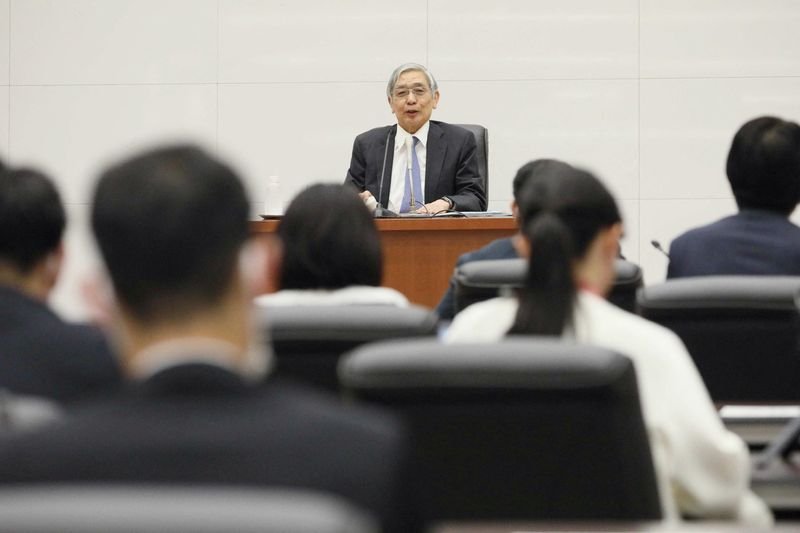
    Image captures a Bank of Japan meeting discussing Haruhiko Kuroda's 'bazooka' stimulus expansion, reflecting the internal debates on monetary policy effectiveness amid Japan's economic challenges.
    Bank of Japan policymakers discussing Kuroda's stimulus expansion - Global Banking & Finance Review
    Why waste money on news and opinion when you can access them for free?

    Take advantage of our newsletter subscription and stay informed on the go!

    Subscribe

    Tags:monetary policyfinancial stabilityeconomic growth

    Quick Summary

    BOJ policymakers doubted the 2014 stimulus expansion's effectiveness. The decision passed narrowly, highlighting internal debates over economic impacts.

    BOJ Policymakers Doubt Kuroda's 'Bazooka' Stimulus Expansion

    By Leika Kihara

    TOKYO (Reuters) - Some Bank of Japan policymakers began to lose faith in the power of former Governor Haruhiko Kuroda's "bazooka" stimulus less than two years after its introduction, with a decision to ramp up the programme in 2014 made by a narrow 5-4 vote, according to a full account of the deliberations released on Wednesday.

    Under Kuroda, the BOJ deployed a massive asset-buying programme dubbed "quantitative and qualitative easing" (QQE) in April 2013 to pull Japan out of deflation and fire up inflation to its 2% target in roughly two years.

    The BOJ expanded QQE in October 2014 to prevent slumping oil costs and weak consumption from delaying achievement of the price goal. Several more monetary easing steps failed to keep inflation durably around 2% for another decade, forcing the BOJ to prolong what was intended to be a quick-hit stimulus.

    The BOJ releases a summary of discussions at each of its policy meeting about a month after it is held with the comments quoted anonymously. A full account of the deliberations, which identify which policymaker made the comments, is released 10 years after each meeting.

    At the October 2014 meeting, some board members advocated expanding QQE on the view that failing to achieve the price goal within two years would put the BOJ's credibility at risk, the full minutes showed.

    "Failing to adjust policy would lead to a crumble of trust in our commitment. It also means the accomplishments of QQE up till now could go to waste, something I cannot overlook," then Deputy Governor Hiroshi Nakaso was quoted as saying.

    "It would be too late to act after risks materialise, so we must act pre-emptively by seizing the right opportunity to maximise the effect," he said.

    Others, however, voiced doubts on whether ramping up an already huge stimulus would deliver enough benefits to justify the costs, such as the strain the bank's huge buying was causing in the bond market.

    "The longer we continue with the current policy, the downward pressure on interest rates would strengthen. But the marginal boost to the economy and prices might diminish," board member Koji Ishida said, calling for a review of the pros and cons of QQE.

    Another board member, Takehiro Sato, said it was "hard to understand" whether the risks the BOJ sought to forestall was worth the huge sacrifice of deploying a policy "where the cost did not meet the benefits," the minutes showed.

    The biggest scrutiny from those cautions of ramping up QQE came from the key transmission channel of the policy: shocking the public out of deflation with a huge blow of stimulus.

    While Nakaso described the impact on public sentiment as the "life line" of QQE, board member Takahide Kiuchi said such a psychological effect was "likely to be quite limited" - a view echoed by another board member Yoshihisa Morimoto.

    "The positive effect on consumption from influencing public expectations will likely be limited. There's also questions about the sustainability," Morimoto said.

    In proposing an expansion of QQE, Kuroda said the move was necessary to forestall the risk of further price falls delaying a shift in Japan's deflationary mindset, the minutes showed.

    While Kuroda's stimulus failed to fire up inflation, supply constraints caused by the COVID-19 pandemic, as well as rising raw material costs from the weak yen and Russia's war in Ukraine lifted inflation above the BOJ's target in 2022.

    The BOJ exited QQE and other remnants of Kuroda's stimulus in March last year, and raised short-term interest rates to 0.25 in July. The policy rate was hiked to 0.5% this month.

    Under incumbent Governor Kazuo Ueda, the BOJ also conducted a review of past monetary easing steps in December and concluded that Kuroda's stimulus did not change consumer psychology as much as planned.

    Kuroda defended his policies in a paper he contributed to a journal in January, saying the damage to regional banks' profits were limited and deteriorating bond market function was a necessary cost to sufficiently reflate growth.

    (Reporting by Leika Kihara; Editing by Kim Coghill)

    Key Takeaways

    • •BOJ's 2014 stimulus expansion was narrowly approved.
    • •Internal doubts about the effectiveness of QQE emerged.
    • •Kuroda's policies aimed to combat deflation in Japan.
    • •The stimulus failed to achieve long-term inflation goals.
    • •BOJ reviewed past policies under Governor Ueda.

    Frequently Asked Questions about Kuroda's 'bazooka' was losing fans within BOJ by time it was expanded, minutes show

    1What was Kuroda's 'bazooka' stimulus?

    Kuroda's 'bazooka' stimulus refers to the massive asset-buying program known as quantitative and qualitative easing (QQE) introduced by the Bank of Japan in April 2013 to combat deflation and achieve a 2% inflation target.

    2Why did some BOJ policymakers lose faith in QQE?

    Some BOJ policymakers began to doubt the effectiveness of QQE less than two years after its introduction, questioning whether the benefits of expanding the stimulus justified the costs and potential risks.

    3What were the concerns regarding the expansion of QQE?

    Concerns included the potential for diminishing returns on economic and price boosts, as well as the strain on the bond market caused by the bank's extensive asset purchases.

    4What did the BOJ conclude about Kuroda's stimulus in December?

    In December, the BOJ concluded that Kuroda's stimulus did not significantly change consumer psychology as intended, leading to further scrutiny of its long-term effectiveness.

    5What actions did the BOJ take after Kuroda's tenure?

    After Kuroda's tenure, the BOJ exited QQE and raised short-term interest rates, increasing them to 0.25% in July and further to 0.5% in the following month.

    More from Finance

    Explore more articles in the Finance category

    Image for Farmers report 'catastrophic' damage to crops as Storm Marta hits Spain and Portugal
    Farmers report 'catastrophic' damage to crops as Storm Marta hits Spain and Portugal
    Image for If US attacks, Iran says it will strike US bases in the region
    If US attacks, Iran says it will strike US bases in the region
    Image for Olympics-Biathlon-Winter Games bring tourism boost to biathlon hotbed of northern Italy
    Olympics-Biathlon-Winter Games bring tourism boost to biathlon hotbed of northern Italy
    Image for Analysis-Bitcoin loses Trump-era gains as crypto market volatility signals uncertainty
    Analysis-Bitcoin loses Trump-era gains as crypto market volatility signals uncertainty
    Image for NatWest closes in on $3.4 billion takeover of wealth manager Evelyn, Sky News reports
    NatWest closes in on $3.4 billion takeover of wealth manager Evelyn, Sky News reports
    Image for Stellantis-backed ACC drops plans for Italian, German gigafactories, union says
    Stellantis-backed ACC drops plans for Italian, German gigafactories, union says
    Image for US pushes Russia and Ukraine to end war by summer, Zelenskiy says
    US pushes Russia and Ukraine to end war by summer, Zelenskiy says
    Image for Russia launches massive attack on Ukraine's energy system, Zelenskiy says
    Russia launches massive attack on Ukraine's energy system, Zelenskiy says
    Image for Russia launched 400 drones, 40 missiles to hit Ukraine's energy sector, Zelenskiy says
    Russia launched 400 drones, 40 missiles to hit Ukraine's energy sector, Zelenskiy says
    Image for The Kyiv family, with its pets and pigs, defying Russia and the cold
    The Kyiv family, with its pets and pigs, defying Russia and the cold
    Image for Two Polish airports reopen after NATO jets activated over Russian strikes on Ukraine
    Two Polish airports reopen after NATO jets activated over Russian strikes on Ukraine
    Image for French miner Eramet's finance chief steps aside temporarily, days after CEO ouster
    French miner Eramet's finance chief steps aside temporarily, days after CEO ouster
    View All Finance Posts
    Previous Finance PostBioVersys launches IPO seeking to raise 80 million Swiss francs
    Next Finance PostAustralia urges citizens to be cautious about using China AI model DeepSeek