Search
00
GBAF Logo
trophy
Top StoriesInterviewsBusinessFinanceBankingTechnologyInvestingTradingVideosAwardsMagazinesHeadlinesTrends

Subscribe to our newsletter

Get the latest news and updates from our team.

Global Banking & Finance Review®

Global Banking & Finance Review® - Subscribe to our newsletter

Company

    GBAF Logo
    • About Us
    • Profile
    • Privacy & Cookie Policy
    • Terms of Use
    • Contact Us
    • Advertising
    • Submit Post
    • Latest News
    • Research Reports
    • Press Release
    • Awards▾
      • About the Awards
      • Awards TimeTable
      • Submit Nominations
      • Testimonials
      • Media Room
      • Award Winners
      • FAQ
    • Magazines▾
      • Global Banking & Finance Review Magazine Issue 79
      • Global Banking & Finance Review Magazine Issue 78
      • Global Banking & Finance Review Magazine Issue 77
      • Global Banking & Finance Review Magazine Issue 76
      • Global Banking & Finance Review Magazine Issue 75
      • Global Banking & Finance Review Magazine Issue 73
      • Global Banking & Finance Review Magazine Issue 71
      • Global Banking & Finance Review Magazine Issue 70
      • Global Banking & Finance Review Magazine Issue 69
      • Global Banking & Finance Review Magazine Issue 66
    Top StoriesInterviewsBusinessFinanceBankingTechnologyInvestingTradingVideosAwardsMagazinesHeadlinesTrends

    Global Banking & Finance Review® is a leading financial portal and online magazine offering News, Analysis, Opinion, Reviews, Interviews & Videos from the world of Banking, Finance, Business, Trading, Technology, Investing, Brokerage, Foreign Exchange, Tax & Legal, Islamic Finance, Asset & Wealth Management.
    Copyright © 2010-2026 GBAF Publications Ltd - All Rights Reserved. | Sitemap | Tags | Developed By eCorpIT

    Editorial & Advertiser disclosure

    Global Banking & Finance Review® is an online platform offering news, analysis, and opinion on the latest trends, developments, and innovations in the banking and finance industry worldwide. The platform covers a diverse range of topics, including banking, insurance, investment, wealth management, fintech, and regulatory issues. The website publishes news, press releases, opinion and advertorials on various financial organizations, products and services which are commissioned from various Companies, Organizations, PR agencies, Bloggers etc. These commissioned articles are commercial in nature. This is not to be considered as financial advice and should be considered only for information purposes. It does not reflect the views or opinion of our website and is not to be considered an endorsement or a recommendation. We cannot guarantee the accuracy or applicability of any information provided with respect to your individual or personal circumstances. Please seek Professional advice from a qualified professional before making any financial decisions. We link to various third-party websites, affiliate sales networks, and to our advertising partners websites. When you view or click on certain links available on our articles, our partners may compensate us for displaying the content to you or make a purchase or fill a form. This will not incur any additional charges to you. To make things simpler for you to identity or distinguish advertised or sponsored articles or links, you may consider all articles or links hosted on our site as a commercial article placement. We will not be responsible for any loss you may suffer as a result of any omission or inaccuracy on the website.

    Home > Finance > Analysis-Germany faces year of industrial strife as companies go into battle with workers
    Finance

    Analysis-Germany faces year of industrial strife as companies go into battle with workers

    Published by Global Banking & Finance Review®

    Posted on February 13, 2025

    5 min read

    Last updated: January 26, 2026

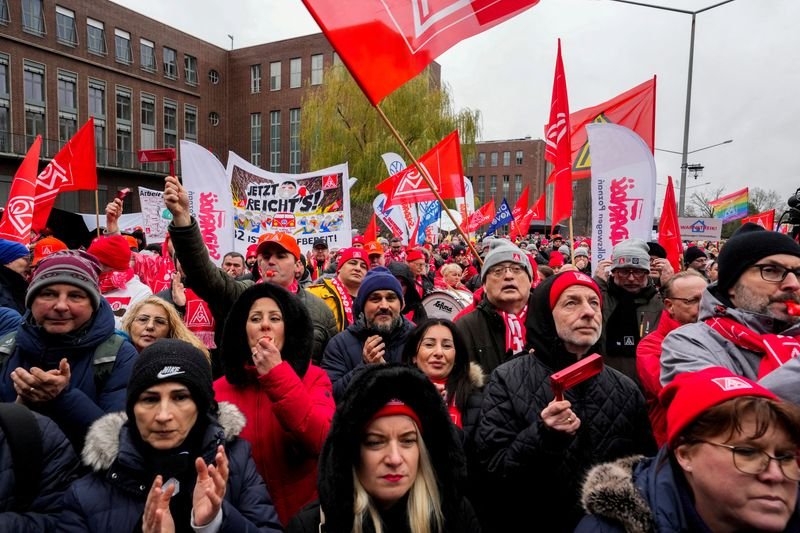
    An illustration depicting the tension between German workers and company management amidst rising industrial strife, reflecting challenges in the finance sector. The image underscores the growing labor disputes in Germany as firms like Volkswagen and Thyssenkrupp face economic pressures.
    Workers and management in Germany confront industrial strife amidst economic challenges - Global Banking & Finance Review
    Why waste money on news and opinion when you can access them for free?

    Take advantage of our newsletter subscription and stay informed on the go!

    Subscribe

    Quick Summary

    Germany's 2025 industrial strife stems from economic challenges, with major firms cutting jobs and unions losing influence amid disputes.

    Germany's Industrial Strife: A Year of Economic Challenges

    By Christoph Steitz and Tom Käckenhoff

    FRANKFURT/DUESSELDORF (Reuters) - Germany faces major labour disputes in 2025, as an established bond between firms and workers -- long seen as a pillar of the country's economic success -- is starting to unravel in the wake of brutal competition, economic weakness and spiralling costs.

    Labour bosses at industrial giants Bosch, Thyssenkrupp ZF Friedrichshafen and Volkswagen - jointly representing more than half a million German workers - say that firms are showing a new level of determination to cut jobs, close factories and move staff abroad.

    Unlike during previous crises, boards are less willing to compromise and in some cases have unilaterally ended wage agreements or broken off talks with workers, according to more than a dozen interviews with labour representatives, politicians, executives and economists in Germany.

    That's due to the poor health of Europe's top economy, which has shrunk for the second consecutive year and staked much of its reputation on labour- and energy-intensive sectors such as cars and chemicals. Germany is now one of the world's highest-cost countries.

    This has raised the question of whether Germany's legally-enshrined principle of "co-determination", which guarantees a major influence for workers on company's supervisory boards, is becoming a liability by slowing down corporate restructuring.

    Answering this will be high on the agenda of Germany's next government, to be determined in a snap election on February 23.

    "We have to brace for a year of disputes," said Knut Giesler, deputy chairperson of Thyssenkrupp's steel unit and head of the powerful IG Metall union in North Rhine-Westphalia, where the group is based.

    He said Germany was currently experiencing a battle over co-determination, including at Thyssenkrupp where management and workers are clashing over plans to cut or outsource 11,000 jobs - around 11% of its workforce.

    Giesler said steel workers could quickly go into dispute mode by freeing themselves from no-strike deals established under current labour pacts.

    "The search for co-determination-free zones and the lowest labour costs is booming," said Achim Dietrich, head of the works council at automotive supplier ZF Friedrichshafen, which may close around a third of its German plants and cut more than a quarter of German jobs.

    "Some (executives) believe it is necessary to cut off an arm in order to save the rest of the body," he said, adding the current situation was far worse than the 2008 financial crisis, when company leaders had been more open to compromise.

    'FULLY COLLAPSED'

    Economic change is already affecting German unions, with data from the Hans-Boeckler Foundation showing the number of unrepresented workers in Germany's largest companies has risen by around 14% since 2019.

    Germany's top unions IG Metall and Verdi have both seen their membership decline by a respective 8% and 6% since 2016.

    While unions say they are not in denial about the state of the economy, with insolvency numbers hitting their highest level in nearly a decade, they accuse boards of exploiting the current situation to push through radical change.

    That also includes Bosch, the world's biggest auto supplier, which is planning to cut around 3,800 jobs in Germany.

    "Talks have fully collapsed since summer," said Axel Petruzzelli, who leads the works council at Bosch's Stuttgart plant, its largest globally, adding unions had put forward proposals in order to avoid job cuts.

    "There is no feedback, there are no conversations. (Management) doesn't want to talk," he added, saying workers would stage more actions in the near future.

    Bosch said it would honour existing agreements with labour representatives, including avoiding forced layoffs.

    ZF Friedrichshafen said it remained committed to co-determination, while Thyssenkrupp referred to comments by CEO Miguel Lopez last month that fair cooperation with labour remained critical.

    Volkswagen had no immediate comment on its approach to labour relations.

    All companies have noted the increased need for deeper structural reform in light of overcapacity and intensifying competition from abroad.

    Germany's car production has fallen 28% since 2016 to 4.1 million last year, while jobs in the auto sector declined by just 4%, according to data from industry association VDA and the country's statistics office.

    Mona Neubaur, Economy Minister of North Rhine-Westphalia, Germany's most populous state, has called the deepening conflict between labour and companies an "extreme burden", urging firms to embrace cooperation with their employees.

    Two senior executives, who declined to be named, said that strong unions made it more difficult for companies to implement deeper structural changes and that prolonged walkouts were an effective way to force management to budge.

    Statistics from Germany's Labour Agency show that German companies were hit by nearly 600,000 days of strikes in 2023, more than double the year before and the highest level since 2015.

    And while numbers for 2024 are not yet in, far-reaching walkouts at Lufthansa, Deutsche Bahn and Volkswagen alone have cost the companies nearly 800 million euros ($829 million) last year.

    Given Germany's economy is expected to remain weak -- with economists forecasting GDP growth of 0.2% at best in 2025 -- firms and unions are being forced to relearn how to restructure using job cuts, said Hagen Lesch of the IW economic institute in Cologne.

    "It is becoming increasingly expensive to keep jobs that are no longer needed."

    ($1 = 0.9649 euros)

    (Reporting by Christoph Steitz in Frankfurt and Tom Kaeckenhoff in Duesseldorf; Additional reporting by Ilona Wissenbach and John O'Donnell in Frankfurt, Matthias Inverardi in Duesseldorf and Rene Wagner in Berlin; editing by Matthias Williams and Toby Chopra)

    Key Takeaways

    • •Germany is facing significant labor disputes in 2025.
    • •Major companies are cutting jobs and moving operations abroad.
    • •The principle of co-determination is under scrutiny.
    • •Unions are losing members amid economic challenges.
    • •Snap elections in February may influence future policies.

    Frequently Asked Questions about Analysis-Germany faces year of industrial strife as companies go into battle with workers

    1What is the main topic?

    The article discusses Germany's impending industrial strife in 2025 due to economic challenges and labor disputes.

    2Why are German companies cutting jobs?

    Companies are cutting jobs due to economic weakness, high costs, and the need for restructuring.

    3What is co-determination?

    Co-determination is a principle ensuring workers have significant influence on company supervisory boards in Germany.

    More from Finance

    Explore more articles in the Finance category

    Image for Olympics-Biathlon-Winter Games bring tourism boost to biathlon hotbed of northern Italy
    Olympics-Biathlon-Winter Games bring tourism boost to biathlon hotbed of northern Italy
    Image for Analysis-Bitcoin loses Trump-era gains as crypto market volatility signals uncertainty
    Analysis-Bitcoin loses Trump-era gains as crypto market volatility signals uncertainty
    Image for NatWest closes in on $3.4 billion takeover of wealth manager Evelyn, Sky News reports
    NatWest closes in on $3.4 billion takeover of wealth manager Evelyn, Sky News reports
    Image for Stellantis-backed ACC drops plans for Italian, German gigafactories, union says
    Stellantis-backed ACC drops plans for Italian, German gigafactories, union says
    Image for US wants Russia, Ukraine to end war by summer, Zelenskiy says
    US wants Russia, Ukraine to end war by summer, Zelenskiy says
    Image for Russia launches massive attack on Ukraine's energy system, Zelenskiy says
    Russia launches massive attack on Ukraine's energy system, Zelenskiy says
    Image for Russia launched 400 drones, 40 missiles to hit Ukraine's energy sector, Zelenskiy says
    Russia launched 400 drones, 40 missiles to hit Ukraine's energy sector, Zelenskiy says
    Image for The Kyiv family, with its pets and pigs, defying Russia and the cold
    The Kyiv family, with its pets and pigs, defying Russia and the cold
    Image for Two Polish airports reopen after NATO jets activated over Russian strikes on Ukraine
    Two Polish airports reopen after NATO jets activated over Russian strikes on Ukraine
    Image for French miner Eramet's finance chief steps aside temporarily, days after CEO ouster
    French miner Eramet's finance chief steps aside temporarily, days after CEO ouster
    Image for Ukraine's Zelenskiy calls for faster action on air defence, repairs to grid
    Ukraine's Zelenskiy calls for faster action on air defence, repairs to grid
    Image for Goldman Sachs teams up with Anthropic to automate banking tasks with AI agents, CNBC reports
    Goldman Sachs teams up with Anthropic to automate banking tasks with AI agents, CNBC reports
    View All Finance Posts
    Previous Finance PostNestle beats sales forecasts but expects profit margin to shrink
    Next Finance PostECB can keep cutting rates even if Fed takes it slow, Vujcic says