Search
00
GBAF Logo
trophy
Top StoriesInterviewsBusinessFinanceBankingTechnologyInvestingTradingVideosAwardsMagazinesHeadlinesTrends

Subscribe to our newsletter

Get the latest news and updates from our team.

Global Banking & Finance Review®

Global Banking & Finance Review® - Subscribe to our newsletter

Company

    GBAF Logo
    • About Us
    • Profile
    • Privacy & Cookie Policy
    • Terms of Use
    • Contact Us
    • Advertising
    • Submit Post
    • Latest News
    • Research Reports
    • Press Release
    • Awards▾
      • About the Awards
      • Awards TimeTable
      • Submit Nominations
      • Testimonials
      • Media Room
      • Award Winners
      • FAQ
    • Magazines▾
      • Global Banking & Finance Review Magazine Issue 79
      • Global Banking & Finance Review Magazine Issue 78
      • Global Banking & Finance Review Magazine Issue 77
      • Global Banking & Finance Review Magazine Issue 76
      • Global Banking & Finance Review Magazine Issue 75
      • Global Banking & Finance Review Magazine Issue 73
      • Global Banking & Finance Review Magazine Issue 71
      • Global Banking & Finance Review Magazine Issue 70
      • Global Banking & Finance Review Magazine Issue 69
      • Global Banking & Finance Review Magazine Issue 66
    Top StoriesInterviewsBusinessFinanceBankingTechnologyInvestingTradingVideosAwardsMagazinesHeadlinesTrends

    Global Banking & Finance Review® is a leading financial portal and online magazine offering News, Analysis, Opinion, Reviews, Interviews & Videos from the world of Banking, Finance, Business, Trading, Technology, Investing, Brokerage, Foreign Exchange, Tax & Legal, Islamic Finance, Asset & Wealth Management.
    Copyright © 2010-2026 GBAF Publications Ltd - All Rights Reserved. | Sitemap | Tags | Developed By eCorpIT

    Editorial & Advertiser disclosure

    Global Banking & Finance Review® is an online platform offering news, analysis, and opinion on the latest trends, developments, and innovations in the banking and finance industry worldwide. The platform covers a diverse range of topics, including banking, insurance, investment, wealth management, fintech, and regulatory issues. The website publishes news, press releases, opinion and advertorials on various financial organizations, products and services which are commissioned from various Companies, Organizations, PR agencies, Bloggers etc. These commissioned articles are commercial in nature. This is not to be considered as financial advice and should be considered only for information purposes. It does not reflect the views or opinion of our website and is not to be considered an endorsement or a recommendation. We cannot guarantee the accuracy or applicability of any information provided with respect to your individual or personal circumstances. Please seek Professional advice from a qualified professional before making any financial decisions. We link to various third-party websites, affiliate sales networks, and to our advertising partners websites. When you view or click on certain links available on our articles, our partners may compensate us for displaying the content to you or make a purchase or fill a form. This will not incur any additional charges to you. To make things simpler for you to identity or distinguish advertised or sponsored articles or links, you may consider all articles or links hosted on our site as a commercial article placement. We will not be responsible for any loss you may suffer as a result of any omission or inaccuracy on the website.

    Home > Finance > Europe's power price divide hits southeastern economies
    Finance

    Europe's power price divide hits southeastern economies

    Published by Global Banking & Finance Review®

    Posted on January 7, 2025

    5 min read

    Last updated: January 27, 2026

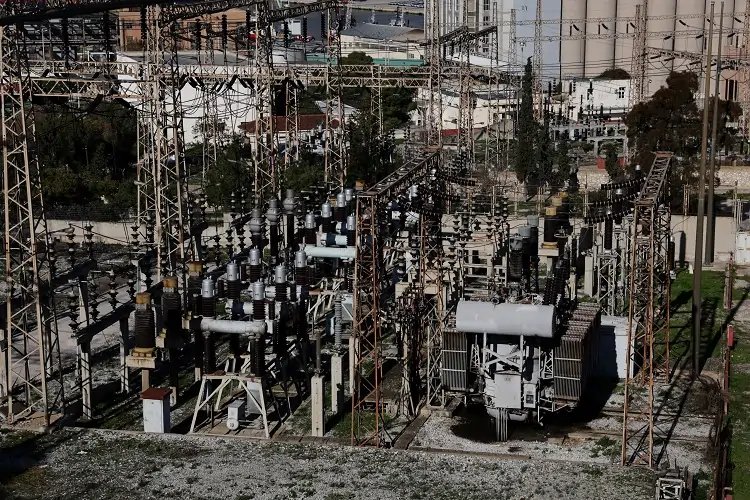
    An Athens restaurant owner struggles with rising electricity costs amid Europe's energy crisis, highlighting the financial strain on southeastern economies affected by high power prices.
    Electricity bills impact on Athens restaurant amidst Europe's energy crisis - Global Banking & Finance Review
    Why waste money on news and opinion when you can access them for free?

    Take advantage of our newsletter subscription and stay informed on the go!

    Subscribe

    Quick Summary

    Southeast Europe faces higher electricity costs, impacting economic growth. Greece's energy prices have surged, highlighting the need for infrastructure investment.

    Europe's Power Price Divide Challenges Southeastern Economies

    By Angeliki Koutantou, Forrest Crellin and Edward McAllister

    ATHENS/PARIS (Reuters) - For Athens restaurant owner Christos Kapetanakis, rent has always been high, but now he faces what he calls "a second rent" as soaring electricity bills slash profits and force him to raise prices.

    Kapetanakis pays between 3,000 and 3,800 euros ($3,083-$3,905) a month on power, up 40% since Russia invaded Ukraine in 2022 and triggered a European energy crisis. Electricity used to amount to 3% of monthly turnover and now it's more like 15%, he said.

    "The continuous increase in prices, especially in the tourism sector...will lead Greece to become less competitive compared to other Mediterranean countries," he said from his restaurant in the historic Plaka neighbourhood.

    His predicament has been echoed across the continent since the Ukraine war interrupted Russian pipeline gas supplies to Europe and forced countries like Greece to seek more expensive alternatives.

    But southeast Europe has felt the impact much more than the northwest. Experts say that will only widen as winter hits, and will have a knock-on effect on economic growth.

    Wholesale power in Greece and Italy in August were 12 times higher than in Nordic countries and even dwarfed other southern European countries which were experiencing hot weather.

    HIGHEST IN THE EU

    Since 2021, Greece has spent 11 billion euros on energy subsidies to try to protect customers. In 2022, the spend amounted to 5.3% of GDP - by far the highest in the EU and double that of second-placed Italy, according to France-based energy consultancy Enerdata.

    Despite Athens' efforts to shield citizens from the energy cost rises, the situation has exacerbated a cost of living crisis in Greece in the wake of a 2009-18 debt crisis that slashed wages, pensions, and investments in power production and transport.

    "Increased energy prices and a negative impact on GDP are a tautology," said Nikos Magginas, a senior economist at Greece's National Bank.

    "Increased prices have a negative impact on household consumption and on the cost structure for industries, airlines and shipping."

    Much of the contrast between southeast Europe and its neighbours comes down to investment. While the northeast has power and gas lines that allow the easy transfer of energy between nations, as well as a strong mix of renewable sources, much of southeast Europe is fragmented and isolated.

    Power storage, which is becoming increasingly important in northern European countries, is nonexistent in parts of the southeast. Germany has 1,668 megawatts (MW) of large-scale storage capacity, versus none in mainland Greece, according to data from LCP Delta, an Edinburgh-based power consultancy.

    "Southeast Europe and the Balkans are lacking in (electricity) interconnects. Whenever there is a power shortage, and renewables output is low, they struggle to import the necessary volumes," said Henning Gloystein, head of energy, climate and resources at Eurasia Group.

    In contrast, Spain's renewable power generation has skyrocketed in the past decade, in part thanks to EU funding. It generated almost 60% of its electricity from renewable energy in the first half of this year, up from 51% a year before.

    "If you don't invest, energy prices will stay high," Gloystein said.

    MORE TO BE DONE

    Europe's power network is in many ways a great success. In 2022, France increased imports from Germany when nuclear power output dipped. When Russian gas supplies to Europe via Ukraine were halted last week, the price impact was muted because the bloc had found alternatives.

    But for some, more needs to be done. After power prices spiked in Greece last summer, Prime Minister Kyriakos Mitsotakis wrote to the European Commission demanding a solution to the "unacceptable" differences in electricity costs across Europe.

    Greece is not alone. Much of the Balkans relies heavily on fossil fuels and the regional power system is weak. Last June, a power outage hit Montenegro, Bosnia, Albania and Croatia when the grid was overloaded by air conditioning needs during a heatwave.

    Kosovo, which generates more than 90% of its power from coal, is struggling to catch up with the rest of Europe in installing more renewables.

    In December, it launched an auction to install 100 MW of wind capacity. But the World Bank estimates that it needs 100 times that - at least 10 gigawatts of new capacity - to meet its target of eliminating coal usage by 2050. This transition is estimated to cost Kosovo 4.5 billion euros, a daunting sum for the small economy.

    Without enough cross-border integration or storage, sometimes there is too much power for one market, forcing producers to curtail supply.

    "If the target is more concretely to reduce prices, the easiest way to do that is to increase penetration of renewables or nuclear," said Fabian Ronningen, an analyst at consultancy Rystad Energy.

    While Greece has no nuclear plants, Aristotelis Aivaliotis, secretary general of the Energy Ministry, is upbeat, noting renewable output is on the rise, two new gas-fired power plants set to come online this year, and battery storage to be built by 2028.

    Plans also call for power links with Italy, Albania and Turkey to be upgraded by 2031 at a cost of about 750 million euros.

    "Wholesale prices will gradually fall ... and this will definitely get passed on to consumers at some point," Aivaliotis told Reuters.

    Greek customers are not convinced. Taxiarchis Fekas, who lives in a suburb of Athens, struggles to pay school tuition and allowances for his three children because power bills are so high.

    He urges his kids to reduce their laptop and tablet use to save power - a tough ask for young children glued to their devices.

    "We are on the verge of becoming a financially struggling family," he said. "The government needs to pay attention."

    ($1 = 0.9730 euros)

    (Reporting by Angeliki Koutantou and Edward McAllister in Athens and Forrest Crellin in Paris; additional reporting by Lefteris Papadimas in Athens and Fatos Bytyci in Pristina; writing by Edward McAllister; editing by Jason Neely)

    Key Takeaways

    • •Southeast Europe faces higher power prices compared to the northwest.
    • •Greece's electricity costs have surged, impacting competitiveness.
    • •Investment in energy infrastructure is lacking in southeast Europe.
    • •Greece spends significantly on energy subsidies, highest in the EU.
    • •Renewable energy investment is crucial for reducing costs.

    Frequently Asked Questions about Europe's power price divide hits southeastern economies

    1What is the main topic?

    The article discusses the impact of Europe's power price divide on southeastern economies, particularly Greece.

    2How has Greece been affected?

    Greece faces soaring electricity costs, impacting competitiveness and economic growth.

    3What is the solution to high energy prices?

    Investing in energy infrastructure and renewable sources is crucial to reduce costs.

    More from Finance

    Explore more articles in the Finance category

    Image for French miner Eramet's finance chief steps aside temporarily, days after CEO ouster
    French miner Eramet's finance chief steps aside temporarily, days after CEO ouster
    Image for Ukraine's Zelenskiy calls for faster action on air defence, repairs to grid
    Ukraine's Zelenskiy calls for faster action on air defence, repairs to grid
    Image for Goldman Sachs teams up with Anthropic to automate banking tasks with AI agents, CNBC reports
    Goldman Sachs teams up with Anthropic to automate banking tasks with AI agents, CNBC reports
    Image for Analysis-Hims' $49 weight-loss pill rattles investor case for cash-pay obesity market
    Analysis-Hims' $49 weight-loss pill rattles investor case for cash-pay obesity market
    Image for Analysis-Glencore to focus on short-term disposals as Rio deal remains elusive
    Analysis-Glencore to focus on short-term disposals as Rio deal remains elusive
    Image for Belgium's Agomab Therapeutics valued at $716 million as shares fall in Nasdaq debut
    Belgium's Agomab Therapeutics valued at $716 million as shares fall in Nasdaq debut
    Image for Big Tech's quarter in four charts: AI splurge and cloud growth
    Big Tech's quarter in four charts: AI splurge and cloud growth
    Image for EU hikes tariffs on Chinese ceramics to 79% to counter dumping 
    EU hikes tariffs on Chinese ceramics to 79% to counter dumping 
    Image for AI trade splinters as investors get more selective
    AI trade splinters as investors get more selective
    Image for EU extends tariff suspension on $109.8 billion of US imports for six months
    EU extends tariff suspension on $109.8 billion of US imports for six months
    Image for Dog food maker Ollie acquired by Spain’s Agrolimen
    Dog food maker Ollie acquired by Spain’s Agrolimen
    Image for Salzgitter to take over HKM steel joint venture, end clash with Thyssenkrupp
    Salzgitter to take over HKM steel joint venture, end clash with Thyssenkrupp
    View All Finance Posts
    Previous Finance PostDollar falls as markets ponder proposed Trump tariffs, US data in focus
    Next Finance PostGetty Images, Shutterstock gear up for AI challenge with $3.7 billion merger