Search
00
GBAF Logo
trophy
Top StoriesInterviewsBusinessFinanceBankingTechnologyInvestingTradingVideosAwardsMagazinesHeadlinesTrends

Subscribe to our newsletter

Get the latest news and updates from our team.

Global Banking & Finance Review®

Global Banking & Finance Review® - Subscribe to our newsletter

Company

    GBAF Logo
    • About Us
    • Profile
    • Privacy & Cookie Policy
    • Terms of Use
    • Contact Us
    • Advertising
    • Submit Post
    • Latest News
    • Research Reports
    • Press Release
    • Awards▾
      • About the Awards
      • Awards TimeTable
      • Submit Nominations
      • Testimonials
      • Media Room
      • Award Winners
      • FAQ
    • Magazines▾
      • Global Banking & Finance Review Magazine Issue 79
      • Global Banking & Finance Review Magazine Issue 78
      • Global Banking & Finance Review Magazine Issue 77
      • Global Banking & Finance Review Magazine Issue 76
      • Global Banking & Finance Review Magazine Issue 75
      • Global Banking & Finance Review Magazine Issue 73
      • Global Banking & Finance Review Magazine Issue 71
      • Global Banking & Finance Review Magazine Issue 70
      • Global Banking & Finance Review Magazine Issue 69
      • Global Banking & Finance Review Magazine Issue 66
    Top StoriesInterviewsBusinessFinanceBankingTechnologyInvestingTradingVideosAwardsMagazinesHeadlinesTrends

    Global Banking & Finance Review® is a leading financial portal and online magazine offering News, Analysis, Opinion, Reviews, Interviews & Videos from the world of Banking, Finance, Business, Trading, Technology, Investing, Brokerage, Foreign Exchange, Tax & Legal, Islamic Finance, Asset & Wealth Management.
    Copyright © 2010-2026 GBAF Publications Ltd - All Rights Reserved. | Sitemap | Tags | Developed By eCorpIT

    Editorial & Advertiser disclosure

    Global Banking & Finance Review® is an online platform offering news, analysis, and opinion on the latest trends, developments, and innovations in the banking and finance industry worldwide. The platform covers a diverse range of topics, including banking, insurance, investment, wealth management, fintech, and regulatory issues. The website publishes news, press releases, opinion and advertorials on various financial organizations, products and services which are commissioned from various Companies, Organizations, PR agencies, Bloggers etc. These commissioned articles are commercial in nature. This is not to be considered as financial advice and should be considered only for information purposes. It does not reflect the views or opinion of our website and is not to be considered an endorsement or a recommendation. We cannot guarantee the accuracy or applicability of any information provided with respect to your individual or personal circumstances. Please seek Professional advice from a qualified professional before making any financial decisions. We link to various third-party websites, affiliate sales networks, and to our advertising partners websites. When you view or click on certain links available on our articles, our partners may compensate us for displaying the content to you or make a purchase or fill a form. This will not incur any additional charges to you. To make things simpler for you to identity or distinguish advertised or sponsored articles or links, you may consider all articles or links hosted on our site as a commercial article placement. We will not be responsible for any loss you may suffer as a result of any omission or inaccuracy on the website.

    Home > Finance > Analysis-Is China's state-funded stock revival plan pie in the sky?
    Finance

    Analysis-Is China's state-funded stock revival plan pie in the sky?

    Published by Global Banking & Finance Review®

    Posted on February 12, 2025

    5 min read

    Last updated: January 26, 2026

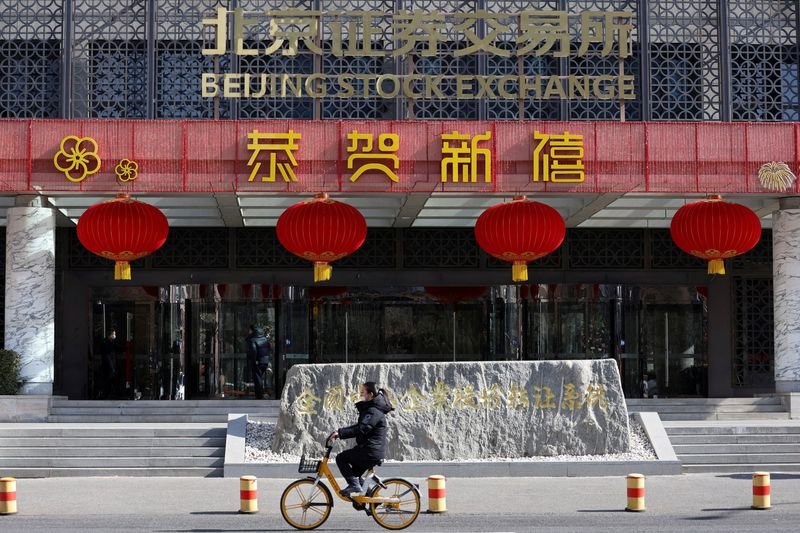
    This image depicts a financial graph analyzing China's state-funded stock market revival plan, showcasing key trends and figures. It relates to the article's exploration of China's efforts to stabilize its stock market amid economic challenges.
    Graph illustrating China's state-funded stock market revival plan - Global Banking & Finance Review
    Why waste money on news and opinion when you can access them for free?

    Take advantage of our newsletter subscription and stay informed on the go!

    Subscribe

    Quick Summary

    China's state-funded plan to revive its stock market aims to boost investor confidence but faces challenges from underlying economic issues.

    Is China's State-Funded Stock Market Revival Feasible?

    By Samuel Shen and Vidya Ranganathan

    SHANGHAI/SINGAPORE (Reuters) - As China directs its large financial institutions to help revive and rebalance a struggling stock market, analysts see merit in the plan but are sceptical it will stimulate a recovery.

    Beijing has used this playbook before to some success. Now, however, it is in a vicious chicken-and-egg cycle where the stock market and weak economy feed off each other, hobbling consumer spending and private investment.

    The benchmark CSI 300 index is down 1% this year and overall, those who have waited patiently since China's post-pandemic reopening two years ago have lost 9% in Chinese stocks.

    Seeking a circuit breaker, the Communist Party aims to use state funds to mimic the "animal spirits" of capitalism. State insurers and mutual funds have been asked to pump billions of dollars that could prop up the stock market.

    "I understand why they're doing this right now," said Francis Tan, chief Asia strategist at CA Indosuez.

    "If you can fix the asset prices, confidence will be up and when the confidence will be up, there'll be real economic demand and then we'll see economic growth. So they're coming in from the asset price angle to fix sentiment. They are now trying to start a virtuous cycle," he said.

    The world's second-largest economy is in desperate need of a feel-good factor as deepening deflation, a slump in property values, government debt problems and, more recently, a fresh trade war with the United States sap sentiment.

    Regulators have touted the idea of luring more long-term investors into the retail-dominated stock market for more than a decade. But this time they have set specific targets.

    China Securities Regulatory Commission (CSRC) head Wu Qing has said big state insurers are to invest 30% of their new policy premiums in China-listed shares and mutual funds to grow stock holdings by 10% a year for the next three years.

    Wu also expects insurers to channel at least 100 billion yuan ($13.8 billion) into stocks via a pilot scheme in the first half of this year.

    Mutual funds are scurrying to launch more equity investment offerings to comply with that directive. More than 100 equity funds are being marketed or in the sales pipeline, according to data provider East Money Information Co.

    The new rules are estimated to attract at least 1 trillion yuan ($138.1 billion) from insurers and mutual funds into domestic stocks each year, although that's a pittance for a $12 trillion market.

    BALLAST AND STABILISER

    While the measures have not yet spurred a market rally, they may over time attract more professional investors that become the 'ballast' and 'stabiliser' that CSRC's Wu hopes for.

    Four years into a bear market, the CSI 300 index trades where it did a decade ago. The total value of the market, dominated by small-cap firms favoured by retail investors and rife with pump-and-dump speculation, has not changed since 2015.

    Sat Duhra, a portfolio manager at Janus Henderson, believes China needs to address underlying macroeconomic issues for these efforts to have a lasting impact.

    "If you go back over history and look at what was important for consumption in China, it was household income ... and that's employment. It was not equity market creating wealth effect and it was not interest rates," he said.

    Institutional investors own around 19% of tradable shares in China, dwarfed by retail traders who own 30%, according to Huaxi Securities. Individuals constitute 70% of daily turnover.

    Dong Baozhen, chairman of Beijing-based asset manager Lingtong Shengtai, says the measures are a "way out" for the fragile stock market.

    "The cyclical boom and bust of Chinese shares over the past three decades was the result of pricing power resting in the wrong hands", so the government has a strong political will to seize that power from speculators, he said.

    He reckons Beijing's carrot-and-stick approach will boost the clout of risk-averse insurers currently under-represented in the market, potentially benefiting stocks with high dividends, such as banks.

    Stock investments by insurers have already jumped by a third over the past four months to 4.4 trillion yuan under the government's push. That compares with roughly 7 trillion yuan of equity holdings by mutual funds.

    Still, some analysts question the wisdom of making long-term bets on a slowing economy facing persistent deflation, an aging population and geopolitical tensions.

    "The core issue is not really the nature of the capital, it's the market environment," said Zhang Jianan, a self-employed stock trader.

    "You've got public funds as potatoes, you've got insurance funds as roses. You sprinkle it in the soil and it will grow, but you sprinkle it in a shit hole and they will all die."

    ($1 = 7.2440 Chinese yuan)

    (Reporting by Samuel Shen in Shanghai and Summer Zhen, Jiaxin Li in Hong Kong, Rae Wee in Singapore; Editing by Jacqueline Wong)

    Key Takeaways

    • •China aims to revive its stock market using state funds.
    • •The CSI 300 index has seen a decline this year.
    • •State insurers and mutual funds are key players in the plan.
    • •The plan seeks to attract long-term investors.
    • •Underlying economic issues may hinder the plan's success.

    Frequently Asked Questions about Analysis-Is China's state-funded stock revival plan pie in the sky?

    1What is the main topic?

    The article discusses China's state-funded plan to revive its struggling stock market and its potential impact on the economy.

    2How does China plan to revive the stock market?

    China plans to use state funds, involving insurers and mutual funds, to boost stock market confidence and attract long-term investors.

    3What are the challenges to the plan's success?

    The plan faces challenges from China's weak economy, deflation, and macroeconomic issues that may limit its effectiveness.

    More from Finance

    Explore more articles in the Finance category

    Image for Farmers report 'catastrophic' damage to crops as Storm Marta hits Spain and Portugal
    Farmers report 'catastrophic' damage to crops as Storm Marta hits Spain and Portugal
    Image for If US attacks, Iran says it will strike US bases in the region
    If US attacks, Iran says it will strike US bases in the region
    Image for Olympics-Biathlon-Winter Games bring tourism boost to biathlon hotbed of northern Italy
    Olympics-Biathlon-Winter Games bring tourism boost to biathlon hotbed of northern Italy
    Image for Analysis-Bitcoin loses Trump-era gains as crypto market volatility signals uncertainty
    Analysis-Bitcoin loses Trump-era gains as crypto market volatility signals uncertainty
    Image for NatWest closes in on $3.4 billion takeover of wealth manager Evelyn, Sky News reports
    NatWest closes in on $3.4 billion takeover of wealth manager Evelyn, Sky News reports
    Image for Stellantis-backed ACC drops plans for Italian, German gigafactories, union says
    Stellantis-backed ACC drops plans for Italian, German gigafactories, union says
    Image for US pushes Russia and Ukraine to end war by summer, Zelenskiy says
    US pushes Russia and Ukraine to end war by summer, Zelenskiy says
    Image for Russia launches massive attack on Ukraine's energy system, Zelenskiy says
    Russia launches massive attack on Ukraine's energy system, Zelenskiy says
    Image for Russia launched 400 drones, 40 missiles to hit Ukraine's energy sector, Zelenskiy says
    Russia launched 400 drones, 40 missiles to hit Ukraine's energy sector, Zelenskiy says
    Image for The Kyiv family, with its pets and pigs, defying Russia and the cold
    The Kyiv family, with its pets and pigs, defying Russia and the cold
    Image for Two Polish airports reopen after NATO jets activated over Russian strikes on Ukraine
    Two Polish airports reopen after NATO jets activated over Russian strikes on Ukraine
    Image for French miner Eramet's finance chief steps aside temporarily, days after CEO ouster
    French miner Eramet's finance chief steps aside temporarily, days after CEO ouster
    View All Finance Posts
    Previous Finance PostTrump says he will sign reciprocal tariffs order soon, as trade war fears mount
    Next Finance PostIndian central bank hikes overnight fund infusion post heavy FX intervention