Search
00
GBAF Logo
trophy
Top StoriesInterviewsBusinessFinanceBankingTechnologyInvestingTradingVideosAwardsMagazinesHeadlinesTrends

Subscribe to our newsletter

Get the latest news and updates from our team.

Global Banking and Finance Review

Global Banking and Finance Review - Subscribe to our newsletter

Company

    GBAF Logo
    • About Us
    • Profile
    • Privacy & Cookie Policy
    • Terms of Use
    • Contact Us
    • Advertising
    • Submit Post
    • Latest News
    • Research Reports
    • Press Release
    • Awards▾
      • About the Awards
      • Awards TimeTable
      • Submit Nominations
      • Testimonials
      • Media Room
      • Award Winners
      • FAQ
    • Magazines▾
      • Global Banking & Finance Review Magazine Issue 79
      • Global Banking & Finance Review Magazine Issue 78
      • Global Banking & Finance Review Magazine Issue 77
      • Global Banking & Finance Review Magazine Issue 76
      • Global Banking & Finance Review Magazine Issue 75
      • Global Banking & Finance Review Magazine Issue 73
      • Global Banking & Finance Review Magazine Issue 71
      • Global Banking & Finance Review Magazine Issue 70
      • Global Banking & Finance Review Magazine Issue 69
      • Global Banking & Finance Review Magazine Issue 66
    Top StoriesInterviewsBusinessFinanceBankingTechnologyInvestingTradingVideosAwardsMagazinesHeadlinesTrends

    Global Banking & Finance Review® is a leading financial portal and online magazine offering News, Analysis, Opinion, Reviews, Interviews & Videos from the world of Banking, Finance, Business, Trading, Technology, Investing, Brokerage, Foreign Exchange, Tax & Legal, Islamic Finance, Asset & Wealth Management.
    Copyright © 2010-2026 GBAF Publications Ltd - All Rights Reserved. | Sitemap | Tags | Developed By eCorpIT

    Editorial & Advertiser disclosure

    Global Banking and Finance Review is an online platform offering news, analysis, and opinion on the latest trends, developments, and innovations in the banking and finance industry worldwide. The platform covers a diverse range of topics, including banking, insurance, investment, wealth management, fintech, and regulatory issues. The website publishes news, press releases, opinion and advertorials on various financial organizations, products and services which are commissioned from various Companies, Organizations, PR agencies, Bloggers etc. These commissioned articles are commercial in nature. This is not to be considered as financial advice and should be considered only for information purposes. It does not reflect the views or opinion of our website and is not to be considered an endorsement or a recommendation. We cannot guarantee the accuracy or applicability of any information provided with respect to your individual or personal circumstances. Please seek Professional advice from a qualified professional before making any financial decisions. We link to various third-party websites, affiliate sales networks, and to our advertising partners websites. When you view or click on certain links available on our articles, our partners may compensate us for displaying the content to you or make a purchase or fill a form. This will not incur any additional charges to you. To make things simpler for you to identity or distinguish advertised or sponsored articles or links, you may consider all articles or links hosted on our site as a commercial article placement. We will not be responsible for any loss you may suffer as a result of any omission or inaccuracy on the website.

    Home > Finance > Young Greeks priced out as inflation, rents soar
    Finance

    Young Greeks priced out as inflation, rents soar

    Published by Jessica Weisman-Pitts

    Posted on October 26, 2022

    5 min read

    Last updated: February 3, 2026

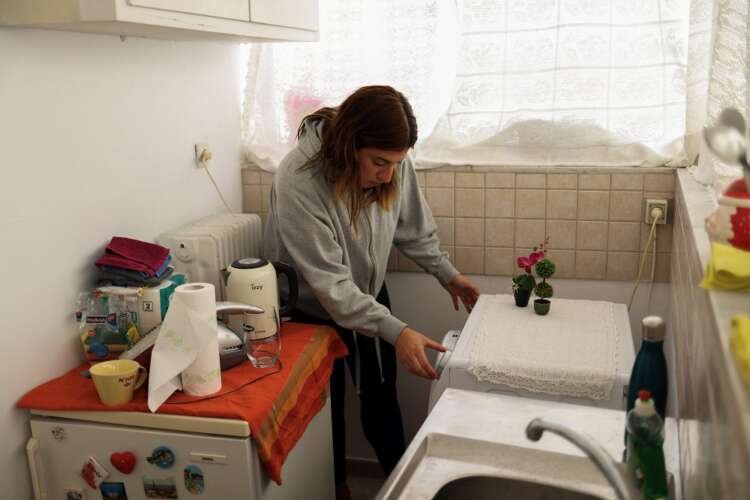
    Christina Pappas, a 27-year-old aspiring actress, uses her washing machine in a small Athens apartment, highlighting the struggle for affordable housing in Greece as rents soar and inflation rises.
    Young Greek actress Christina Pappas in her small Athens apartment - Global Banking & Finance Review
    Why waste money on news and opinion when you can access them for free?

    Take advantage of our newsletter subscription and stay informed on the go!

    Subscribe

    Tags:economic crisisliving standardsHousing marketfinancial management

    By George Georgiopoulos and Lefteris Papadimas

    ATHENS (Reuters) – Like many young Greeks trying to live within their means, Christina Pappas had to look for a cheaper flat in an Athens suburb after her rent went up and was relieved to find one through word of mouth.

    At 200 euros ($197.20) per month, she got lucky.

    While Greece’s economy is growing at nearly twice the euro zone rate this year thanks to a robust rebound in tourism, young people are increasingly being priced out of the property market due to the energy crisis and inflation, soaring rents and a scarce supply of small flats.

    Pappas, 27, an aspiring actress, says it is not the dividend young people hoped for after a ravaging debt crisis and a decade of austerity.

    “The energy crisis scares me a lot, that in such a small amount of time we would have such an increase in prices. I am frightened by the idea of how I will manage and continue to live alone,” Pappas said.

    Rising rents and unaffordability of housing is a problem across many industrialised economies, but in Greece it is particularly acute as living standards and household wealth have already been crippled by the debt crisis that began in 2009 and the years of austerity that followed.

    The rent on Pappas’s new 25 square metre (269 sq. ft) flat in the suburb of Neo Psychiko does not include utilities.

    She moved last month after the rent on her flat in the Kaisariani district of Athens went up 12.5%, pushing the total monthly outlay including utilities to 500 euros, making it “hard to make ends meet when one’s pay is 650 euros a month.”

    “Many people in my age group face the same problem. They either opt for a roommate or they continue living with their parents,” she said. “You can do that when you are 19 but not in later years.”

    A poll by the Athens-based Eteron think tank this year showed that for 83% of 1,007 respondents aged 18-44, affordable housing was their top concern. Nearly half said they faced difficulties or were unable to pay their rent, with 77% barely making ends meet.

    INFLATION BITES

    While the Greek economy has shown resilience, growing at an annual clip of 7.7% in the second quarter, inflation is near a three-decade peak at 12%, one of the highest among the 19 countries sharing the euro.

    The Greek Statistics Service’s cost of housing indicator, which reflects rents and mortgage costs, jumped 35.4% year-on-year in September with electricity prices up 30.5% and heating oil up 65.1%.

    That is squeezing disposable income, which for the average Greek household has risen by 13% since 2018, says Nikos Magginas, chief economist at National Bank.

    He attributes the surge in rents mainly to “an overly depressed market during the (debt) crisis.”

    “Now we have a shock from the combined price rises in energy, foods and the cost of housing. Up to now it is not having serious effects on the economy as the government supports weak incomes, but there are concerns should this continue next year,” he said.

    Residential property prices in Greece plunged 42% during the debt crisis but are now more than 29% higher than their low in 2017, according to the Bank of Greece. The rebound has also pulled rents higher.

    Additional factors at play are exacerbating the problem, real estate brokers say.

    On the supply side, a large chunk of small 45-50 square metre flats have been turned into Airbnb apartments for tourists, while prospective home buyers face the scrutiny of much more stringent banks. Loan-to-values on mortgages have dropped to 70-75%, from more than 100% before the debt crisis.

    Banks’ caution underpins financial stability but could also keep young working people off the property ladder for decades.

    “The situation is tough … we will see many returning to their childhood rooms,” said Themistocles Bakas, president of E-Real Estate, adding that home ownership in Greece has dropped by 2.9 percentage points in the last three years to about 73%.

    After a decade of economic crisis and a two-year pandemic it is hard for a young person to have saved 45,000-60,000 euros for a down payment on a 150,000 euro apartment, he said.

    Most Greek cities have seen rents rise but central Athens has seen the biggest spike, by up to 40% in the last four years.

    Aware of the squeeze, the country’s conservative government last month launched a 1.74 billion euro relief programme.

    It raised an annual housing subsidy for students to 1,500 euros from 1,000, and to 2,000 if they opt for a roommate. Also, a pilot programme of low interest rate loans to buy apartments built before 2007 and up to 120 square metres will start in January.

    Officials expect about 10,000 young couples aged 25-39 will benefit from the programme offering 1% interest on loans up to 150,000 euros.

    But Stephania Papadopoulou, a 20-year old student who earns 35 euros a day as a waitress and relies on her family for financial support, says leaving the country is the only way out.

    “We emerged from a crisis to enter another, tougher one,” she told Reuters. “Unless something changes, I certainly see my future abroad.”

    (Writing by George Georgiopoulos, additional reporting by Renee Maltezou; Editing by Susan Fenton)

    Frequently Asked Questions about Young Greeks priced out as inflation, rents soar

    1What is inflation?

    Inflation is the rate at which the general level of prices for goods and services rises, eroding purchasing power. It indicates how much more expensive a set of goods and services has become over a certain period.

    2What is the housing market?

    The housing market refers to the supply and demand for residential properties, including buying, selling, and renting homes. It is influenced by various factors such as economic conditions, interest rates, and demographics.

    3What are living standards?

    Living standards refer to the level of wealth, comfort, material goods, and necessities available to a certain socioeconomic class or geographic area. They are often measured by income, employment, and access to services.

    More from Finance

    Explore more articles in the Finance category

    Image for Rio Tinto seeks leadership roles in Glencore merger talks, FT says
    Rio Tinto seeks leadership roles in Glencore merger talks, FT says
    Image for Exclusive-EU rethinks climate diplomacy after bruising COP30 summit, document shows
    Exclusive-EU rethinks climate diplomacy after bruising COP30 summit, document shows
    Image for SAS in talks with Boeing and Airbus on widebody order, Bloomberg News reports
    SAS in talks with Boeing and Airbus on widebody order, Bloomberg News reports
    Image for Automakers back Trump plan to roll back fuel economy rules, but seek changes
    Automakers back Trump plan to roll back fuel economy rules, but seek changes
    Image for Serbia seeks EU gas deals as it reduces Russian supplies, says President Vucic
    Serbia seeks EU gas deals as it reduces Russian supplies, says President Vucic
    Image for Germany's Merz heads to Saudi, Gulf in quest for new partners
    Germany's Merz heads to Saudi, Gulf in quest for new partners
    Image for Stellantis faces Peugeot model delays due to battery plant issues, Bloomberg News reports
    Stellantis faces Peugeot model delays due to battery plant issues, Bloomberg News reports
    Image for UNICEF calls for criminalization of AI content depicting child sex abuse
    UNICEF calls for criminalization of AI content depicting child sex abuse
    Image for UK asks Air India to explain Boeing Dreamliner fuel-switch incident
    UK asks Air India to explain Boeing Dreamliner fuel-switch incident
    Image for Siemens board to make decision on new chairman no later than 2027
    Siemens board to make decision on new chairman no later than 2027
    Image for Norway's Socialist Party backs down from threat to LNG electricity project
    Norway's Socialist Party backs down from threat to LNG electricity project
    Image for Russian central bank says export outlook to worsen in first quarter
    Russian central bank says export outlook to worsen in first quarter
    View All Finance Posts
    Previous Finance PostStrictly Come Inflation: The Fed, ECB and BoE’s delicate dance
    Next Finance Post3 Steps FIs Can Take to Bolster AML Compliance with ESG