
Search
00
GBAF Logo
trophy
Top StoriesInterviewsBusinessFinanceBankingTechnologyInvestingTradingVideosAwardsMagazinesHeadlinesTrends

Subscribe to our newsletter

Get the latest news and updates from our team.

Global Banking & Finance Review®

Global Banking & Finance Review® - Subscribe to our newsletter

Company

    GBAF Logo
    • About Us
    • Advertising and Sponsorship
    • Profile & Readership
    • Contact Us
    • Latest News
    • Privacy & Cookies Policies
    • Terms of Use
    • Advertising Terms
    • Issue 81
    • Issue 80
    • Issue 79
    • Issue 78
    • Issue 77
    • Issue 76
    • Issue 75
    • Issue 74
    • Issue 73
    • Issue 72
    • Issue 71
    • Issue 70
    • View All
    • About the Awards
    • Awards Timetable
    • Awards Winners
    • Submit Nominations
    • Testimonials
    • Media Room
    • FAQ
    • Asset Management Awards
    • Brand of the Year Awards
    • Business Awards
    • Cash Management Banking Awards
    • Banking Technology Awards
    • CEO Awards
    • Customer Service Awards
    • CSR Awards
    • Deal of the Year Awards
    • Corporate Governance Awards
    • Corporate Banking Awards
    • Digital Transformation Awards
    • Fintech Awards
    • Education & Training Awards
    • ESG & Sustainability Awards
    • ESG Awards
    • Forex Banking Awards
    • Innovation Awards
    • Insurance & Takaful Awards
    • Investment Banking Awards
    • Investor Relations Awards
    • Leadership Awards
    • Islamic Banking Awards
    • Real Estate Awards
    • Project Finance Awards
    • Process & Product Awards
    • Telecommunication Awards
    • HR & Recruitment Awards
    • Trade Finance Awards
    • The Next 100 Global Awards
    • Wealth Management Awards
    • Travel Awards
    • Years of Excellence Awards
    • Publishing Principles
    • Ownership & Funding
    • Corrections Policy
    • Editorial Code of Ethics
    • Diversity & Inclusion Policy
    • Fact Checking Policy
    Original content: Global Banking and Finance Review - https://www.globalbankingandfinance.com

    A global financial intelligence and recognition platform delivering authoritative insights, data-driven analysis, and institutional benchmarking across Banking, Capital Markets, Investment, Technology, and Financial Infrastructure.

    Copyright © 2010-2026 - All Rights Reserved. | Sitemap | Tags

    Editorial & Advertiser disclosure

    Global Banking & Finance Review® is an online platform offering news, analysis, and opinion on the latest trends, developments, and innovations in the banking and finance industry worldwide. The platform covers a diverse range of topics, including banking, insurance, investment, wealth management, fintech, and regulatory issues. The website publishes news, press releases, opinion and advertorials on various financial organizations, products and services which are commissioned from various Companies, Organizations, PR agencies, Bloggers etc. These commissioned articles are commercial in nature. This is not to be considered as financial advice and should be considered only for information purposes. It does not reflect the views or opinion of our website and is not to be considered an endorsement or a recommendation. We cannot guarantee the accuracy or applicability of any information provided with respect to your individual or personal circumstances. Please seek Professional advice from a qualified professional before making any financial decisions. We link to various third-party websites, affiliate sales networks, and to our advertising partners websites. When you view or click on certain links available on our articles, our partners may compensate us for displaying the content to you or make a purchase or fill a form. This will not incur any additional charges to you. To make things simpler for you to identity or distinguish advertised or sponsored articles or links, you may consider all articles or links hosted on our site as a commercial article placement. We will not be responsible for any loss you may suffer as a result of any omission or inaccuracy on the website.

    1. Home
    2. >Technology
    3. >What’s the actual cost of the cloud in 2018/19?
    Technology

    What’s the Actual Cost of the Cloud in 2018/19?

    Published by Gbaf News

    Posted on October 23, 2018

    4 min read

    Last updated: January 21, 2026

    Add as preferred source on Google

    This image illustrates key points on writing a business memo, emphasizing cloud cost comparisons and investment strategies relevant to IT decisions in 2018/19.
    Business memo outlining cloud cost comparisons and IT investment strategies - Global Banking & Finance Review
    Why waste money on news and opinion when you can access them for free?

    Take advantage of our newsletter subscription and stay informed on the go!

    Subscribe

    Tags:(Virtual Desktop Infrastructurecloud costsDatacentre Solutionsnetwork virtualisation

    Matthew Beale, Datacentre Solutions Specialist, Ultima

    As companies look ahead to 2019 and where they should be investing in IT, cloud is bound to be on the agenda. But what do the latest cloud cost comparisons look like and who should be investing in cloud?

    How does cloud stack up against on-premise?

    Ultima has recently researched the cost of cloud vs on-premise computing and found some interesting comparisons. Importantly, because of advancements in software that can be deployed, the functionality of on-premise platforms has increased drastically allowing organisations to consume on-premise IT in a similar manner to public cloud.

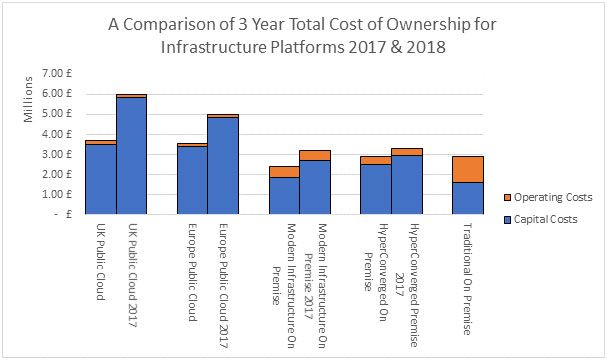
    The comparison looked at a similar sizing for the infrastructure (for both on-premise and cloud) as follows:

    • 600 virtual machines.
    • 4 vCPUs (virtual central processing units)per virtual machine.
    • 16GB RAM per virtual machine.
    • 256GB storage per virtual machine.

    There are five different platforms that have been considered for this, each with their own benefits and pitfalls:

    • Public cloud platform based within the UK.
    • Public cloud paltform based within the European region.
    • A modern infrastrucutre based on software driven server, storage and networking.
    • A hyperconverged platform, where the compute and storage scale linearly together.
    • A traditional IT infrastructure, a hardware driven platform that lacks flexibility.

    Good news

    Even with the additional functionality all of the on-premise, costs have dropped. The same can also be said for the cloud costs, given how new the UK platform was last year the costs here have dropped drastically. The graph shows how some costs have been changing at a far more rapid rate than others.

    If a different style of migration was applied the graph would look very different; the cloud becomes much more cost-efficient additional services, auto-scaling instances and rapid scaling are being leveraged. However, these services require a much more complex, and therefore more costly, migration.

    SME vs large business

    For smaller businesses despite this year’s reductions the cost of running on-premise systems is still a prohibitive overhead, therefore SaaS (Software as a Service) and IaaS (Infrastructure as a Service) still work more effectively.
    comparison-2018

    * NB: Traditional On Premise wasn’t on 2017 costs.  

    For those businesses needing to scale quickly there might be a need to provide bespoke applications to suit specific business use cases. The need to run these applications and build platforms to support a diverse range of applications becomes paramount.

    Another important aspect of this analysis is based on a static and predictable workload, however, in the ‘real’ business world not every application is of this nature and businesses need to take this into account. Workloads that vary widely throughout their lifecycle may well end up as hybrid or fully public cloud workloads. As businesses evolve and grow in the next year there may be a need to use applications that can leverage alternative capabilities that cloud services can provide, such as machine learning, if this doesn’t exist on-premise.

    n-premise

    The research highlighted the public cloud should be used when it allows businesses to augment its on-premise capabilities. Every workload has its own characteristics and requirements and it should be based on this mix that businesses select the best option.

    For example, if a business is using VDI (Virtual Desktop Infrastructure), but it is only being used between 9am-5pm in the UK, it could utilise the cloud and auto scaling to reduce the cost during the night; whilst still enabling the business to utilise the number desktops needed during the day. The other option is to re-architect applications to take advantage of PaaS (Platform as a Service) and SaaS technologies. If this is carried out, then the costings will improve too.

    Businesses using cloud services might not look to pocket these savings, but to reinvest them in order to gain a higher level of functionality within the platform. This could include software for automation and network virtualisation. 

    Looking Ahead

    Saving the best news for last, it is highly likely that these costs will continue to decrease in 2019. This is due to the increasing supply of flash drives from the new fabrication plants that have come online in 2018 and which will lessen hardware costs. This, coupled with the new competitive nature of AMD (Advanced Micro Devices) within the server market, means the costs for both on-premise and public cloud will decrease.

    Increased competition in the network virtualisation world with two goliaths fighting for control (Cisco with ACI and VMWare with NSX) should also be good news for businesses looking at these types of technology.

    Over the next 12 to 24 months there will be a big change in how applications are built and designed. A distinct move away from monolithic applications into a world built on microservices which will allow businesses to take advantage of a hybrid workload which is being load-balanced across both public and private platforms.

    More from Technology

    Explore more articles in the Technology category

    Image for Nominations Open for Technology Awards 2026
    Nominations Open for Technology Awards 2026
    Image for Nominations Open for Innovation Awards 2026
    Nominations Open for Innovation Awards 2026
    Image for Archie earns industry recognition across G2, Capterra, and SoftwareReviews
    Archie Earns Industry Recognition Across G2, Capterra, and SoftwareReviews
    Image for The Bankaool Transformation: How a Regional Mexican Bank Became a Fintech Disruptor
    The Bankaool Transformation: How a Regional Mexican Bank Became a FinTech Disruptor
    Image for Submit Your Entry Today for Digital Banking Awards 2026
    Submit Your Entry Today for Digital Banking Awards 2026
    Image for Behavioral AI in Financial Services: Moving Beyond Automation Toward Human Understanding
    Behavioral AI in Financial Services: Moving Beyond Automation Toward Human Understanding
    Image for Submit Your Entry for Brand of the Year Awards Technology Bahrain 2026
    Submit Your Entry for Brand of the Year Awards Technology Bahrain 2026
    Image for Entries Now Open for Best Islamic Open Banking Burkina Faso APIs 2026
    Entries Now Open for Best Islamic Open Banking Burkina Faso APIs 2026
    Image for Entrepreneurial Discipline in the AI Economy: Insights from Dmytro Lavryniuk
    Entrepreneurial Discipline in the AI Economy: Insights From Dmytro Lavryniuk
    Image for Entries Now Open for Best New Digital Wallet Innovation Award 2026
    Entries Now Open for Best New Digital Wallet Innovation Award 2026
    Image for Call for Entries: Best Digital Wallet 2026
    Call for Entries: Best Digital Wallet 2026
    Image for Nominations Open for Brand of the Year Technology 2026
    Nominations Open for Brand of the Year Technology 2026
    View All Technology Posts
    Previous Technology PostSap Migration to the Cloud: What Is Important When Choosing a Provider?
    Next Technology PostSimplifying IT Complexity in the Public Sector





