Search
00
GBAF Logo
trophy
Top StoriesInterviewsBusinessFinanceBankingTechnologyInvestingTradingVideosAwardsMagazinesHeadlinesTrends

Subscribe to our newsletter

Get the latest news and updates from our team.

Global Banking & Finance Review®

Global Banking & Finance Review® - Subscribe to our newsletter

Company

    GBAF Logo
    • About Us
    • Profile
    • Privacy & Cookie Policy
    • Terms of Use
    • Contact Us
    • Advertising
    • Submit Post
    • Latest News
    • Research Reports
    • Press Release
    • Awards▾
      • About the Awards
      • Awards TimeTable
      • Submit Nominations
      • Testimonials
      • Media Room
      • Award Winners
      • FAQ
    • Magazines▾
      • Global Banking & Finance Review Magazine Issue 79
      • Global Banking & Finance Review Magazine Issue 78
      • Global Banking & Finance Review Magazine Issue 77
      • Global Banking & Finance Review Magazine Issue 76
      • Global Banking & Finance Review Magazine Issue 75
      • Global Banking & Finance Review Magazine Issue 73
      • Global Banking & Finance Review Magazine Issue 71
      • Global Banking & Finance Review Magazine Issue 70
      • Global Banking & Finance Review Magazine Issue 69
      • Global Banking & Finance Review Magazine Issue 66
    Top StoriesInterviewsBusinessFinanceBankingTechnologyInvestingTradingVideosAwardsMagazinesHeadlinesTrends

    Global Banking & Finance Review® is a leading financial portal and online magazine offering News, Analysis, Opinion, Reviews, Interviews & Videos from the world of Banking, Finance, Business, Trading, Technology, Investing, Brokerage, Foreign Exchange, Tax & Legal, Islamic Finance, Asset & Wealth Management.
    Copyright © 2010-2026 GBAF Publications Ltd - All Rights Reserved. | Sitemap | Tags | Developed By eCorpIT

    Editorial & Advertiser disclosure

    Global Banking & Finance Review® is an online platform offering news, analysis, and opinion on the latest trends, developments, and innovations in the banking and finance industry worldwide. The platform covers a diverse range of topics, including banking, insurance, investment, wealth management, fintech, and regulatory issues. The website publishes news, press releases, opinion and advertorials on various financial organizations, products and services which are commissioned from various Companies, Organizations, PR agencies, Bloggers etc. These commissioned articles are commercial in nature. This is not to be considered as financial advice and should be considered only for information purposes. It does not reflect the views or opinion of our website and is not to be considered an endorsement or a recommendation. We cannot guarantee the accuracy or applicability of any information provided with respect to your individual or personal circumstances. Please seek Professional advice from a qualified professional before making any financial decisions. We link to various third-party websites, affiliate sales networks, and to our advertising partners websites. When you view or click on certain links available on our articles, our partners may compensate us for displaying the content to you or make a purchase or fill a form. This will not incur any additional charges to you. To make things simpler for you to identity or distinguish advertised or sponsored articles or links, you may consider all articles or links hosted on our site as a commercial article placement. We will not be responsible for any loss you may suffer as a result of any omission or inaccuracy on the website.

    Home > Investing > “We want to increase investment in Germany”, FDP leader says
    Investing

    “We want to increase investment in Germany”, FDP leader says

    Published by maria gbaf

    Posted on September 14, 2021

    5 min read

    Last updated: January 21, 2026

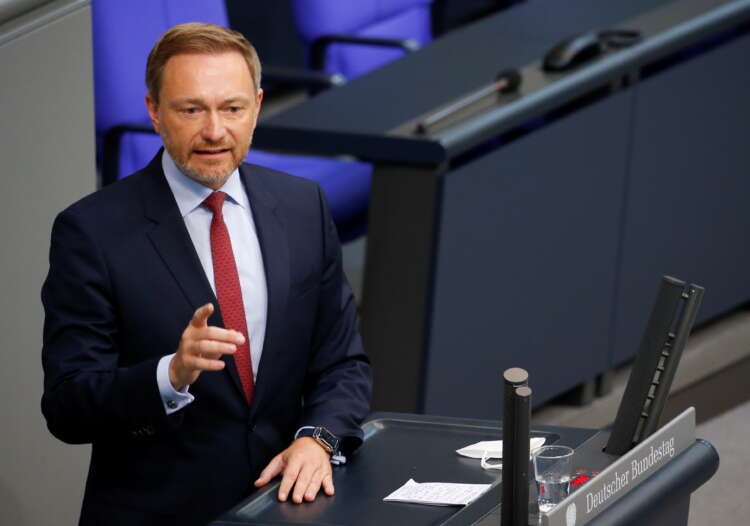
    Image of FDP leader Christian Lindner, emphasizing the party's commitment to boosting investment in Germany during coalition talks. This aligns with the article's focus on fiscal policy and economic strategies.
    FDP leader Christian Lindner discusses investment plans for Germany - Global Banking & Finance Review
    Why waste money on news and opinion when you can access them for free?

    Take advantage of our newsletter subscription and stay informed on the go!

    Subscribe

    By Tanja Daube and Alexander Ratz

    BERLIN (Reuters) – Germany’s Free Democrats, potential kingmakers in coalition talks after a Sept. 26 election, want to boost investment, their leader told Reuters on Monday, lowering the hurdles to a three-way coalition with the centre-left Social Democrats and Greens.

    FDP leader Christian Lindner said his business-friendly party would not join any coalition government that wanted to increase taxes and soften constitionally enshrined borrowing limits.

    But Lindner made clear that the fiscal policy of a balanced budget, cherished by Chancellor Angela Merkel’s conservatives and also known as the “black zero”, was not a priority for him.

    “The black zero is not our goal, the black zero has been a prestige project of the conservatives,” Lindner said.

    “For us it’s important that the debt brake in the constitution must be respected,” Lindner said, opening the door for reduced deficit-spending in Europe’s largest economy.

    “We want to increase investment in Germany,” said Lindner, who has voiced interest in becoming Germany’s first finance minister in the post-Merkel era.

    An INSA poll for newspaper Bild published on Monday put support for the FDP at 12.5%, with the Social Democrats (SPD) leading on 26% and the Greens on 15%. Merkel’s conservative alliance was on 20.5%.

    DEFICIT SPENDING

    Linder said he wanted to improve conditions for private investment by implementing a “super depreciation programme” in which investments in digitization and climate protection could be written off within two years.

    Finance Minister Olaf Scholz has financed COVID-19 emergency measures with record new borrowing of up to 240 billion euros this year and more than 130 billion euros last year, for which parliament suspended the debt limits in the constitution.

    Scholz, the Social Democrat candidate to succeed Merkel as chancellor after the election, has proposed suspending the debt brake for a third year in 2022 to allow additional borrowing of nearly 100 billion euros.

    From 2023 onwards, Scholz wants to consolidate public finances and return to the debt brake rule that would limit new borrowing to 0.35% of economic output. That would allow only reduced deficit spending of 10-15 billion euros each year.

    The Greens are calling for an additional 50 billion euros a year in extra public investment over 10 years, which would be about 1.5% of 2019 output.

    However, this would require a reform of the debt brake rule in the constitution – a tricky political task for which two-thirds majorities are needed in both chambers of parliament.

    (Reporting by Tanja Daube and Alexander Ratz; Writing by Paul Carrel; Editing by Michael Nienaber and Alex Richardson)

    By Tanja Daube and Alexander Ratz

    BERLIN (Reuters) – Germany’s Free Democrats, potential kingmakers in coalition talks after a Sept. 26 election, want to boost investment, their leader told Reuters on Monday, lowering the hurdles to a three-way coalition with the centre-left Social Democrats and Greens.

    FDP leader Christian Lindner said his business-friendly party would not join any coalition government that wanted to increase taxes and soften constitionally enshrined borrowing limits.

    But Lindner made clear that the fiscal policy of a balanced budget, cherished by Chancellor Angela Merkel’s conservatives and also known as the “black zero”, was not a priority for him.

    “The black zero is not our goal, the black zero has been a prestige project of the conservatives,” Lindner said.

    “For us it’s important that the debt brake in the constitution must be respected,” Lindner said, opening the door for reduced deficit-spending in Europe’s largest economy.

    “We want to increase investment in Germany,” said Lindner, who has voiced interest in becoming Germany’s first finance minister in the post-Merkel era.

    An INSA poll for newspaper Bild published on Monday put support for the FDP at 12.5%, with the Social Democrats (SPD) leading on 26% and the Greens on 15%. Merkel’s conservative alliance was on 20.5%.

    DEFICIT SPENDING

    Linder said he wanted to improve conditions for private investment by implementing a “super depreciation programme” in which investments in digitization and climate protection could be written off within two years.

    Finance Minister Olaf Scholz has financed COVID-19 emergency measures with record new borrowing of up to 240 billion euros this year and more than 130 billion euros last year, for which parliament suspended the debt limits in the constitution.

    Scholz, the Social Democrat candidate to succeed Merkel as chancellor after the election, has proposed suspending the debt brake for a third year in 2022 to allow additional borrowing of nearly 100 billion euros.

    From 2023 onwards, Scholz wants to consolidate public finances and return to the debt brake rule that would limit new borrowing to 0.35% of economic output. That would allow only reduced deficit spending of 10-15 billion euros each year.

    The Greens are calling for an additional 50 billion euros a year in extra public investment over 10 years, which would be about 1.5% of 2019 output.

    However, this would require a reform of the debt brake rule in the constitution – a tricky political task for which two-thirds majorities are needed in both chambers of parliament.

    (Reporting by Tanja Daube and Alexander Ratz; Writing by Paul Carrel; Editing by Michael Nienaber and Alex Richardson)

    More from Investing

    Explore more articles in the Investing category

    Image for Understanding the Factors Shaping Bitcoin’s Current Market Conditions
    Understanding the Factors Shaping Bitcoin’s Current Market Conditions
    Image for Understanding Investment Management Consulting Services in the U.S. Market
    Understanding Investment Management Consulting Services in the U.S. Market
    Image for The Role of DST Sponsors and Service Providers in Delaware Statutory Trusts
    The Role of DST Sponsors and Service Providers in Delaware Statutory Trusts
    Image for Understanding Self-Directed IRA Structures and Platform Models
    Understanding Self-Directed IRA Structures and Platform Models
    Image for 1031 Exchanges and Delaware Statutory Trusts: What Investors Need to Know
    1031 Exchanges and Delaware Statutory Trusts: What Investors Need to Know
    Image for Excellence in Innovation – Strategic Investment & Economic Transformation Egypt 2025
    Excellence in Innovation – Strategic Investment & Economic Transformation Egypt 2025
    Image for What Is the Average Pension Pot in the UK? (By Age)
    What Is the Average Pension Pot in the UK? (By Age)
    Image for From Money Printing to Market Surge: The Macro Forces Driving Crypto in 2026
    From Money Printing to Market Surge: The Macro Forces Driving Crypto in 2026
    Image for  Millennials Aren’t Ignoring Retirement. They’re Rebuilding It.
    Millennials Aren’t Ignoring Retirement. They’re Rebuilding It.
    Image for BridgeWise Launches FixedWise, the First AI Solution Bringing Granular Bond Intelligence to the European Market
    BridgeWise Launches FixedWise, the First AI Solution Bringing Granular Bond Intelligence to the European Market
    Image for Why Financial Advisors Are Rethinking Gold Allocations
    Why Financial Advisors Are Rethinking Gold Allocations
    Image for From Opaque to Investable: Yaniv Bertele's Blueprint for Transparent Alternatives
    From Opaque to Investable: Yaniv Bertele's Blueprint for Transparent Alternatives
    View All Investing Posts
    Previous Investing PostCrypto CEOs should cooperate with regulators to unlock future growth -SALT panel
    Next Investing PostGlobal stock markets slip on inflation, tax, regulation worries