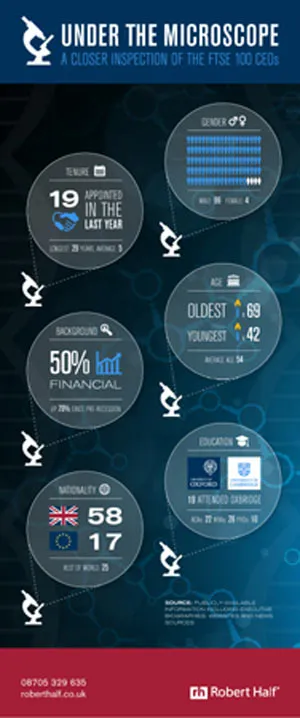
- Analysis shows half (50%) of FTSE 100 CEOs have a finance background
- Over a quarter (28%) have an MBA and one in 10 have PhDs
- Resurgence of Oxbridge graduate CEOs running UK PLCs from 15 last year to 19
- Number of women FTSE 100 CEOs (4) remains low
Despite calls for greater diversity at the top of Britain’s biggest companies, the typical profile of a FTSE 100 CEO remains unchanged as male, 50-plus and likely to have a background in finance, as well as post-graduate qualifications including MBAs and PhDs, according to new research from Robert Half UK, the UK’s leading recruitment specialist.
Key Statistics From FTSE 100 CEO Tracker
The annual Robert Half FTSE 100 CEO Tracker analyses the background and experience of current FTSE 100 CEOs and shows that half (50%) of current leaders have an accountancy or financial management background compared to 18% in retail/hospitality, 14% with a background in engineering/natural resources, 10% in marketing/advertising, 3% in technology and 6% in other industries.
Rise in CEOs With Marketing Backgrounds
The biggest change was in the number of marketing/advertising specialists taking the helm. This grew from six in 2011 to seven in 2012 and 2013 to 10 in 2014, perhaps indicating a new focus on innovation and new product development as the economy improves.
Economic recovery may also be driving more churn at the top of the FTSE Index, with 19% of current CEOs having been in their role for less than 12 months, compared to just 10% at the same point in 2013 and 8% in 2012. The constant transformation of the FTSE 100 continues to progress, with 25 new CEOs1 either being promoted or joining the Index along with their company.
The 12 new companies entering the index cover a wide range of industry sectors including Retail (Travis Perkins and Sports Direct), Transportation and Logistics (Royal Mail) and Travel & Leisure (William Hill). Newly appointed CEOs include Albert Manifold, CEO of CRH plc since January 2014 and Stephen Hester, CEO of RSA Insurance Group since February 2014.
Demographics of the Average FTSE 100 CEO
The average FTSE 100 CEO is aged 54 and male, similar to the previous two years. Following a fall in 2013 of the number of ‘Oxbridge’ graduates leading the UK’s top performing companies to 15, the total has risen once again to 19. Non-British nationals continue to lead 42% of FTSE 100 companies, although this total has fallen from 46% in 2011
Persistent Gender Gap in FTSE 100 CEOs
The number of women CEOs remains persistently low. Although there are two new female CEOs in the shape of Moya Greene, CEO of newly listed Royal Mail Group and Liv Garfield CEO of Severn Trent Water; Angela Ahrendts is standing down from Burberry in mid-2014 and so the number of women CEOs will remain at four. Looking at total representation on FTSE 100 boards, a fifth (20.7%) of women hold senior positions, compared to just 12.5% in 2011. Just two companies have male only boards – copper mining company Antofagasta and natural resources group Glencore Xstrata.
Industry Insights and Expert Commentary
Phil Sheridan, UK Managing Director of Robert Half said: “We’re seeing an evolution in the make-up of Britain’s top bosses, especially now that the economy is showing signs of improvement. The doubling of the attrition rate and the introduction of more advertising and marketing specialists shows movement in the market, but the old guard of finance still holds sway with executives with a background in accountancy and finance holding the reins of the UK’s top companies.
“Perhaps the biggest disappointment is that the number of women FTSE 100 CEOs has remained consistently low since we began this study in 2008. We look forward to the day when diversity at the highest levels stops being a discussion item and becomes a reality: organisations should be looking for the best talent, not just the typical candidate that they have always chosen.”