Search
00
GBAF Logo
trophy
Top StoriesInterviewsBusinessFinanceBankingTechnologyInvestingTradingVideosAwardsMagazinesHeadlinesTrends

Subscribe to our newsletter

Get the latest news and updates from our team.

Global Banking & Finance Review®

Global Banking & Finance Review® - Subscribe to our newsletter

Company

    GBAF Logo
    • About Us
    • Profile
    • Privacy & Cookie Policy
    • Terms of Use
    • Contact Us
    • Advertising
    • Submit Post
    • Latest News
    • Research Reports
    • Press Release
    • Awards▾
      • About the Awards
      • Awards TimeTable
      • Submit Nominations
      • Testimonials
      • Media Room
      • Award Winners
      • FAQ
    • Magazines▾
      • Global Banking & Finance Review Magazine Issue 79
      • Global Banking & Finance Review Magazine Issue 78
      • Global Banking & Finance Review Magazine Issue 77
      • Global Banking & Finance Review Magazine Issue 76
      • Global Banking & Finance Review Magazine Issue 75
      • Global Banking & Finance Review Magazine Issue 73
      • Global Banking & Finance Review Magazine Issue 71
      • Global Banking & Finance Review Magazine Issue 70
      • Global Banking & Finance Review Magazine Issue 69
      • Global Banking & Finance Review Magazine Issue 66
    Top StoriesInterviewsBusinessFinanceBankingTechnologyInvestingTradingVideosAwardsMagazinesHeadlinesTrends

    Global Banking & Finance Review® is a leading financial portal and online magazine offering News, Analysis, Opinion, Reviews, Interviews & Videos from the world of Banking, Finance, Business, Trading, Technology, Investing, Brokerage, Foreign Exchange, Tax & Legal, Islamic Finance, Asset & Wealth Management.
    Copyright © 2010-2026 GBAF Publications Ltd - All Rights Reserved. | Sitemap | Tags | Developed By eCorpIT

    Editorial & Advertiser disclosure

    Global Banking & Finance Review® is an online platform offering news, analysis, and opinion on the latest trends, developments, and innovations in the banking and finance industry worldwide. The platform covers a diverse range of topics, including banking, insurance, investment, wealth management, fintech, and regulatory issues. The website publishes news, press releases, opinion and advertorials on various financial organizations, products and services which are commissioned from various Companies, Organizations, PR agencies, Bloggers etc. These commissioned articles are commercial in nature. This is not to be considered as financial advice and should be considered only for information purposes. It does not reflect the views or opinion of our website and is not to be considered an endorsement or a recommendation. We cannot guarantee the accuracy or applicability of any information provided with respect to your individual or personal circumstances. Please seek Professional advice from a qualified professional before making any financial decisions. We link to various third-party websites, affiliate sales networks, and to our advertising partners websites. When you view or click on certain links available on our articles, our partners may compensate us for displaying the content to you or make a purchase or fill a form. This will not incur any additional charges to you. To make things simpler for you to identity or distinguish advertised or sponsored articles or links, you may consider all articles or links hosted on our site as a commercial article placement. We will not be responsible for any loss you may suffer as a result of any omission or inaccuracy on the website.

    Home > Investing > Wall Street seen opening higher but U.S. recession priced in
    Investing

    Wall Street seen opening higher but U.S. recession priced in

    Published by Jessica Weisman-Pitts

    Posted on November 18, 2022

    4 min read

    Last updated: February 3, 2026

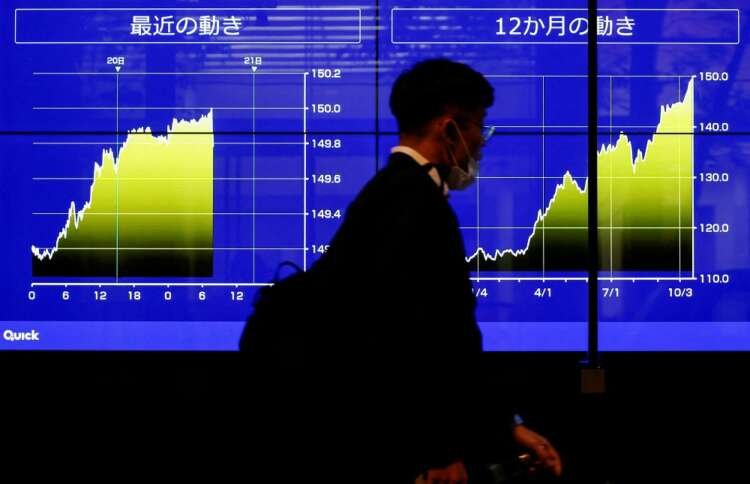
    This image captures passersby looking at an electronic monitor displaying currency exchange rates, reflecting investor sentiment as Wall Street is set to open higher despite recession fears. It highlights key themes of the article on U.S. stock index futures and Federal Reserve interest rate discussions.
    Passersby observe currency exchange rates during Wall Street's market opening - Global Banking & Finance Review
    Why waste money on news and opinion when you can access them for free?

    Take advantage of our newsletter subscription and stay informed on the go!

    Subscribe

    Tags:interest ratesfinancial marketseconomic growth

    By Carolyn Cohn

    LONDON (Reuters) – U.S. stock index futures rose on Friday, indicating a higher open on Wall Street, as investors digest warnings from U.S. Federal Reserve officials on U.S. interest rates, but the U.S. bond yield curve remains priced for a recession.

    S&P futures gained 0.8%, recovering poise after the S&P 500 index dipped 0.3% and U.S. bond yields rose on Thursday following comments from St. Louis Fed President James Bullard.

    Bullard said interest rates might need to hit a range from 5-5.25% from the current level of just below 4.00% to be “sufficiently restrictive” to curb inflation.

    That was a blow to investors who had been wagering rates would peak at 5% and saw Fed fund futures sell off as markets priced in more chance that rates would now top out at 5-5.25%, rather than 4.75-5.0%.

    “The Fed has come back through their speeches and pushed back against the market narrative – we are not going to see a pivot,” said Arun Sai, senior multi-asset strategist at Pictet Asset Management.

    Sai said markets were currently “running on fumes” and would likely switch focus to the real economy’s response to rising rates, such as anecdotal signs of slowdown in the U.S. labour market.

    GRAPHIC: Implied Fed terminal rate – https://fingfx.thomsonreuters.com/gfx/mkt/akveqzmxrvr/One.PNG

    The MSCI world equities index rose 0.33% but was heading for a 0.5% loss on the week, coming off recent two-month highs.

    Inflows into global equity funds hit their highest level in 35 weeks in the week to Wednesday, according to a report from Bank of America (BofA), as investor optimism brightened.

    Euro zone banks, meanwhile, are set to repay 296 billion euros in multi-year loans from the European Central Bank next week, the ECB said on Friday, in its latest step to fight runaway inflation in the euro zone.

    This is less than the half a trillion euros that analysts were expecting but still the biggest drop in excess liquidity since records began in 2000.

    The yield on Germany’s 10-year government bond, the benchmark for the euro zone, was up 3.6 basis points at 2.06%. European stocks gained 1.2%, with banks up 1.4%.

    The European Central Bank may need to raise interest rates so much that they dampen growth as it fights sky-high inflation, while any runoff in the ECB’s bond holdings must be “measured and predictable”, its chief Christine Lagarde said earlier on Friday.

    “The ECB will be wanting to show that it’s a strong institution and that it’s willing to fight inflation,” Jim Leaviss, Chief Investment Officer, Public Fixed Income at M&G Investments told the Reuters Global Markets Forum.

    “There will come a time during 2023 where rates will come down from the ECB because the recessionary impulse will be quite severe.”

    Britain’s FTSE rose 1% to two-month highs, a day after finance minister Jeremy Hunt announced tax rises and spending cuts in an effort to reassure markets that the government was serious about fighting inflation.

    U.S. two-year yields rose 3.8 bps to 4.49%, retracing a little of last week’s sharp inflation-driven drop of 33 basis points to a low of 4.29%.

    That left them 69 basis points above 10-year yields, the largest inversion since 1981 and an indicator of impending recession. [US/]

    The dollar fell 0.2% to 106.5 on a basket of currencies, after touching a three-month trough of 105.30 early in the week.

    The U.S. currency dropped 0.26% to 139.82 yen <JPY=EBS. Sterling rose 0.45% to $1.1921.

    The euro held at $1.0375, having eased from a four-month peak of $1.0481 hit on Tuesday as some policymakers argued for caution on tightening.

    MSCI’s broadest index of Asia-Pacific shares outside Japan rose 0.2%.

    Chinese blue chips dropped 0.45% amid reports that Beijing had asked banks to check liquidity in the bond market after soaring yields caused losses for some investors.

    There were also concerns that a surge in COVID-19 cases in China would challenge plans to ease strict movement curbs that have throttled the economy.

    Japan’s Nikkei slipped 0.1% as data showed inflation running at a 40-year high as a weak yen stoked import costs.

    Oil was on track for a second weekly decline, pressured by concern about the weakening demand in China and further U.S.interest rate rises [O/R]

    Brent crude hit four-week lows and was down 0.8% at $89.07 a barrel. U.S. crude was down 0.5% at $81.23 a barrel.

    Gold was flat at $1,762 an ounce. [GOL/]

    (Additional reporting by Wayne Cole in Sydney and Lisa Mattackal in Bengaluru, editing by Sam Holmes, Simon Cameron-Moore and Louise Heavens)

    Frequently Asked Questions about Wall Street seen opening higher but U.S. recession priced in

    1What is a recession?

    A recession is a significant decline in economic activity across the economy lasting longer than a few months, typically visible in GDP, income, employment, manufacturing, and retail sales.

    2What are interest rates?

    Interest rates are the cost of borrowing money or the return on savings, expressed as a percentage of the amount borrowed or saved, typically set by central banks.

    3What is the Federal Reserve?

    The Federal Reserve, often referred to as the Fed, is the central bank of the United States, responsible for monetary policy, regulating banks, and maintaining financial stability.

    4What is the yield curve?

    The yield curve is a graph that plots interest rates of bonds with equal credit quality but differing maturity dates, used to predict changes in economic output and growth.

    5What are bond yields?

    Bond yields represent the return an investor can expect to earn if the bond is held until maturity, typically expressed as an annual percentage.

    More from Investing

    Explore more articles in the Investing category

    Image for Understanding the Factors Shaping Bitcoin’s Current Market Conditions
    Understanding the Factors Shaping Bitcoin’s Current Market Conditions
    Image for Understanding Investment Management Consulting Services in the U.S. Market
    Understanding Investment Management Consulting Services in the U.S. Market
    Image for The Role of DST Sponsors and Service Providers in Delaware Statutory Trusts
    The Role of DST Sponsors and Service Providers in Delaware Statutory Trusts
    Image for Understanding Self-Directed IRA Structures and Platform Models
    Understanding Self-Directed IRA Structures and Platform Models
    Image for 1031 Exchanges and Delaware Statutory Trusts: What Investors Need to Know
    1031 Exchanges and Delaware Statutory Trusts: What Investors Need to Know
    Image for Excellence in Innovation – Strategic Investment & Economic Transformation Egypt 2025
    Excellence in Innovation – Strategic Investment & Economic Transformation Egypt 2025
    Image for What Is the Average Pension Pot in the UK? (By Age)
    What Is the Average Pension Pot in the UK? (By Age)
    Image for From Money Printing to Market Surge: The Macro Forces Driving Crypto in 2026
    From Money Printing to Market Surge: The Macro Forces Driving Crypto in 2026
    Image for  Millennials Aren’t Ignoring Retirement. They’re Rebuilding It.
    Millennials Aren’t Ignoring Retirement. They’re Rebuilding It.
    Image for BridgeWise Launches FixedWise, the First AI Solution Bringing Granular Bond Intelligence to the European Market
    BridgeWise Launches FixedWise, the First AI Solution Bringing Granular Bond Intelligence to the European Market
    Image for Why Financial Advisors Are Rethinking Gold Allocations
    Why Financial Advisors Are Rethinking Gold Allocations
    Image for From Opaque to Investable: Yaniv Bertele's Blueprint for Transparent Alternatives
    From Opaque to Investable: Yaniv Bertele's Blueprint for Transparent Alternatives
    View All Investing Posts
    Previous Investing PostInvestment Filters to Guide Investors in an Uncertain Market
    Next Investing PostFrom Apollo to DZ Bank, funds snap up bargains in UK pension scramble