Search
00
GBAF Logo
trophy
Top StoriesInterviewsBusinessFinanceBankingTechnologyInvestingTradingVideosAwardsMagazinesHeadlinesTrends

Subscribe to our newsletter

Get the latest news and updates from our team.

Global Banking & Finance Review®

Global Banking & Finance Review® - Subscribe to our newsletter

Company

    GBAF Logo
    • About Us
    • Profile
    • Privacy & Cookie Policy
    • Terms of Use
    • Contact Us
    • Advertising
    • Submit Post
    • Latest News
    • Research Reports
    • Press Release
    • Awards▾
      • About the Awards
      • Awards TimeTable
      • Submit Nominations
      • Testimonials
      • Media Room
      • Award Winners
      • FAQ
    • Magazines▾
      • Global Banking & Finance Review Magazine Issue 79
      • Global Banking & Finance Review Magazine Issue 78
      • Global Banking & Finance Review Magazine Issue 77
      • Global Banking & Finance Review Magazine Issue 76
      • Global Banking & Finance Review Magazine Issue 75
      • Global Banking & Finance Review Magazine Issue 73
      • Global Banking & Finance Review Magazine Issue 71
      • Global Banking & Finance Review Magazine Issue 70
      • Global Banking & Finance Review Magazine Issue 69
      • Global Banking & Finance Review Magazine Issue 66
    Top StoriesInterviewsBusinessFinanceBankingTechnologyInvestingTradingVideosAwardsMagazinesHeadlinesTrends

    Global Banking & Finance Review® is a leading financial portal and online magazine offering News, Analysis, Opinion, Reviews, Interviews & Videos from the world of Banking, Finance, Business, Trading, Technology, Investing, Brokerage, Foreign Exchange, Tax & Legal, Islamic Finance, Asset & Wealth Management.
    Copyright © 2010-2026 GBAF Publications Ltd - All Rights Reserved. | Sitemap | Tags | Developed By eCorpIT

    Editorial & Advertiser disclosure

    Global Banking & Finance Review® is an online platform offering news, analysis, and opinion on the latest trends, developments, and innovations in the banking and finance industry worldwide. The platform covers a diverse range of topics, including banking, insurance, investment, wealth management, fintech, and regulatory issues. The website publishes news, press releases, opinion and advertorials on various financial organizations, products and services which are commissioned from various Companies, Organizations, PR agencies, Bloggers etc. These commissioned articles are commercial in nature. This is not to be considered as financial advice and should be considered only for information purposes. It does not reflect the views or opinion of our website and is not to be considered an endorsement or a recommendation. We cannot guarantee the accuracy or applicability of any information provided with respect to your individual or personal circumstances. Please seek Professional advice from a qualified professional before making any financial decisions. We link to various third-party websites, affiliate sales networks, and to our advertising partners websites. When you view or click on certain links available on our articles, our partners may compensate us for displaying the content to you or make a purchase or fill a form. This will not incur any additional charges to you. To make things simpler for you to identity or distinguish advertised or sponsored articles or links, you may consider all articles or links hosted on our site as a commercial article placement. We will not be responsible for any loss you may suffer as a result of any omission or inaccuracy on the website.

    Home > Investing > Stocks eye steepest slide since 2020 as central bankers roil markets
    Investing

    Stocks eye steepest slide since 2020 as central bankers roil markets

    Published by Jessica Weisman-Pitts

    Posted on June 17, 2022

    3 min read

    Last updated: February 6, 2026

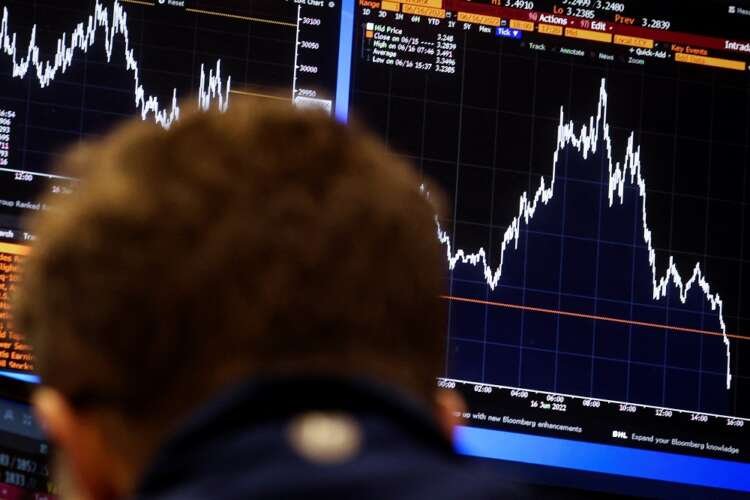
    Traders on the New York Stock Exchange react to significant market fluctuations caused by aggressive central bank policies. This image reflects the tension in investing as stocks face a steep decline, marking the worst week since the 2020 pandemic meltdown.
    Traders on the NYSE floor react to market volatility amid central bank policies - Global Banking & Finance Review
    Why waste money on news and opinion when you can access them for free?

    Take advantage of our newsletter subscription and stay informed on the go!

    Subscribe

    Tags:financial marketsmonetary policyeconomic growthstock market

    By Simon Jessop

    LONDON (Reuters) – World stocks headed for their worst week since markets’ pandemic meltdown in March 2020 as leading central banks doubled down on tighter policy in an effort to tame inflation, setting investors on edge about future economic growth.

    The biggest U.S. rate rise since 1994, the first such Swiss move in 15 years, a fifth rise in British rates since December and a move by the European Central Bank to bolster the indebted south ahead of future rises all took turns in roiling markets.

    The Bank of Japan was the only outlier in a week where money prices rose around the world, sticking with its strategy of pinning 10-year yields near zero on Friday.

    After a week of punchy moves across asset classes, world stocks were flat on Friday to take weekly losses to 5.5% and leave the index on course for the steepest weekly percentage drop in more than two years.

    Overnight in Asia, the dollar climbed 1.9% against the yen to 134.70 in volatile trade, while MSCI’s broadest index of Asia-Pacific shares outside Japan fell to a five-week low, dragged by selling in Australia. Japan’s Nikkei fell 1.8% and headed for a weekly drop of almost 7%.

    S&P 500 futures were up 0.8% and Nasdaq 100 futures up 1.2%, although both remain well underwater on the week. [.N]

    “The more aggressive line by central banks adds to headwinds for both economic growth and equities,” Mark Haefele, Chief Investment Officer at UBS Global Wealth Management, said. “The risks of a recession are rising, while achieving a soft landing for the US economy appears increasingly challenging.”

    Data from analysts at Bank of America showed more than 88% of the stock indexes it tracks are trading below their 50-day and 200-day moving average, leading markets “painfully oversold”.

    ONE WAY

    Bonds and currencies were jittery after a rollercoaster week.

    U.S. labour and housing data came in soft on Thursday, on the heels of disappointing retail sales figures, with the worries knocking the dollar and helping Treasuries.

    Benchmark U.S. 10-year Treasury yields fell nearly 10 basis points overnight but were last at 3.2200%. Yields rise when prices fall. [US/]

    Southern European bond yields dropped sharply on Friday, though, after reports of more detail from ECB President Christine Lagarde over its plans to develop a tool to support yields.

    Germany’s 10-year yield, the benchmark for the euro area, was last at 1.66%.

    In recent sessions, the dollar pulled back from a 20-year high, but it has not fallen far and was last up 0.5%, on course to end the week steady against a basket of currencies.

    Sterling rose 1.4% on Thursday after a 25-basis-point rate rise and was last down 0.5% as it heads for a steady week. Two-year gilts were last at 2.091%. [GB/]

    “Despite today’s apparent semblance of calm in the markets, investors will need to transition from a soft to a hard landing strategy meaning they will either have to turn to defensive or de-risk completely,” Stephen Innes, managing partner at SPI Asset Management, said.

    Growth fears took oil on a brief trip lower before prices steadied. Brent crude futures were last at $120.40 a barrel. Gold extended intraday losses to trade down 0.6% at $1,848 an ounce while bitcoin climbed 2.8% to $20,943.

    (Additional reporting by Tom Westbrook; Editing by Lincoln Feast, Angus MacSwan and Andrew Heavens)

    Frequently Asked Questions about Stocks eye steepest slide since 2020 as central bankers roil markets

    1What is monetary policy?

    Monetary policy refers to the actions taken by a country's central bank to control the money supply and interest rates to achieve macroeconomic objectives such as controlling inflation, consumption, growth, and liquidity.

    2What is inflation?

    Inflation is the rate at which the general level of prices for goods and services rises, eroding purchasing power. Central banks attempt to limit inflation, and avoid deflation, to keep the economy running smoothly.

    3What is the stock market?

    The stock market is a collection of markets where stocks (shares of ownership in businesses) are bought and sold. It serves as a platform for companies to raise capital and for investors to buy shares.

    4What is economic growth?

    Economic growth is an increase in the production of goods and services in an economy over a specific period, typically measured by the growth rate of real GDP (Gross Domestic Product).

    More from Investing

    Explore more articles in the Investing category

    Image for Understanding the Factors Shaping Bitcoin’s Current Market Conditions
    Understanding the Factors Shaping Bitcoin’s Current Market Conditions
    Image for Understanding Investment Management Consulting Services in the U.S. Market
    Understanding Investment Management Consulting Services in the U.S. Market
    Image for The Role of DST Sponsors and Service Providers in Delaware Statutory Trusts
    The Role of DST Sponsors and Service Providers in Delaware Statutory Trusts
    Image for Understanding Self-Directed IRA Structures and Platform Models
    Understanding Self-Directed IRA Structures and Platform Models
    Image for 1031 Exchanges and Delaware Statutory Trusts: What Investors Need to Know
    1031 Exchanges and Delaware Statutory Trusts: What Investors Need to Know
    Image for Excellence in Innovation – Strategic Investment & Economic Transformation Egypt 2025
    Excellence in Innovation – Strategic Investment & Economic Transformation Egypt 2025
    Image for What Is the Average Pension Pot in the UK? (By Age)
    What Is the Average Pension Pot in the UK? (By Age)
    Image for From Money Printing to Market Surge: The Macro Forces Driving Crypto in 2026
    From Money Printing to Market Surge: The Macro Forces Driving Crypto in 2026
    Image for  Millennials Aren’t Ignoring Retirement. They’re Rebuilding It.
    Millennials Aren’t Ignoring Retirement. They’re Rebuilding It.
    Image for BridgeWise Launches FixedWise, the First AI Solution Bringing Granular Bond Intelligence to the European Market
    BridgeWise Launches FixedWise, the First AI Solution Bringing Granular Bond Intelligence to the European Market
    Image for Why Financial Advisors Are Rethinking Gold Allocations
    Why Financial Advisors Are Rethinking Gold Allocations
    Image for From Opaque to Investable: Yaniv Bertele's Blueprint for Transparent Alternatives
    From Opaque to Investable: Yaniv Bertele's Blueprint for Transparent Alternatives
    View All Investing Posts
    Previous Investing PostOil slumps 5% on recession worries, strong U.S. dollar
    Next Investing PostGlobal equity fund outflows rise on fears of inflationary risks