Search
00
GBAF Logo
trophy
Top StoriesInterviewsBusinessFinanceBankingTechnologyInvestingTradingVideosAwardsMagazinesHeadlinesTrends

Subscribe to our newsletter

Get the latest news and updates from our team.

Global Banking & Finance Review®

Global Banking & Finance Review® - Subscribe to our newsletter

Company

    GBAF Logo
    • About Us
    • Profile
    • Privacy & Cookie Policy
    • Terms of Use
    • Contact Us
    • Advertising
    • Submit Post
    • Latest News
    • Research Reports
    • Press Release
    • Awards▾
      • About the Awards
      • Awards TimeTable
      • Submit Nominations
      • Testimonials
      • Media Room
      • Award Winners
      • FAQ
    • Magazines▾
      • Global Banking & Finance Review Magazine Issue 79
      • Global Banking & Finance Review Magazine Issue 78
      • Global Banking & Finance Review Magazine Issue 77
      • Global Banking & Finance Review Magazine Issue 76
      • Global Banking & Finance Review Magazine Issue 75
      • Global Banking & Finance Review Magazine Issue 73
      • Global Banking & Finance Review Magazine Issue 71
      • Global Banking & Finance Review Magazine Issue 70
      • Global Banking & Finance Review Magazine Issue 69
      • Global Banking & Finance Review Magazine Issue 66
    Top StoriesInterviewsBusinessFinanceBankingTechnologyInvestingTradingVideosAwardsMagazinesHeadlinesTrends

    Global Banking & Finance Review® is a leading financial portal and online magazine offering News, Analysis, Opinion, Reviews, Interviews & Videos from the world of Banking, Finance, Business, Trading, Technology, Investing, Brokerage, Foreign Exchange, Tax & Legal, Islamic Finance, Asset & Wealth Management.
    Copyright © 2010-2026 GBAF Publications Ltd - All Rights Reserved. | Sitemap | Tags | Developed By eCorpIT

    Editorial & Advertiser disclosure

    Global Banking & Finance Review® is an online platform offering news, analysis, and opinion on the latest trends, developments, and innovations in the banking and finance industry worldwide. The platform covers a diverse range of topics, including banking, insurance, investment, wealth management, fintech, and regulatory issues. The website publishes news, press releases, opinion and advertorials on various financial organizations, products and services which are commissioned from various Companies, Organizations, PR agencies, Bloggers etc. These commissioned articles are commercial in nature. This is not to be considered as financial advice and should be considered only for information purposes. It does not reflect the views or opinion of our website and is not to be considered an endorsement or a recommendation. We cannot guarantee the accuracy or applicability of any information provided with respect to your individual or personal circumstances. Please seek Professional advice from a qualified professional before making any financial decisions. We link to various third-party websites, affiliate sales networks, and to our advertising partners websites. When you view or click on certain links available on our articles, our partners may compensate us for displaying the content to you or make a purchase or fill a form. This will not incur any additional charges to you. To make things simpler for you to identity or distinguish advertised or sponsored articles or links, you may consider all articles or links hosted on our site as a commercial article placement. We will not be responsible for any loss you may suffer as a result of any omission or inaccuracy on the website.

    Home > Investing > Stocks, dollar little changed as inflation data sends mixed signals
    Investing

    Stocks, dollar little changed as inflation data sends mixed signals

    Published by Jessica Weisman-Pitts

    Posted on December 9, 2022

    5 min read

    Last updated: February 2, 2026

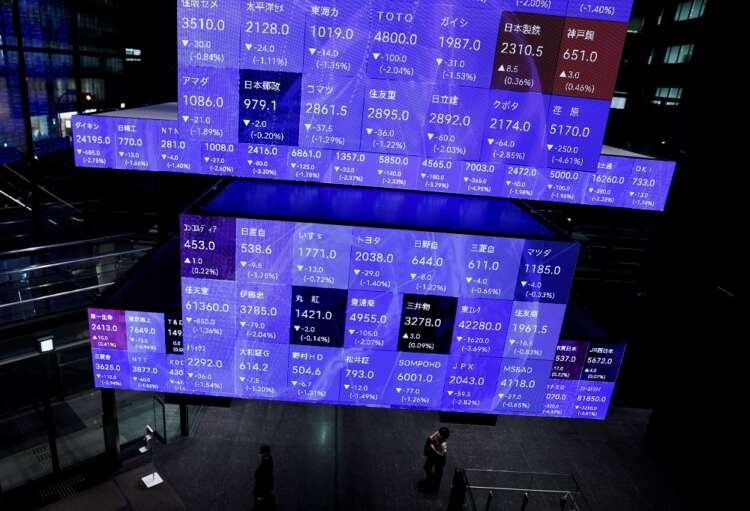
    The image shows a stock market display board in Tokyo, highlighting the fluctuating stock prices amidst mixed inflation data, relevant to current investing trends in global finance.
    Stock market display board in Tokyo reflecting mixed signals in global finance - Global Banking & Finance Review
    Why waste money on news and opinion when you can access them for free?

    Take advantage of our newsletter subscription and stay informed on the go!

    Subscribe

    Tags:interest ratesfinancial marketseconomic growth

    By Herbert Lash and Carolyn Cohn

    NEW YORK/LONDON (Reuters) – The dollar and Wall Street stocks traded little changed on Friday after data on U.S. producer prices drove conflicting reactions, stirring hope that inflation is moderating while also raising fears the Federal Reserve will need to keep interest rates higher for longer.

    The producer price index (PPI) for final demand rose 0.3% last month and increased 7.4% in the 12 months through November, while the PPI for October was revised up to 0.3% from 0.2% as previously reported, the U.S. Labor Department said.

    Economists polled by Reuters had forecast monthly PPI climbing 0.2% and rising 7.2% year-on-year.

    While the data showed a moderating pace of inflation for the last 12 months, the monthly rise fueled concerns that next week’s report on the consumer price index may indicate hotter-than-expected inflation and lead the Fed to not cut rates as soon as many anticipate.

    Fed policymakers are expected to raise rates by 50 basis points next Wednesday, in their last policy meeting of 2022, to a range of 4.25% to 4.50%, which would mark a slower pace of rate increases.

    “The markets are overly optimistic that at some point between June and December (next year) the Fed is going to be willing to cut,” said Anthony Saglimbene, chief market strategist at Ameriprise Financial in Troy, Michigan.

    “Today’s data shows that inflation is coming down, but it’s lingering and is stickier than most assume,” he said. “The Fed is going to have to raise interest rates a little bit more.”

    Futures show the terminal rate peaking at 4.948% next May, and then declining to 4.488% by December 2023.

    U.S. stocks earlier pared losses after the University of Michigan’s preliminary reading on consumer sentiment showed an improvement to 59.1 in December from 56.8 the prior month.

    But enthusiasm over the UMich surveys soon waned, and stocks on Wall Street traded little changed. The Dow Jones Industrial Average fell 0.25%, while the S&P 500 lost 0.06% and the Nasdaq Composite added 0.11%.

    “The Fed has made it abundantly clear that it’s not in the business of repeating mistakes of the past,” Johan Grahn, head of ETFs at Allianz Investment Management in Minneapolis, said in a reference to halting rate hikes too soon.

    “Time just needs to run its course before we know we’re on the right path toward the Fed’s goal, a softish landing that’s been talked about,” Grahn said. “It will take time for inflation to work its way down.”

    MSCI’s gauge of stocks across the globe gained 0.29%, and in Europe the broad STOXX 600 index closed up 0.84%. But recession worries dragged the pan-European index to a weekly loss after a seven-week rally.

    Treasury yields mostly rose, suggesting higher rates ahead for the long term, with the benchmarket 10-year yield up 6.9 basis points to 3.562%.

    The two-year note, which often moves in step with rate expectations, rose 0.9 basis points to 4.321%.

    Market prices also showed a declining trend in breakeven inflation rates for U.S. Treasury inflation-protected securities (TIPS), seen as a good leading indicator for future prices.

    The two-year breakeven rate fell to 2.3372% from 2.407% late Thursday, suggesting that investors expect inflation to average almost 2.34% over the next two years. The yield curve measuring the gap between yields on two- and 10-year notes, a recession harbinger, lessened too, at -76.1 basis points.

    The dollar was broadly weaker overnight, but reversed some of its losses after the PPI report.

    The euro fell 0.1% to $1.0545, and the yen strengthened 0.16% to 136.43 per dollar.

    The world’s largest investment banks expect global economic growth to slow further in 2023 following a year roiled by the Ukraine conflict and soaring inflation, which triggered one of the fastest monetary policy tightening cycles in recent times.

    Investors sold stocks and bought gold in the week to Wednesday, withdrawing $5.7 billion from equity funds, BofA Global Research said, a week of “small, joyless flows.”

    In addition to the Fed, the European Central Bank and the Bank of England are also set to announce interest rate hikes next week as policymakers continue to put the brakes on growth to curb inflation.

    Euro zone banks are set to repay early another 447.5 billion euros in multi-year loans from the ECB, bringing the total reduction of outstanding loans to nearly 800 billion euros in just a few weeks, the ECB said.

    Oil prices rose but both benchmarks were set for a weekly loss as worries over a weak economic outlook in China, Europe and the United States weighed on oil demand.

    U.S. crude fell 44 cents to settle at $71.02 a barrel.

    U.S. gold futures settled 0.5% higher at $1,810.70 an ounce.

    (Reporting by Herbert Lash; Additional reporting by Carolyn Cohn in London, Stella Qiu in Sydney; Editing by Chizu Nomiyama, Mark Potter and Leslie Adler)

    Frequently Asked Questions about Stocks, dollar little changed as inflation data sends mixed signals

    1What is inflation?

    Inflation is the rate at which the general level of prices for goods and services rises, eroding purchasing power.

    2What is the Producer Price Index (PPI)?

    The Producer Price Index (PPI) measures the average change over time in the selling prices received by domestic producers for their output.

    3What are interest rates?

    Interest rates are the amount charged by lenders to borrowers for the use of money, expressed as a percentage of the principal.

    4What is consumer sentiment?

    Consumer sentiment refers to the overall attitude of consumers toward the economy and their personal financial situation, influencing their spending behavior.

    5What is economic growth?

    Economic growth is an increase in the production of goods and services in an economy over a specific period, usually measured by GDP.

    More from Investing

    Explore more articles in the Investing category

    Image for Understanding the Factors Shaping Bitcoin’s Current Market Conditions
    Understanding the Factors Shaping Bitcoin’s Current Market Conditions
    Image for Understanding Investment Management Consulting Services in the U.S. Market
    Understanding Investment Management Consulting Services in the U.S. Market
    Image for The Role of DST Sponsors and Service Providers in Delaware Statutory Trusts
    The Role of DST Sponsors and Service Providers in Delaware Statutory Trusts
    Image for Understanding Self-Directed IRA Structures and Platform Models
    Understanding Self-Directed IRA Structures and Platform Models
    Image for 1031 Exchanges and Delaware Statutory Trusts: What Investors Need to Know
    1031 Exchanges and Delaware Statutory Trusts: What Investors Need to Know
    Image for Excellence in Innovation – Strategic Investment & Economic Transformation Egypt 2025
    Excellence in Innovation – Strategic Investment & Economic Transformation Egypt 2025
    Image for What Is the Average Pension Pot in the UK? (By Age)
    What Is the Average Pension Pot in the UK? (By Age)
    Image for From Money Printing to Market Surge: The Macro Forces Driving Crypto in 2026
    From Money Printing to Market Surge: The Macro Forces Driving Crypto in 2026
    Image for  Millennials Aren’t Ignoring Retirement. They’re Rebuilding It.
    Millennials Aren’t Ignoring Retirement. They’re Rebuilding It.
    Image for BridgeWise Launches FixedWise, the First AI Solution Bringing Granular Bond Intelligence to the European Market
    BridgeWise Launches FixedWise, the First AI Solution Bringing Granular Bond Intelligence to the European Market
    Image for Why Financial Advisors Are Rethinking Gold Allocations
    Why Financial Advisors Are Rethinking Gold Allocations
    Image for From Opaque to Investable: Yaniv Bertele's Blueprint for Transparent Alternatives
    From Opaque to Investable: Yaniv Bertele's Blueprint for Transparent Alternatives
    View All Investing Posts
    Previous Investing PostWall St seen steady ahead of inflation data, Fed later in week
    Next Investing PostNEW RESEARCH REVEALS TWO THIRDS OF COMMERCIAL REAL ESTATE ASSET MANAGERS ARE INVESTING 7-10% OF AUM VALUE TO ASSESS ESG PERFORMANCE