Search
00
GBAF Logo
trophy
Top StoriesInterviewsBusinessFinanceBankingTechnologyInvestingTradingVideosAwardsMagazinesHeadlinesTrends

Subscribe to our newsletter

Get the latest news and updates from our team.

Global Banking & Finance Review®

Global Banking & Finance Review® - Subscribe to our newsletter

Company

    GBAF Logo
    • About Us
    • Profile
    • Privacy & Cookie Policy
    • Terms of Use
    • Contact Us
    • Advertising
    • Submit Post
    • Latest News
    • Research Reports
    • Press Release
    • Awards▾
      • About the Awards
      • Awards TimeTable
      • Submit Nominations
      • Testimonials
      • Media Room
      • Award Winners
      • FAQ
    • Magazines▾
      • Global Banking & Finance Review Magazine Issue 79
      • Global Banking & Finance Review Magazine Issue 78
      • Global Banking & Finance Review Magazine Issue 77
      • Global Banking & Finance Review Magazine Issue 76
      • Global Banking & Finance Review Magazine Issue 75
      • Global Banking & Finance Review Magazine Issue 73
      • Global Banking & Finance Review Magazine Issue 71
      • Global Banking & Finance Review Magazine Issue 70
      • Global Banking & Finance Review Magazine Issue 69
      • Global Banking & Finance Review Magazine Issue 66
    Top StoriesInterviewsBusinessFinanceBankingTechnologyInvestingTradingVideosAwardsMagazinesHeadlinesTrends

    Global Banking & Finance Review® is a leading financial portal and online magazine offering News, Analysis, Opinion, Reviews, Interviews & Videos from the world of Banking, Finance, Business, Trading, Technology, Investing, Brokerage, Foreign Exchange, Tax & Legal, Islamic Finance, Asset & Wealth Management.
    Copyright © 2010-2026 GBAF Publications Ltd - All Rights Reserved. | Sitemap | Tags | Developed By eCorpIT

    Editorial & Advertiser disclosure

    Global Banking & Finance Review® is an online platform offering news, analysis, and opinion on the latest trends, developments, and innovations in the banking and finance industry worldwide. The platform covers a diverse range of topics, including banking, insurance, investment, wealth management, fintech, and regulatory issues. The website publishes news, press releases, opinion and advertorials on various financial organizations, products and services which are commissioned from various Companies, Organizations, PR agencies, Bloggers etc. These commissioned articles are commercial in nature. This is not to be considered as financial advice and should be considered only for information purposes. It does not reflect the views or opinion of our website and is not to be considered an endorsement or a recommendation. We cannot guarantee the accuracy or applicability of any information provided with respect to your individual or personal circumstances. Please seek Professional advice from a qualified professional before making any financial decisions. We link to various third-party websites, affiliate sales networks, and to our advertising partners websites. When you view or click on certain links available on our articles, our partners may compensate us for displaying the content to you or make a purchase or fill a form. This will not incur any additional charges to you. To make things simpler for you to identity or distinguish advertised or sponsored articles or links, you may consider all articles or links hosted on our site as a commercial article placement. We will not be responsible for any loss you may suffer as a result of any omission or inaccuracy on the website.

    Home > Investing > NatWest shares plunge after warning on rising costs
    Investing

    NatWest shares plunge after warning on rising costs

    Published by Jessica Weisman-Pitts

    Posted on October 28, 2022

    4 min read

    Last updated: February 3, 2026

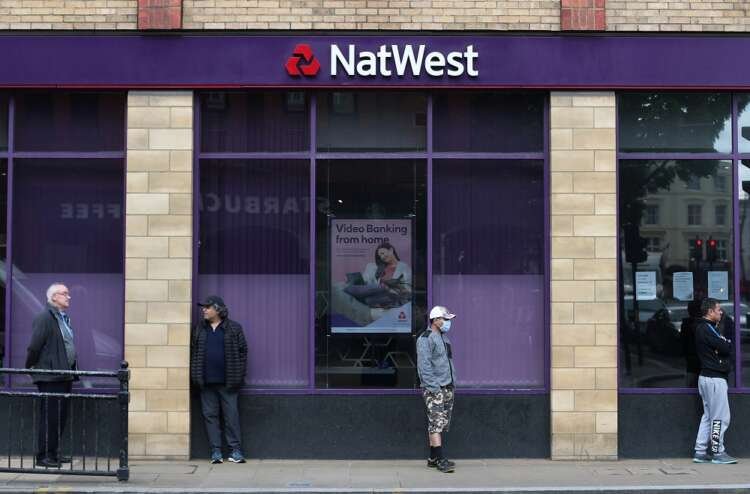
    The image illustrates NatWest's logo alongside a stock market graph indicating a decline in share prices following the bank's warning about rising costs and economic challenges. This visual relates to the article discussing NatWest's recent financial struggles and market outlook.
    NatWest bank logo with a stock market graph showing declining shares - Global Banking & Finance Review
    Why waste money on news and opinion when you can access them for free?

    Take advantage of our newsletter subscription and stay informed on the go!

    Subscribe

    Tags:UK economyfinancial crisisinterest ratescorporate tax

    By Iain Withers and Lawrence White

    LONDON (Reuters) -NatWest’s shares fell as much as 9% on Friday after the British bank warned of rising costs, and as its third-quarter results were hit by a deteriorating UK economic outlook that prompted an increase in bad debt provisions.

    Britain’s economy is facing recession at a time when the Bank of England is raising interest rates to curb double-digit inflation, squeezing the finances of households and businesses.

    NatWest set aside an additional 247 million pounds to reflect the gloomy outlook and said its costs next year would no longer be stable, in a sign of how soaring inflation is impacting bank finances.

    The bank was also hit by a 652 million euro ($650 million) loss in its Ulster Bank business in Ireland – which it is in the process of exiting. NatWest said this was mainly due to a revaluation of its loans.

    Pre-tax profit came in at 1.1 billion pounds ($1.27 billion) for July-September, slightly below analyst forecasts and unchanged on the prior year.

    The lender’s shares were last down 8%, against a benchmark FTSE index down 1%.

    “While the bank is in a reasonable position for now, we are expecting an arduous downturn in the economy by the middle of next year, which will rock the boat,” said Sophie Lund-Yates, analyst at Hargreaves Lansdown.

    Analysts at JPMorgan said in a note that NatWest’s warning on costs could also lead to downward revisions for its profitability.

    NatWest is the last of Britain’s “Big Four” banks to report results this week. Lloyds, Barclays and HSBC earlier all reported solid profits but unsettled investors with higher bad loan charges.

    The bank said its bad loan provisions reflected its more negative view of its existing economic scenarios, and it now expects house prices to fall 7% next year. Rival Lloyds adopted a similarly bearish view on Thursday, predicting an 8% drop.

    NatWest CEO Alison Rose said the bank had not yet seen increased signs of financial distress from customers, but said the bank was closely monitoring the situation.

    On costs, Rose told reporters the bank’s changed guidance partly reflected the need to increase pay for staff to help them cope with inflation.

    MORTGAGE MAYHEM

    Britain’s new prime minister Rishi Sunak has pledged to restore investor confidence in the country, after predecessor Liz Truss’s policies caused chaos in financial markets.

    The contagion hit mortgage markets, leading lenders to withdraw around 1,700 products in the space of a week before reintroducing them at higher prices.

    Market conditions have since calmed down, but lenders have been slow to pass on the benefits to customers.

    Rose told reporters NatWest cut some fixed rates on Friday, adding: “It’s important that we make sure we pass those through.”

    NatWest cut rates on several products for existing customers by up to 0.6 percentage points, a spokesperson said. Data provider Moneyfacts said as the changes did not affect new customers it would not impact its compiled average rates.

    Banks are wary that Sunak may slap extra taxes on the sector, as he seeks to plug a gap in the country’s finances.

    “Banks based in the UK already pay a considerable amount of tax… It’s important that the financial services sector remains competitive and investible,” Rose said.

    State-backed NatWest returned to majority private ownership earlier this year, more than a decade on from its 45 billion pound taxpayer bailout in the global financial crisis.

    Banks in general are benefiting from higher rates as they profit from the difference in what they charge on lending and pay out on deposits. But higher interest rates are a double-edged sword as they also squeeze borrowers and raise the risk of loan defaults.

    Higher rates helped to boost the bank’s income by a fifth to 3.2 billion pounds.

    NatWest said it still expects to reach its return on equity target – a key measure of profitability – of 14-16% in 2023, adding that rising income would help make up for higher costs.

    ($1 = 0.8654 pounds)

    ($1 = 1.0030 euros)

    (Reporting by Iain Withers and Lawrence White, Editing by Jane Merriman)

    Frequently Asked Questions about NatWest shares plunge after warning on rising costs

    1What is bad debt?

    Bad debt refers to loans or receivables that are unlikely to be collected, often due to the borrower's inability to repay. It represents a loss for the lender.

    2What are interest rates?

    Interest rates are the cost of borrowing money, expressed as a percentage of the loan amount. They can influence economic activity and consumer spending.

    3What is inflation?

    Inflation is the rate at which the general level of prices for goods and services rises, eroding purchasing power. It is often measured by the Consumer Price Index (CPI).

    4What is a financial crisis?

    A financial crisis is a situation in which the value of financial institutions or assets drops significantly, often leading to widespread economic instability.

    5What are bad debt provisions?

    Bad debt provisions are reserves set aside by banks to cover potential losses from loans that may not be repaid. They reflect the lender's expectations of future defaults.

    More from Investing

    Explore more articles in the Investing category

    Image for Understanding the Factors Shaping Bitcoin’s Current Market Conditions
    Understanding the Factors Shaping Bitcoin’s Current Market Conditions
    Image for Understanding Investment Management Consulting Services in the U.S. Market
    Understanding Investment Management Consulting Services in the U.S. Market
    Image for The Role of DST Sponsors and Service Providers in Delaware Statutory Trusts
    The Role of DST Sponsors and Service Providers in Delaware Statutory Trusts
    Image for Understanding Self-Directed IRA Structures and Platform Models
    Understanding Self-Directed IRA Structures and Platform Models
    Image for 1031 Exchanges and Delaware Statutory Trusts: What Investors Need to Know
    1031 Exchanges and Delaware Statutory Trusts: What Investors Need to Know
    Image for Excellence in Innovation – Strategic Investment & Economic Transformation Egypt 2025
    Excellence in Innovation – Strategic Investment & Economic Transformation Egypt 2025
    Image for What Is the Average Pension Pot in the UK? (By Age)
    What Is the Average Pension Pot in the UK? (By Age)
    Image for From Money Printing to Market Surge: The Macro Forces Driving Crypto in 2026
    From Money Printing to Market Surge: The Macro Forces Driving Crypto in 2026
    Image for  Millennials Aren’t Ignoring Retirement. They’re Rebuilding It.
    Millennials Aren’t Ignoring Retirement. They’re Rebuilding It.
    Image for BridgeWise Launches FixedWise, the First AI Solution Bringing Granular Bond Intelligence to the European Market
    BridgeWise Launches FixedWise, the First AI Solution Bringing Granular Bond Intelligence to the European Market
    Image for Why Financial Advisors Are Rethinking Gold Allocations
    Why Financial Advisors Are Rethinking Gold Allocations
    Image for From Opaque to Investable: Yaniv Bertele's Blueprint for Transparent Alternatives
    From Opaque to Investable: Yaniv Bertele's Blueprint for Transparent Alternatives
    View All Investing Posts
    Previous Investing PostFrench economy ekes out meagre growth in Q3, inflation hits record high
    Next Investing PostOPEC expected to stick to view of long-term oil demand rise