Business
German 2024 Gas Consumption up 3.3%, Industry Group Says
Published by Uma Rajagopal
Posted on December 18, 2024
2 min readLast updated: January 28, 2026
Add as preferred source on Google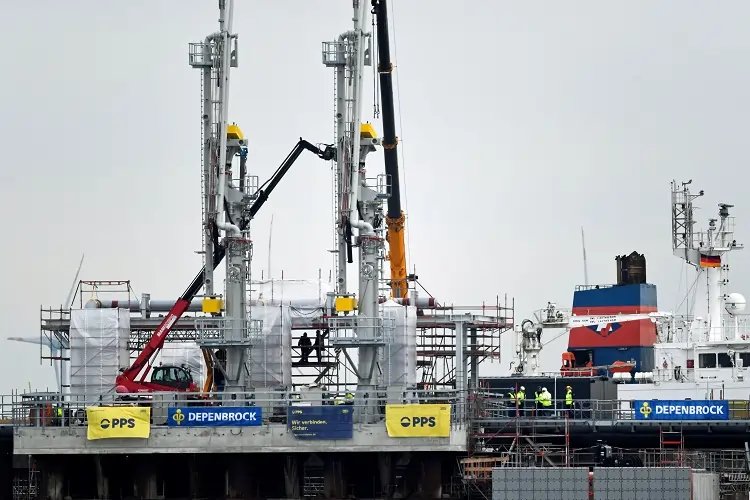
Published by Uma Rajagopal
Posted on December 18, 2024
2 min readLast updated: January 28, 2026
Add as preferred source on GoogleFRANKFURT (Reuters) – German utility industry group BDEW on Wednesday reported annual national usage of natural gas rose 3.3% in 2024 to 835 billion kilowatt hours (kWh).
FRANKFURT (Reuters) – German utility industry group BDEW on Wednesday reported annual national usage of natural gas rose 3.3% in 2024 to 835 billion kilowatt hours (kWh).
The figure is watched in the context of Germany’s growing reliance on gas imports via intra-European pipelines other than from Russia, which were halted in the Ukraine war, and on liquefied natural gas (LNG) from overseas.
Europe’s biggest economy imported 1% less gas than in the previous year, with net receipts, cleared of transit for import and export, amounting to 771 billion kWh.
Germany possesses the biggest underground storage capacity for gas in the European Union and was able to meet its demand with stocks and from small domestic fields.
The bulk of gas arriving via pipelines came from Norway, which held a share of 45.1% of national consumption, BDEW figures showed.
Some 9% of the consumption total was received at new landing terminals for liquefied and supercooled natural gas (LNG), which were built up inside Germany in the energy crisis, the BDEW data also showed.
Germany also receives pipeline gas from many other origins via import destinations elsewhere in Europe, and LNG via other EU landing terminals, where the LNG is regasified and fed into trans-European pipeline grids.
Within the LNG share, a big reliance on United States origins was manifest: 91% of the total volume was from the U.S.
Separately, in preliminary power statistics, BDEW said that gross electricity production was 488.5 billion kWh in 2024, down 2.4% year-on-year, of which 58.1% came from renewable sources.
(Reporting by Vera Eckert, editing by Rachel More and Tomasz Janowski)
Natural gas is a fossil fuel composed mainly of methane, used as an energy source for heating, electricity generation, and as fuel for vehicles.
Liquefied natural gas (LNG) is natural gas that has been cooled to a liquid state for ease of storage and transport, reducing its volume significantly.
Renewable energy sources are energy sources that are replenished naturally, such as solar, wind, hydro, and geothermal energy, and are more sustainable than fossil fuels.
Energy consumption refers to the amount of energy used by individuals, businesses, or nations, typically measured in kilowatt hours (kWh) or other units.
Energy import is the process of bringing energy resources, such as oil, gas, or electricity, from other countries to meet domestic energy needs.
Explore more articles in the Business category