Search
00
GBAF Logo
trophy
Top StoriesInterviewsBusinessFinanceBankingTechnologyInvestingTradingVideosAwardsMagazinesHeadlinesTrends

Subscribe to our newsletter

Get the latest news and updates from our team.

Global Banking and Finance Review

Global Banking & Finance Review

Company

    GBAF Logo
    • About Us
    • Profile
    • Privacy & Cookie Policy
    • Terms of Use
    • Contact Us
    • Advertising
    • Submit Post
    • Latest News
    • Research Reports
    • Press Release
    • Awards▾
      • About the Awards
      • Awards TimeTable
      • Submit Nominations
      • Testimonials
      • Media Room
      • Award Winners
      • FAQ
    • Magazines▾
      • Global Banking & Finance Review Magazine Issue 79
      • Global Banking & Finance Review Magazine Issue 78
      • Global Banking & Finance Review Magazine Issue 77
      • Global Banking & Finance Review Magazine Issue 76
      • Global Banking & Finance Review Magazine Issue 75
      • Global Banking & Finance Review Magazine Issue 73
      • Global Banking & Finance Review Magazine Issue 71
      • Global Banking & Finance Review Magazine Issue 70
      • Global Banking & Finance Review Magazine Issue 69
      • Global Banking & Finance Review Magazine Issue 66
    Top StoriesInterviewsBusinessFinanceBankingTechnologyInvestingTradingVideosAwardsMagazinesHeadlinesTrends

    Global Banking & Finance Review® is a leading financial portal and online magazine offering News, Analysis, Opinion, Reviews, Interviews & Videos from the world of Banking, Finance, Business, Trading, Technology, Investing, Brokerage, Foreign Exchange, Tax & Legal, Islamic Finance, Asset & Wealth Management.
    Copyright © 2010-2025 GBAF Publications Ltd - All Rights Reserved.

    Editorial & Advertiser disclosure

    Global Banking and Finance Review is an online platform offering news, analysis, and opinion on the latest trends, developments, and innovations in the banking and finance industry worldwide. The platform covers a diverse range of topics, including banking, insurance, investment, wealth management, fintech, and regulatory issues. The website publishes news, press releases, opinion and advertorials on various financial organizations, products and services which are commissioned from various Companies, Organizations, PR agencies, Bloggers etc. These commissioned articles are commercial in nature. This is not to be considered as financial advice and should be considered only for information purposes. It does not reflect the views or opinion of our website and is not to be considered an endorsement or a recommendation. We cannot guarantee the accuracy or applicability of any information provided with respect to your individual or personal circumstances. Please seek Professional advice from a qualified professional before making any financial decisions. We link to various third-party websites, affiliate sales networks, and to our advertising partners websites. When you view or click on certain links available on our articles, our partners may compensate us for displaying the content to you or make a purchase or fill a form. This will not incur any additional charges to you. To make things simpler for you to identity or distinguish advertised or sponsored articles or links, you may consider all articles or links hosted on our site as a commercial article placement. We will not be responsible for any loss you may suffer as a result of any omission or inaccuracy on the website.

    Home > Investing > European Asset Managers Need Strategic Rethink
    Investing

    European Asset Managers Need Strategic Rethink

    European Asset Managers Need Strategic Rethink

    Published by Gbaf News

    Posted on November 1, 2012

    Featured image for article about Investing
    By Aymeric Poizot, Managing Director, EMEA Fund and Asset Manager Ratings, Fitch Ratings.
    Asset managers are facing a difficult environment. In order to compete in Europe, they will have to focus on the areas where they are credible, demand is sustained and performance expectations are high. They will need to strengthen their key areas of expertise, scale down or outsource other areas and expand in neighbouring activities while # in new areas. Aymeric Poizot
    There has been no growth in European assets under management (both funds and mandates) in the past five years, with assets unchanged at USD18trn. In the past three years, only 40% of managers experienced fund inflows and 75 to 80% of inflows were concentrated solely among the top ten houses across asset classes
    Disaffected investors are turning their backs on managed products, while the retail sector is shifting its focus to bank deposits and institutional investors are increasingly internalising their asset management operations. These issues will be compounded over the coming months by other concerns, such as portfolios in the low yield environment being reallocated toward income generating and global assets, which is a real problem for managers focused on traditional domestic assets. Cross-border activity is also intensifying competition, with new entrants and less room for second-tier players
    Fitch believes capital markets and investor demand will be driven by structural forces over the next few years. These include bank disintermediation, Solvency II and derisking, and globalisation. As a result, the asset classes and investment strategies likely to be favoured include credit; global equity, global fixed income, global credit;  investment solutions;  multi-strategy fixed-income;  non-directional credit and equity (eg market neutral); low risk/income-oriented multi-asset; and  equity themes.
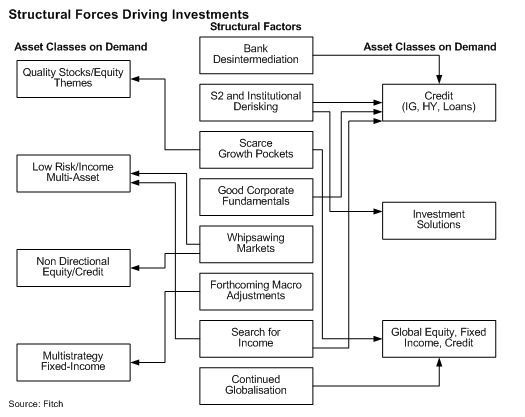
    Structural Forces
    European institutional investors are now de-risking, while seeking out yield to meet commercial or actuarial targets. Credit is particularly appealing to institutional investors, while insurers favour investment grade corporates and pension funds target high yield and emerging markets, at the expense of equity. Sub-asset classes, such as inflation linkers, tactical asset allocation funds, infrastructure or cash are benefiting from some institutional interest, notably from Dutch and UK pension funds and continental European insurers. Managers that are not well positioned on credit – notably specialties (high yield, short term, emerging markets) are likely to lose institutional market share.
    As markets change rapidly, managers must adapt quickly and well to new challenges. For example, in investment-grade credit, managers have focused on directional strategies. However, as spreads tighten, most proactive managers are now adding absolute return or market neutral strategies to their offerings
    As investor demand will focus on income generation, global products and moderate volatility products, Fitch anticipates limited growth in the core assets of domestic equity and government bonds. While investors will maintain a reasonable allocation to such assets, they will become more receptive to switching to passive strategies, or to managers with stronger track records, an active management style and diversifying profiles. Competition for such assets will be intense.
    We expect to see European asset managers re-shaping their activities in three key ways: strengthening their key areas of expertise; scaling down or outsourcing others areas; and expanding in neighbouring activities while # in new areas.

    Focusing the portfolio of expertise
    To be successful, investment strategies where demand is anticipated and where the manager is credible, will require  strengthened resources (front office, commercial, product specialists, staff with international profiles); increased critical mass (by merging funds, using master feeders, moving client money); heightened commercial efforts (referencing, distribution, communication, ratings); and adoption of international standards (funds’ benchmark, product name and domicile).

    Conversely, investment strategies where demand is expected to be weak and/or the manager lacks credibility will need to be scaled down, either by closing funds, outsourcing management or by using funds of funds or funds of mandates.

    Expanding selectively
    In order to remain competitive, asset managers in our view should not hesitate to expand into “neighbouring” activities, despite the resource and process adjustment this requires. For example, a high yield manager may consider expanding into loans, or a loan manager into high yield, as the issuer pool is similar.

    Likewise, moving into the diversified income space is a logical progression for a European equity manager, given the overlap between large-cap stocks and investment-grade credit issuers. Such a development would require the recruitment of bond portfolio managers and the set-up of a top down allocation process. Long only stock and bond pickers are also well placed to navigate sideways markets by developing absolute return offerings.

    # on long-term trends
    Bank deleveraging and globalisation should also benefit the European asset management industry. The European banks’ deleveraging process is expected to generate market financing needs representing roughly 10% to 20% of the current European investor asset base (pension funds, insurance companies, mutual funds), New areas of growth fuelled by these factors  include: global equity or bond products; emerging markets; senior secured high yield; direct lending; and real assets. Many of these are new to asset managers, who must develop scale and credibility if they wish to successfully compete in these areas. Yet in most cases, doing so demands serious investment in terms of local analysts, sourcing channels, and technical and legal knowledge. Fitch believes that acquisition and team lift out are the only viable options.

    However, developing new activities, for example in global equity or senior secured high yield, requires significant investments in terms of personnel and/or acquisitions. Managers unwilling or unable to commit in these areas now may find themselves less able to compete in the near future.

    Related Posts
     Millennials Aren’t Ignoring Retirement. They’re Rebuilding It.
    Millennials Aren’t Ignoring Retirement. They’re Rebuilding It.
    BridgeWise Launches FixedWise, the First AI Solution Bringing Granular Bond Intelligence to the European Market
    BridgeWise Launches FixedWise, the First AI Solution Bringing Granular Bond Intelligence to the European Market
    Why Financial Advisors Are Rethinking Gold Allocations
    Why Financial Advisors Are Rethinking Gold Allocations
    From Opaque to Investable: Yaniv Bertele's Blueprint for Transparent Alternatives
    From Opaque to Investable: Yaniv Bertele's Blueprint for Transparent Alternatives
    Private Equity Needs AI Advocates
    Private Equity Needs AI Advocates
    Understanding the Global Impact of Rising Medical Insurance Premiums on the Middle Class
    Understanding the Global Impact of Rising Medical Insurance Premiums on the Middle Class
    The New Model Driving Creative Investment in University Innovation
    The New Model Driving Creative Investment in University Innovation
    The return of tangible assets in modern portfolios
    The return of tangible assets in modern portfolios
    Retro Bikes And Insurance: What You Should Know?
    Retro Bikes And Insurance: What You Should Know?
    Top Stocks Powering the AI Boom in 2025
    Top Stocks Powering the AI Boom in 2025
    How often should you update your estate plan? The events that demand a refresh
    How often should you update your estate plan? The events that demand a refresh
    Top 5 Mutual Funds in the UAE: Performance, Features, and How to Invest
    Top 5 Mutual Funds in the UAE: Performance, Features, and How to Invest

    Why waste money on news and opinions when you can access them for free?

    Take advantage of our newsletter subscription and stay informed on the go!

    Subscribe

    Previous Investing PostEvolution of the new smart broker
    Next Investing PostIfas‘Concerned’ About Gender Equality Advice

    More from Investing

    Explore more articles in the Investing category

    How One Investor Learned to Find Value Through a Wider Lens

    How One Investor Learned to Find Value Through a Wider Lens

    Freedom Holding Corp’s Global Rise: Why Institutional Investors Are Betting Big

    Freedom Holding Corp’s Global Rise: Why Institutional Investors Are Betting Big

    Pro Visionary Helps Australians Strengthen Their Financial Resilience Through Licensed Wealth Strategies

    Pro Visionary Helps Australians Strengthen Their Financial Resilience Through Licensed Wealth Strategies

    How ZenInvestor Is Breaking Down Barriers to Financial Literacy and Empowering Everyday Investors Nationwide

    How ZenInvestor Is Breaking Down Barriers to Financial Literacy and Empowering Everyday Investors Nationwide

    Edward L. Shugrue III on Returning to the Office: A Cultural Shift and Investment Opportunity

    Edward L. Shugrue III on Returning to the Office: A Cultural Shift and Investment Opportunity

    How Private Capital Can Build Public Good

    How Private Capital Can Build Public Good

    Private Equity Has a Major Speed and Capacity Problem

    Private Equity Has a Major Speed and Capacity Problem

    Navigating AI Investing Tools: Wealth Management Disruption Ahead

    Navigating AI Investing Tools: Wealth Management Disruption Ahead

    MTF Trading Explained: What It Is, How It Works, and Key Benefits

    MTF Trading Explained: What It Is, How It Works, and Key Benefits

    Private Equity Has Trust Issues With AI

    Private Equity Has Trust Issues With AI

    Merifund Capital Management on FTSE 100 Gains

    Merifund Capital Management on FTSE 100 Gains

    Sycamine Capital Management sets outlook on Japan equities

    Sycamine Capital Management sets outlook on Japan equities

    View All Investing Posts