
Search
00
GBAF Logo
trophy
Top StoriesInterviewsBusinessFinanceBankingTechnologyInvestingTradingVideosAwardsMagazinesHeadlinesTrends

Subscribe to our newsletter

Get the latest news and updates from our team.

Global Banking & Finance Review®

Global Banking & Finance Review® - Subscribe to our newsletter

Company

    GBAF Logo
    • About Us
    • Advertising and Sponsorship
    • Profile & Readership
    • Contact Us
    • Latest News
    • Privacy & Cookies Policies
    • Terms of Use
    • Advertising Terms
    • Issue 81
    • Issue 80
    • Issue 79
    • Issue 78
    • Issue 77
    • Issue 76
    • Issue 75
    • Issue 74
    • Issue 73
    • Issue 72
    • Issue 71
    • Issue 70
    • View All
    • About the Awards
    • Awards Timetable
    • Awards Winners
    • Submit Nominations
    • Testimonials
    • Media Room
    • FAQ
    • Asset Management Awards
    • Brand of the Year Awards
    • Business Awards
    • Cash Management Banking Awards
    • Banking Technology Awards
    • CEO Awards
    • Customer Service Awards
    • CSR Awards
    • Deal of the Year Awards
    • Corporate Governance Awards
    • Corporate Banking Awards
    • Digital Transformation Awards
    • Fintech Awards
    • Education & Training Awards
    • ESG & Sustainability Awards
    • ESG Awards
    • Forex Banking Awards
    • Innovation Awards
    • Insurance & Takaful Awards
    • Investment Banking Awards
    • Investor Relations Awards
    • Leadership Awards
    • Islamic Banking Awards
    • Real Estate Awards
    • Project Finance Awards
    • Process & Product Awards
    • Telecommunication Awards
    • HR & Recruitment Awards
    • Trade Finance Awards
    • The Next 100 Global Awards
    • Wealth Management Awards
    • Travel Awards
    • Years of Excellence Awards
    • Publishing Principles
    • Ownership & Funding
    • Corrections Policy
    • Editorial Code of Ethics
    • Diversity & Inclusion Policy
    • Fact Checking Policy
    Original content: Global Banking and Finance Review - https://www.globalbankingandfinance.com

    A global financial intelligence and recognition platform delivering authoritative insights, data-driven analysis, and institutional benchmarking across Banking, Capital Markets, Investment, Technology, and Financial Infrastructure.

    Copyright © 2010-2026 - All Rights Reserved. | Sitemap | Tags

    Editorial & Advertiser disclosure

    Global Banking & Finance Review® is an online platform offering news, analysis, and opinion on the latest trends, developments, and innovations in the banking and finance industry worldwide. The platform covers a diverse range of topics, including banking, insurance, investment, wealth management, fintech, and regulatory issues. The website publishes news, press releases, opinion and advertorials on various financial organizations, products and services which are commissioned from various Companies, Organizations, PR agencies, Bloggers etc. These commissioned articles are commercial in nature. This is not to be considered as financial advice and should be considered only for information purposes. It does not reflect the views or opinion of our website and is not to be considered an endorsement or a recommendation. We cannot guarantee the accuracy or applicability of any information provided with respect to your individual or personal circumstances. Please seek Professional advice from a qualified professional before making any financial decisions. We link to various third-party websites, affiliate sales networks, and to our advertising partners websites. When you view or click on certain links available on our articles, our partners may compensate us for displaying the content to you or make a purchase or fill a form. This will not incur any additional charges to you. To make things simpler for you to identity or distinguish advertised or sponsored articles or links, you may consider all articles or links hosted on our site as a commercial article placement. We will not be responsible for any loss you may suffer as a result of any omission or inaccuracy on the website.

    1. Home
    2. >Banking
    3. >Biometrics Is the Fraud-Fighting Superhero Banks Deserve
    Banking

    Biometrics Is the Fraud-Fighting Superhero Banks Deserve

    Published by Jessica Weisman-Pitts

    Posted on May 9, 2022

    4 min read

    Last updated: February 7, 2026

    Add as preferred source on Google
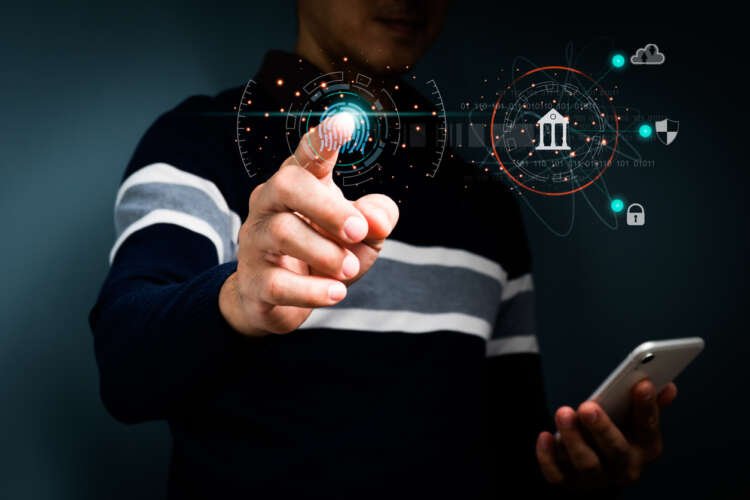
    Image showcasing business professionals using biometric identification to access personal financial data, emphasizing the role of biometrics in combating fraud in banking.
    Business professionals utilizing biometric technology for secure banking access - Global Banking & Finance Review
    Why waste money on news and opinion when you can access them for free?

    Take advantage of our newsletter subscription and stay informed on the go!

    Subscribe

    Tags:innovationtechnologysecurityfraud preventionbiometrics

    By Sanjay Gupta, SVP and Managing Director, HooYu at Mitek Systems

    You may have received a call recently from a breathless IRS employee. They claim you owe back taxes and that if you don’t pay soon the IRS will come after you. The caller, of course, is a fraudulent actor. The IRS only contacts taxpayers via mail correspondence. Unfortunately, plenty of people proceed to give these fraudsters personal information. Some even transfer the requested dollar amount.

    Even if one stops short of wiring money to the fraudster’s account, the damage is already done if the criminal acquires personally identifiable information (PII). Today’s criminals are becoming more adept at collecting PII from unwitting strangers to commit identity theft and eventually crimes such as credit card, loan, or phone or utilities fraud.

    Attempts such as phony IRS calls are particularly effective because they target individuals during moments of duress: “Oh, no! I owe how much in back taxes?” Someone in a state of panic is more likely to hand over the proverbial keys to their account. They’re focused on finding a way out of a bad situation and allow security practices to fall by the wayside.

    Fraudsters can then use that PII to mimic a real person and open a credit card account or take over an existing account. After a few months of regular payments, they max out the line of credit and ditch the account. Now, there are two victims of identity theft: the individual whose identity was stolen and the bank, which is owed a debt it cannot collect.

    Financial services firms are incentivized to protect both themselves and their customers from fraud. But criminals are becoming more sophisticated in their attack methods. Increasingly, todays’ fraudsters use tactics like the phony IRS call to create synthetic identities. By combining made-up information, stolen real or slightly modified PII and information they purchase on the dark web, fraudulent actors can create legitimate-looking online identities. Unfortunately for banks trying to protect customers and their own lines of credit, up to 95% of synthetic identities beat the systems designed to stop fraud.

    Financial services firms must rethink their approach to fraud detection and leverage technology that can stop methods like synthetic fraud in its tracks.

    Right now, banks often rely solely on static PII, such as social security numbers, at account origination. Or they lean on credit bureau information for fraud detection. Most have enabled two-factor identification for logging into digital platforms. But the two factors are typically a static password and texted numerical code. These approaches will not work when criminals have that information readily available.

    Instead, financial services firms should employ solutions that incorporate AI-driven verification technology like biometrics to continuously authenticate their customers’ identities and catch fraud as it happens, if not before. This might be as simple as two-factor authentication that requires a customer to take a selfie, along with inputting their password, to log into their banking app. Liveness detection technology can also analyze voice cues in real-time to verify that an actual human is logging into an app or using an ATM. Fraudsters would need to obtain PII and look and speak exactly like the person they’re mimicking to breach that sort of biometric firewall.

    Other biometric-based approaches analyze behavior, such as how a person types, what words and phrases they use often in correspondence and their internet activity to develop a unique digital fingerprint. Even if a phony IRS call extracts PII, the criminal with that information has no way of replicating typing patterns or someone’s unique lexicon.

    Whether behavioral analytics or liveness detection tools, financial services firms should consider employing biometrics to fight fraud and reduce account takeover because facial patterns are infinitely more complex than six-digit passcodes. Criminals are too sophisticated and PII is too readily available for yesterday’s fraud-detection models to withstand modern defrauders’ attempts. Moving forward, banks must focus on getting their technology right. They must proactively future proof their identity verification processes against modern fraudsters. It’s the only way to protect themselves and their customers.

    Frequently Asked Questions about Biometrics Is the Fraud-Fighting Superhero Banks Deserve

    1What is biometric authentication?

    Biometric authentication is a security process that uses unique biological characteristics, such as fingerprints or facial recognition, to verify a person's identity.

    2What is identity theft?

    Identity theft occurs when someone unlawfully obtains and uses another person's personal information, typically for financial gain.

    3What is synthetic identity fraud?

    Synthetic identity fraud involves the creation of a fake identity using a combination of real and fictitious information to commit fraud.

    4What is two-factor authentication?

    Two-factor authentication is a security measure that requires two forms of verification before granting access, typically combining something you know (like a password) with something you have (like a mobile device).

    5What is personally identifiable information (PII)?

    Personally identifiable information (PII) refers to any data that can be used to identify an individual, such as names, social security numbers, or financial information.

    More from Banking

    Explore more articles in the Banking category

    Image for Nominate Today for the Leadership Awards 2026
    Nominate Today for the Leadership Awards 2026
    Image for Submit Your Entries for Insurance & Takaful Awards 2026
    Submit Your Entries for Insurance & Takaful Awards 2026
    Image for Calling for Entries: ESG & Sustainability Awards 2026
    Calling for Entries: ESG & Sustainability Awards 2026
    Image for Call for Entries: Deal of the Year Awards 2026
    Call for Entries: Deal of the Year Awards 2026
    Image for Submit Your Entry Today for Customer Service Awards 2026
    Submit Your Entry Today for Customer Service Awards 2026
    Image for Submit Your Entry Today for CSR Awards 2026
    Submit Your Entry Today for CSR Awards 2026
    Image for Submit Your Entry Today for Retail Banking Awards 2026
    Submit Your Entry Today for Retail Banking Awards 2026
    Image for Nominations Open for Islamic Banking Awards 2026
    Nominations Open for Islamic Banking Awards 2026
    Image for Submit Your Entry Today for Fund & Asset Management Awards 2026
    Submit Your Entry Today for Fund & Asset Management Awards 2026
    Image for Entries Open for Forex Banking Awards 2026
    Entries Open for Forex Banking Awards 2026
    Image for Call for Entries for Brand of the Year Awards 2026
    Call for Entries for Brand of the Year Awards 2026
    Image for Nominations Open for Corporate Banking Awards 2026
    Nominations Open for Corporate Banking Awards 2026
    View All Banking Posts
    Previous Banking PostOverdraft Reform: A Guide to the Essential Elements Needed
    Next Banking PostNew Czech Central Bank Governor to Be Named on Wednesday, No Name Given






