Search
00
GBAF Logo
trophy
Top StoriesInterviewsBusinessFinanceBankingTechnologyInvestingTradingVideosAwardsMagazinesHeadlinesTrends

Subscribe to our newsletter

Get the latest news and updates from our team.

Global Banking and Finance Review

Global Banking & Finance Review

Company

    GBAF Logo
    • About Us
    • Profile
    • Privacy & Cookie Policy
    • Terms of Use
    • Contact Us
    • Advertising
    • Submit Post
    • Latest News
    • Research Reports
    • Press Release
    • Awards▾
      • About the Awards
      • Awards TimeTable
      • Submit Nominations
      • Testimonials
      • Media Room
      • Award Winners
      • FAQ
    • Magazines▾
      • Global Banking & Finance Review Magazine Issue 79
      • Global Banking & Finance Review Magazine Issue 78
      • Global Banking & Finance Review Magazine Issue 77
      • Global Banking & Finance Review Magazine Issue 76
      • Global Banking & Finance Review Magazine Issue 75
      • Global Banking & Finance Review Magazine Issue 73
      • Global Banking & Finance Review Magazine Issue 71
      • Global Banking & Finance Review Magazine Issue 70
      • Global Banking & Finance Review Magazine Issue 69
      • Global Banking & Finance Review Magazine Issue 66
    Top StoriesInterviewsBusinessFinanceBankingTechnologyInvestingTradingVideosAwardsMagazinesHeadlinesTrends

    Global Banking & Finance Review® is a leading financial portal and online magazine offering News, Analysis, Opinion, Reviews, Interviews & Videos from the world of Banking, Finance, Business, Trading, Technology, Investing, Brokerage, Foreign Exchange, Tax & Legal, Islamic Finance, Asset & Wealth Management.
    Copyright © 2010-2025 GBAF Publications Ltd - All Rights Reserved.

    Editorial & Advertiser disclosure

    Global Banking and Finance Review is an online platform offering news, analysis, and opinion on the latest trends, developments, and innovations in the banking and finance industry worldwide. The platform covers a diverse range of topics, including banking, insurance, investment, wealth management, fintech, and regulatory issues. The website publishes news, press releases, opinion and advertorials on various financial organizations, products and services which are commissioned from various Companies, Organizations, PR agencies, Bloggers etc. These commissioned articles are commercial in nature. This is not to be considered as financial advice and should be considered only for information purposes. It does not reflect the views or opinion of our website and is not to be considered an endorsement or a recommendation. We cannot guarantee the accuracy or applicability of any information provided with respect to your individual or personal circumstances. Please seek Professional advice from a qualified professional before making any financial decisions. We link to various third-party websites, affiliate sales networks, and to our advertising partners websites. When you view or click on certain links available on our articles, our partners may compensate us for displaying the content to you or make a purchase or fill a form. This will not incur any additional charges to you. To make things simpler for you to identity or distinguish advertised or sponsored articles or links, you may consider all articles or links hosted on our site as a commercial article placement. We will not be responsible for any loss you may suffer as a result of any omission or inaccuracy on the website.

    Home > Trading > Best Execution in the US: Three Things Broker-Dealers Need to Think About
    Trading

    Best Execution in the US: Three Things Broker-Dealers Need to Think About

    Best Execution in the US: Three Things Broker-Dealers Need to Think About

    Published by Gbaf News

    Posted on October 18, 2019

    Featured image for article about Trading

    By: John Jannes, Executive Director of Trading Analytics at IHS Markit

    As we head into 2020, US broker-dealers are preparing for new mandates on how they report transactions back to customers. The requirements – established by the Securities and Exchange Commission’s (SEC) updates to Rule 606 – aim to bring investors greater transparency and an assurance that orders are handled in line with the principles of best execution.

    For background, the SEC delayed the implementation of these requirements several times, most recently in September. As of today, broker-dealers are looking towards staggered go-live dates of January 1 2020 for 606a and a simplified version of 606b3, and April 1 2020 for full 606b3 including look-through data, which leaves no time to waste in gathering data from downstream brokers, and more broadly, determining which methods of data collection will be used going forward.

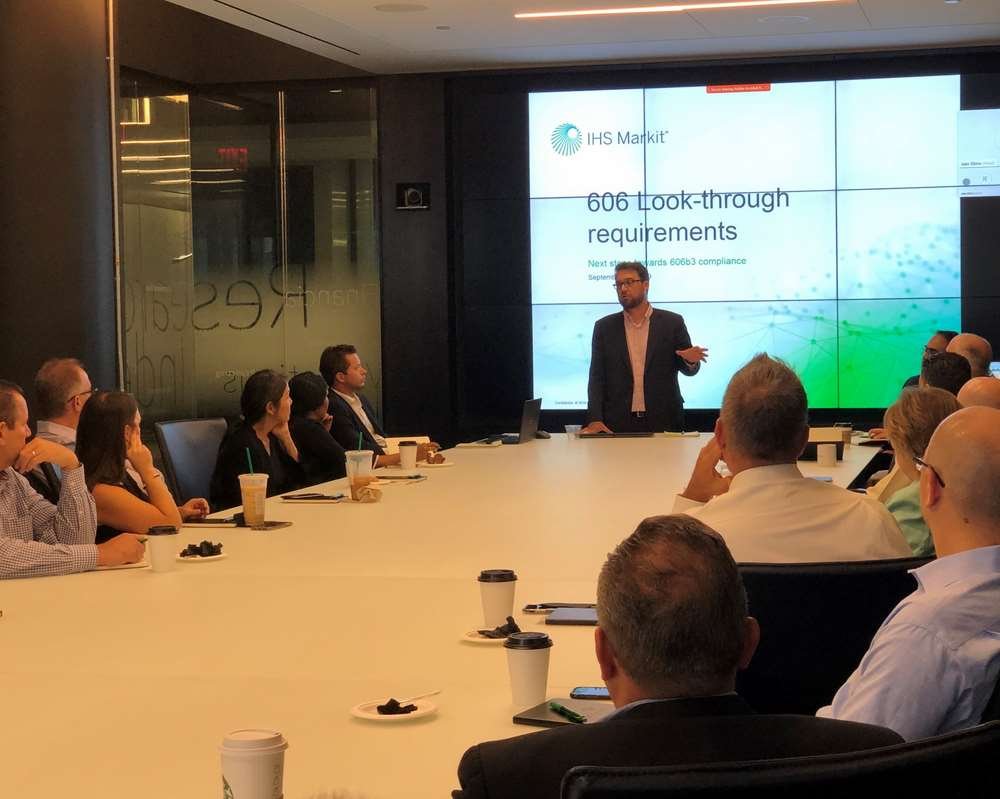
    To address the comprehensive implications of the updates to Rule 606, IHS Markit recently hosted an industry roundtable in New York, where we discussed best practices for meeting the SEC’s requirements.

    Here are three key takeaways that broker-dealers need to think about:

    1. Now is the time to have conversations with your downstream brokers and venues

    It’s difficult to proceed without knowing the level of data and details downstream brokers and venues will be able to provide. By engaging with your counterparties, you’ll be able to discuss the depth of required look-through data and the means of facilitating it to interested parties. In order to stay compliant with 606(b)(3), brokers can only trade with execution service providers who are willing and able to provide downstream route data. It is likely that different execution service providers will have differing approaches to delivering look-through data because there is no SEC template for look-through, and there are some pros and cons to each approach.

    Our discussion at the roundtable showed that most participants are still in the early stages of internal discussion regarding look-through data, and generally have not yet started the conversation with execution service providers. Across the board, there was concern about exposing sensitive information to counterparties, which many firms plan to mitigate through the use of vendor provided technology instead of home-grown solutions.

    1. Start gathering the required look through data

    Broker-dealers who use downstream brokers for execution services will have some challenges in acquiring and processing look-through data. There are two options for receiving data from downstream brokers: aggregated, or raw.

    In practice, this will force firms to consider how implementation is going to work and weigh the various implications of potentially exposing investor identity, revealing routing logic intellectual property, and grappling with the inherent complexity of manipulating and reconciling large datasets.

    1. Understand the two options to obtain and process downstream execution data

    There are two basic formats of receiving data: aggregated data and raw data.

    Option one is to receive aggregated data from downstream brokers, either aggregated by customer, month and venue, or by order number, venue and trade date.

    The positives of aggregating by customer, month and venue are that the SEC’s XML format can be used, which downstream brokers usually support for their own reporting anyway, and that it represents the highest possible level of aggregation, therefore divulging the least amount of proprietary routing logic from the perspective of the downstream broker.

    The negatives are that a customer ID must be supplied, potentially exposing sensitive client information to the downstream broker, and since the it is the highest level of aggregation, it is also the most challenging to reconcile between reporting and downstream brokers.

    The positives of aggregating by order number, venue and trade date are that the downstream broker’s routing logic is still somewhat protected, and at the same time the investor’s identity is also protected.

    The negatives are that special logic must be created by both the downstream broker and the reporting broker, or vendor, to fully process the data, and to a certain extent reconciliation may be challenging at times – as it always is when working off of aggregated records (though less difficult than when aggregated by customer, month and venue).

    Option two is to receive raw data, either provided by a broker or given through an intermediary aggregator.

    The positives of receiving raw data directly from the broker are that no special logic needs to be created by the downstream broker, and very little additional logic is required by the reporting broker (or its vendor). It allows for full reconciliation and can later be used for full scale performance and venue analysis.

    The negatives are that it increases data processing volume for the reporting broker and potentially exposes the downstream broker’s proprietary routing logic.

    Based on these takeaways, it’s clear that the revised data requirements for Rule 606 are substantial – without delay, broker-dealers need to evaluate their capacity for managing this in-house or through an external provider. While the SEC’s delay provides some temporary relief, 2020 is just around the corner, and the New Year will be here in the blink of an eye.

    Related Posts
    What Is a Liquidity Provider – And Why Modern Brokers Can’t Function Without One
    What Is a Liquidity Provider – And Why Modern Brokers Can’t Function Without One
    OneFunded: Prop Firm Overview and Program Structure
    OneFunded: Prop Firm Overview and Program Structure
    What if You Can Actually Chat with Your Crypto Wallet?
    What if You Can Actually Chat with Your Crypto Wallet?
    The Growing Importance of Choosing the Right Crypto Broker in 2025
    The Growing Importance of Choosing the Right Crypto Broker in 2025
    The Rise of Algorithmic Trading Among Retail Investors in the UK
    The Rise of Algorithmic Trading Among Retail Investors in the UK
    Forex Trading for the 9-to-5er: A Realistic Path to a Second Income
    Forex Trading for the 9-to-5er: A Realistic Path to a Second Income
    Quality Matters: ZiNRai’s Focus on Empowering Traders with Precision and Purpose
    Quality Matters: ZiNRai’s Focus on Empowering Traders with Precision and Purpose
    MiCA Regulations and the Legal Requirements for Crypto Presales and Token Offerings in the European Union
    MiCA Regulations and the Legal Requirements for Crypto Presales and Token Offerings in the European Union
    Top Ways Forex Traders Benefit From Peer-to-Peer Learning
    Top Ways Forex Traders Benefit From Peer-to-Peer Learning
    Why High Leverage Remains Attractive to Forex Traders Worldwide
    Why High Leverage Remains Attractive to Forex Traders Worldwide
    XDC Network’s ETP Listing Signals the Maturing Convergence of Blockchain and Trade Finance
    XDC Network’s ETP Listing Signals the Maturing Convergence of Blockchain and Trade Finance
    Inside the Perp DEX Landscape: How Platforms Like Grvt and Hyperliquid Are Shaping Their Long-Term Vision
    Inside the Perp DEX Landscape: How Platforms Like Grvt and Hyperliquid Are Shaping Their Long-Term Vision

    Why waste money on news and opinions when you can access them for free?

    Take advantage of our newsletter subscription and stay informed on the go!

    Subscribe

    Previous Trading PostThe Race to Regulation
    Next Trading PostA Guide on How to Buy and Sell Crypto Without Losing Your Funds in a Hack

    More from Trading

    Explore more articles in the Trading category

    Blending Theory and Practice: Building Stronger Forex Strategies

    Blending Theory and Practice: Building Stronger Forex Strategies

    Strategies for Professional CFD Traders: Tools and Company Support

    Strategies for Professional CFD Traders: Tools and Company Support

    Trust as the Cornerstone of Capital Markets

    Trust as the Cornerstone of Capital Markets

    UK Investors Reassess Trading Venues as Liquidity Shifts

    UK Investors Reassess Trading Venues as Liquidity Shifts

    Bitcoin Price Live: What Factors Influence Its Value?

    Bitcoin Price Live: What Factors Influence Its Value?

    Offshore Forex Brokers vs. U.S.-Regulated Brokers: A Risk Assessment

    Offshore Forex Brokers vs. U.S.-Regulated Brokers: A Risk Assessment

    The Broker Expo, Its Role in the Small Business World, and Everest Business Funding’s Role as Sponsor

    The Broker Expo, Its Role in the Small Business World, and Everest Business Funding’s Role as Sponsor

    Finding Your Edge with a Crypto-First Prop Firm

    Finding Your Edge with a Crypto-First Prop Firm

    Evaluating the Most Reliable Tools for Tracking Real-Time Cryptocurrency Prices

    Evaluating the Most Reliable Tools for Tracking Real-Time Cryptocurrency Prices

    MT5 vs MT4: Why More Brokers Are Moving to MetaTrader 5

    MT5 vs MT4: Why More Brokers Are Moving to MetaTrader 5

    From Central Banks to Retail Traders: Who Drives the Forex Market?

    From Central Banks to Retail Traders: Who Drives the Forex Market?

    Building a Winning Forex Portfolio: Tools and Resources You Can’t Ignore

    Building a Winning Forex Portfolio: Tools and Resources You Can’t Ignore

    View All Trading Posts