Search
00
GBAF Logo
trophy
Top StoriesInterviewsBusinessFinanceBankingTechnologyInvestingTradingVideosAwardsMagazinesHeadlinesTrends

Subscribe to our newsletter

Get the latest news and updates from our team.

Global Banking and Finance Review

Global Banking & Finance Review

Company

    GBAF Logo
    • About Us
    • Profile
    • Privacy & Cookie Policy
    • Terms of Use
    • Contact Us
    • Advertising
    • Submit Post
    • Latest News
    • Research Reports
    • Press Release
    • Awards▾
      • About the Awards
      • Awards TimeTable
      • Submit Nominations
      • Testimonials
      • Media Room
      • Award Winners
      • FAQ
    • Magazines▾
      • Global Banking & Finance Review Magazine Issue 79
      • Global Banking & Finance Review Magazine Issue 78
      • Global Banking & Finance Review Magazine Issue 77
      • Global Banking & Finance Review Magazine Issue 76
      • Global Banking & Finance Review Magazine Issue 75
      • Global Banking & Finance Review Magazine Issue 73
      • Global Banking & Finance Review Magazine Issue 71
      • Global Banking & Finance Review Magazine Issue 70
      • Global Banking & Finance Review Magazine Issue 69
      • Global Banking & Finance Review Magazine Issue 66
    Top StoriesInterviewsBusinessFinanceBankingTechnologyInvestingTradingVideosAwardsMagazinesHeadlinesTrends

    Global Banking & Finance Review® is a leading financial portal and online magazine offering News, Analysis, Opinion, Reviews, Interviews & Videos from the world of Banking, Finance, Business, Trading, Technology, Investing, Brokerage, Foreign Exchange, Tax & Legal, Islamic Finance, Asset & Wealth Management.
    Copyright © 2010-2025 GBAF Publications Ltd - All Rights Reserved.

    ;
    Editorial & Advertiser disclosure

    Global Banking and Finance Review is an online platform offering news, analysis, and opinion on the latest trends, developments, and innovations in the banking and finance industry worldwide. The platform covers a diverse range of topics, including banking, insurance, investment, wealth management, fintech, and regulatory issues. The website publishes news, press releases, opinion and advertorials on various financial organizations, products and services which are commissioned from various Companies, Organizations, PR agencies, Bloggers etc. These commissioned articles are commercial in nature. This is not to be considered as financial advice and should be considered only for information purposes. It does not reflect the views or opinion of our website and is not to be considered an endorsement or a recommendation. We cannot guarantee the accuracy or applicability of any information provided with respect to your individual or personal circumstances. Please seek Professional advice from a qualified professional before making any financial decisions. We link to various third-party websites, affiliate sales networks, and to our advertising partners websites. When you view or click on certain links available on our articles, our partners may compensate us for displaying the content to you or make a purchase or fill a form. This will not incur any additional charges to you. To make things simpler for you to identity or distinguish advertised or sponsored articles or links, you may consider all articles or links hosted on our site as a commercial article placement. We will not be responsible for any loss you may suffer as a result of any omission or inaccuracy on the website.

    Home > Banking > Bank of England cuts rates but sees higher inflation after Reeves’s budget
    Banking

    Bank of England cuts rates but sees higher inflation after Reeves’s budget

    Bank of England cuts rates but sees higher inflation after Reeves’s budget

    Published by Uma Rajagopal

    Posted on November 8, 2024

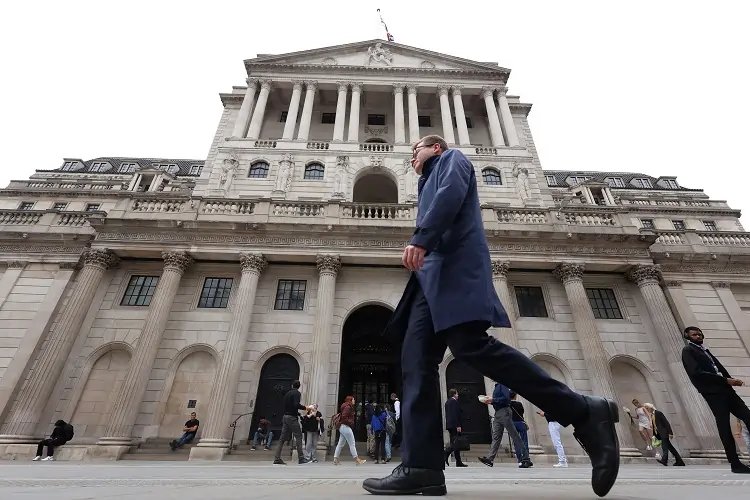
    Featured image for article about Banking

    By Andy Bruce, Suban Abdulla, David Milliken

    LONDON (Reuters) -The Bank of England cut interest rates on Thursday for only the second time since 2020 and said future reductions were likely to be gradual as it predicted the British government’s first budget would lead to higher inflation and economic growth.

    The Monetary Policy Committee voted 8-1 to cut rates to 4.75% from 5%. Analysts polled by Reuters had expected a 7-2 vote. Only Catherine Mann favoured keeping rates on hold.

    Sterling rose by two-thirds of a cent against the U.S. dollar but investors kept their expectations for rate cuts in 2025 largely unchanged.

    BoE Governor Andrew Bailey said “we can’t cut interest rates too quickly or by too much” but added: “If the economy evolves as we expect it’s likely that interest rates will continue to fall gradually from here.”

    Bailey told reporters the BoE might cut rates faster if inflation continued to undershoot the central bank’s forecasts.

    The BoE began cutting borrowing costs in August after seeing signs inflation pressures were easing, but stressed it was moving cautiously. In September it kept rates on hold.

    Last week’s budget, with its heavy borrowing and spending, prompted investors to dial back their bets on the pace of further rate cuts. Bailey said he did not think that path would be “particularly different” due to the budget.

    The BoE said the government’s plans were likely to add almost half a percentage point to inflation at its peak in just over two years’ time and cause it to take a year longer to return sustainably to the central bank’s 2% target.

    The budget would also boost the size of Britain’s economy by about 0.75% next year but barely improve annual growth rates in two or three years’ time, the BoE said.

    Finance minister Rachel Reeves and Prime Minister Keir Starmer, elected in July, have put stronger growth at the centre of their plans.

    Reeves said families would welcome Thursday’s rate cut.

    Despite big spending increases in last week’s UK budget, the Bank of England has signalled that it’s not a game changer for future interest rate cuts,” ING economist James Smith said.

    “We think the Bank will keep rates on hold in December but accelerate the pace of cuts from February onwards.”

    WATCHING FOR TRUMP POLICIES

    The BoE did not refer in its statement to Donald Trump’s U.S. election victory, which has prompted a big reduction in bets that the Federal Reserve will cut rates aggressively.

    Bailey said he would watch for Trump’s trade policies but it was too early to draw conclusions. The president-elect has proposed sweeping import tariffs.

    “The upward pressure on inflation from the budget and growing global risks, including possible new U.S. tariffs, could mean that policy is loosened more modestly,” Suren Thiru, economics director at the Institute of Chartered Accountants in England and Wales, said.

    Investors think the BoE is likely to cut interest rates more slowly than the European Central Bank. The Fed is expected to reduce rates by a quarter of a percentage point on Thursday.

    After the rate decision, financial markets priced between two and three rate cuts from the BoE in 2025, similar to earlier on Thursday and down from around four before the budget.

    HIGHER INFLATION AFTER BUDGET

    The BoE said inflation was likely to rise to around 2.5% by the end of 2024 from 1.7% in September and 2.7% by the end of 2025 before falling gradually below its 2% target in mid-2027.

    Government decisions to raise a cap on bus fares, hike value-added tax on private school fees and increase employers’ social security contributions were likely to boost inflation.

    Together with a 6.7% hike in the national minimum wage, the BoE said employers faced rising costs. But how they will respond remains unclear, Bailey said.

    Two of Britain’s biggest businesses, BT and Sainsbury’s, said tax changes in the budget would fuel inflation.

    Bailey said the central bank’s key gauge of price pressure – inflation in the services sector – remained too high.

    While the BoE cut its forecast for average economic growth this year to 1% from 1.25%, reflecting recent revisions to past growth, it raised its forecast for 2025 to 1.5% from 1%.

    “This reflects the stronger, and relatively front-loaded, paths for government consumption and investment more than offsetting the impact on growth of higher taxes,” the BoE said.

    While the BoE’s growth and inflation forecasts include the impact of higher spending and taxes, they do not incorporate the effect of a big rise in market borrowing costs since the budget.

    If now-higher market interest rates were factored in, the outlook for inflation and growth would likely be a bit lower.

    The BoE said it stuck with its existing forecasting convention to smooth out market volatility, and would reconsider market interest rates in December.

    (Additional reporting by Catarina Demoney, Muvija M and Alistair Smout; Writing by Andy Bruce and William Schomberg; Editing by Catherine Evans)

    Related Posts
    DeFi and banking are converging. Here’s what banks can do.
    DeFi and banking are converging. Here’s what banks can do.
    Are Neo Banks Offering Better Metal Debit Cards Than Traditional Banks?
    Are Neo Banks Offering Better Metal Debit Cards Than Traditional Banks?
    Banking at the Intersection: From Nashville to Cannes, A Strategic Call to Action
    Banking at the Intersection: From Nashville to Cannes, A Strategic Call to Action
    Driving Efficiency and Profit Through Customer-Centric Banking
    Driving Efficiency and Profit Through Customer-Centric Banking
    How Ecosystem Partnerships Are Redefining Deposit Products
    How Ecosystem Partnerships Are Redefining Deposit Products
    CIBC Private Banking wins four 2025 Global Banking & Finance Awards
    CIBC Private Banking wins four 2025 Global Banking & Finance Awards
    How Banks Can Put AI to Work Now and Prove ROI in 90 Days
    How Banks Can Put AI to Work Now and Prove ROI in 90 Days
    Top 5 AI quality assurance framework providers for Banks and Financial Services firms.
    Top 5 AI quality assurance framework providers for Banks and Financial Services firms.
    The Unbanked Paradox: How Banking Access Creates Economic Resilience
    The Unbanked Paradox: How Banking Access Creates Economic Resilience
    Hyper-Personalised Banking - Shaping the Future of Finance
    Hyper-Personalised Banking - Shaping the Future of Finance
    The End of Voice Trust: How AI Deepfakes Are Forcing Banks to Rethink Authentication
    The End of Voice Trust: How AI Deepfakes Are Forcing Banks to Rethink Authentication
    Predicting and Preventing Customer Churn in Retail Banking
    Predicting and Preventing Customer Churn in Retail Banking

    Why waste money on news and opinions when you can access them for free?

    Take advantage of our newsletter subscription and stay informed on the go!

    Subscribe

    Previous Banking PostNo reason not to cut rates in Dec as of now, ECB’s Holzmann tells paper
    Next Banking PostGreece’s Alpha Bank posts higher 9-month profit on lower provisions, strong income

    More from Banking

    Explore more articles in the Banking category

    Growth and Impact: Banreservas Leads Dominican Republic Economic Expansion

    Growth and Impact: Banreservas Leads Dominican Republic Economic Expansion

    Turning Insight into Impact: Making AI and Analytics Work in Retail Banking

    Turning Insight into Impact: Making AI and Analytics Work in Retail Banking

    KeyBank Embraces Next-Generation AI Platform to Transform Fraud and Financial Crime Prevention

    KeyBank Embraces Next-Generation AI Platform to Transform Fraud and Financial Crime Prevention

    Understanding Association Banking: Financial Solutions for Community Success

    Understanding Association Banking: Financial Solutions for Community Success

    Applying Symbiosis for advantage in APAC banking

    Applying Symbiosis for advantage in APAC banking

    AmBank Islamic Berhad Earns Triple Recognition for Excellence in Islamic Banking

    AmBank Islamic Berhad Earns Triple Recognition for Excellence in Islamic Banking

    FinTok Strategy: How Banks Are Reaching Gen Z Through Social Media

    FinTok Strategy: How Banks Are Reaching Gen Z Through Social Media

    Rethinking Retail Banking Sustainability: Why the ATM is an Asset in the Sustainable Transition

    Rethinking Retail Banking Sustainability: Why the ATM is an Asset in the Sustainable Transition

    How private banks can survive the neo-broker revolution

    How private banks can survive the neo-broker revolution

    Next-Gen Bank Branches: The Evolution from Transaction Hubs to Experience Centers

    Next-Gen Bank Branches: The Evolution from Transaction Hubs to Experience Centers

    The Banking Talent Crunch: How Financial Institutions Are Competing for Digital-Native Skills

    The Banking Talent Crunch: How Financial Institutions Are Competing for Digital-Native Skills

    Beyond Interest: How Banks Are Reimagining Revenue in the Digital Age

    Beyond Interest: How Banks Are Reimagining Revenue in the Digital Age

    View All Banking Posts