Search
00
GBAF Logo
trophy
Top StoriesInterviewsBusinessFinanceBankingTechnologyInvestingTradingVideosAwardsMagazinesHeadlinesTrends

Subscribe to our newsletter

Get the latest news and updates from our team.

Global Banking and Finance Review

Global Banking & Finance Review

Company

    GBAF Logo
    • About Us
    • Profile
    • Privacy & Cookie Policy
    • Terms of Use
    • Contact Us
    • Advertising
    • Submit Post
    • Latest News
    • Research Reports
    • Press Release
    • Awards▾
      • About the Awards
      • Awards TimeTable
      • Submit Nominations
      • Testimonials
      • Media Room
      • Award Winners
      • FAQ
    • Magazines▾
      • Global Banking & Finance Review Magazine Issue 79
      • Global Banking & Finance Review Magazine Issue 78
      • Global Banking & Finance Review Magazine Issue 77
      • Global Banking & Finance Review Magazine Issue 76
      • Global Banking & Finance Review Magazine Issue 75
      • Global Banking & Finance Review Magazine Issue 73
      • Global Banking & Finance Review Magazine Issue 71
      • Global Banking & Finance Review Magazine Issue 70
      • Global Banking & Finance Review Magazine Issue 69
      • Global Banking & Finance Review Magazine Issue 66
    Top StoriesInterviewsBusinessFinanceBankingTechnologyInvestingTradingVideosAwardsMagazinesHeadlinesTrends

    Global Banking & Finance Review® is a leading financial portal and online magazine offering News, Analysis, Opinion, Reviews, Interviews & Videos from the world of Banking, Finance, Business, Trading, Technology, Investing, Brokerage, Foreign Exchange, Tax & Legal, Islamic Finance, Asset & Wealth Management.
    Copyright © 2010-2025 GBAF Publications Ltd - All Rights Reserved.

    Editorial & Advertiser disclosure

    Global Banking and Finance Review is an online platform offering news, analysis, and opinion on the latest trends, developments, and innovations in the banking and finance industry worldwide. The platform covers a diverse range of topics, including banking, insurance, investment, wealth management, fintech, and regulatory issues. The website publishes news, press releases, opinion and advertorials on various financial organizations, products and services which are commissioned from various Companies, Organizations, PR agencies, Bloggers etc. These commissioned articles are commercial in nature. This is not to be considered as financial advice and should be considered only for information purposes. It does not reflect the views or opinion of our website and is not to be considered an endorsement or a recommendation. We cannot guarantee the accuracy or applicability of any information provided with respect to your individual or personal circumstances. Please seek Professional advice from a qualified professional before making any financial decisions. We link to various third-party websites, affiliate sales networks, and to our advertising partners websites. When you view or click on certain links available on our articles, our partners may compensate us for displaying the content to you or make a purchase or fill a form. This will not incur any additional charges to you. To make things simpler for you to identity or distinguish advertised or sponsored articles or links, you may consider all articles or links hosted on our site as a commercial article placement. We will not be responsible for any loss you may suffer as a result of any omission or inaccuracy on the website.

    Home > Investing > Asia stocks stagger up from lows, mood fragile
    Investing

    Asia stocks stagger up from lows, mood fragile

    Asia stocks stagger up from lows, mood fragile

    Published by maria gbaf

    Posted on August 23, 2021

    Featured image for article about Investing

    By Wayne Cole

    SYDNEY (Reuters) – Asian shares bounced on Monday as a wave of bargain hunting swept beaten-down markets and China reported no new locally acquired COVID-19 cases for the first time since July, though the mood remained brittle overall.

    A raft of “flash” manufacturing surveys for August out on Monday will offer an early indication of how global growth is faring in the face of the Delta variant, with analysts expecting some slippage and especially in Asia.

    Japan’s factory activity growth slowed in August, while that of the services sector shrank at the fastest pace since May last year, highlighting the toll from COVID-19 measures on the economy.

    “Following a strong V-shaped recovery, there are many signs of slower growth,” says BofA’s chief investment strategist Michael Hartnett. “The U.S. yield curve is at a one-year low, emerging markets are negative YTD and both copper and oil are down double digits from recent highs.”

    He expects negative returns for stocks and credit in the rest of this year and suggests investors own defensive quality.

    Concerns over China’s economy have only intensified in recent weeks, while Beijing’s regulatory crackdown on the tech sector delivered a double blow to markets.

    More than $560 billion was wiped from Hong Kong and mainland China exchanges last week as funds fretted on which sectors regulators might target next.

    Beijing is considering pressing data-rich companies to hand over management and supervision of their data to third-party firms if they want U.S. stock listings, sources told Reuters.

    The impact has been evident in MSCI’s broadest index of Asia-Pacific shares outside Japan which sank 4.8% last week. The sheer speed and scale of the fall left it oversold, helping it rally 1.5% on Monday.

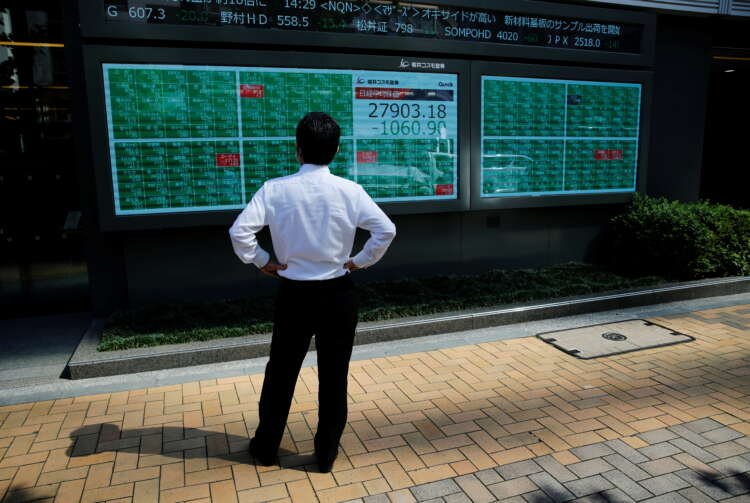
    Japan’s Nikkei also bounced 1.7%, but that follows a 3.4% slide last week to its lowest since December. Chinese blue chips firmed 1.2% from a three-week low.

    Nasdaq futures and S&P 500 futures rose 0.3%, while EUROSTOXX 50 futures added 0.4% and FTSE futures 0.5%.

    TAPERING TIME?

    The spread of the Delta variant also has the potential to upset the timing of the U.S. Federal Reserve’s tapering plans.

    Dallas Federal Reserve President Robert Kaplan, a well-known hawk, said on Friday he might reconsider the need for an early start to tapering if the virus harms the economy.

    That adds an extra frisson of uncertainty to Fed Chair Jerome Powell’s speech at Jackson Hole this week, which has had to be moved online because of pandemic restrictions.

    “Our base case is that the FOMC will announce a taper in September if the August non‑farm payrolls is strong,” said Joseph Capurso, head of international economics at CBA.

    “We anticipate the taper will be implemented in October or November, though the recent increase in Covid infections and deaths in parts of the U.S. may give Powell pause.”

    That is in marked contrast to the European Central Bank which is under pressure to add more stimulus, giving the dollar a leg up on the euro.

    “Unlike the Fed, we do not expect the ECB-POLICY-KAZIMIR-00b06d9b-4b99-46ce-a2aa-458d8eb2d993>ECB to shift away from its ultra‑dovish monetary policy stance,” said Capurso. “We expect EUR to decline to a low of $1.12 in Q1 2022, before gradually appreciating.”

    The single currency was trading at $1.1714, after losing 0.8% last week to touch 10-month lows at $1.1662. The dollar index was trading at 93.323 having hit a 10-month peak of 93.734 last week.

    The dollar also made large gains on commodity and emerging market currencies, and turned higher on the Chinese yuan.

    It has been more restrained against the Japanese yen at 109.84, which is benefiting from safe haven flows.

    Global growth jitters took a heavy toll on commodities last week, with base metals, bulk resources and oil all falling.

    Gold was steadier at $1,785, following a one-day plunge earlier in August.

    Oil pared some losses on Monday, after suffering its worst week in more than nine months as investors anticipated weakened fuel demand worldwide due to a surge in COVID-19 cases. [O/R]

    Brent edged up 70 cents to $65.88 a barrel, while U.S. crude added 57 cents to $62.71.

    (Editing by Shri Navaratnam and Jacqueline Wong)

    By Wayne Cole

    SYDNEY (Reuters) – Asian shares bounced on Monday as a wave of bargain hunting swept beaten-down markets and China reported no new locally acquired COVID-19 cases for the first time since July, though the mood remained brittle overall.

    A raft of “flash” manufacturing surveys for August out on Monday will offer an early indication of how global growth is faring in the face of the Delta variant, with analysts expecting some slippage and especially in Asia.

    Japan’s factory activity growth slowed in August, while that of the services sector shrank at the fastest pace since May last year, highlighting the toll from COVID-19 measures on the economy.

    “Following a strong V-shaped recovery, there are many signs of slower growth,” says BofA’s chief investment strategist Michael Hartnett. “The U.S. yield curve is at a one-year low, emerging markets are negative YTD and both copper and oil are down double digits from recent highs.”

    He expects negative returns for stocks and credit in the rest of this year and suggests investors own defensive quality.

    Concerns over China’s economy have only intensified in recent weeks, while Beijing’s regulatory crackdown on the tech sector delivered a double blow to markets.

    More than $560 billion was wiped from Hong Kong and mainland China exchanges last week as funds fretted on which sectors regulators might target next.

    Beijing is considering pressing data-rich companies to hand over management and supervision of their data to third-party firms if they want U.S. stock listings, sources told Reuters.

    The impact has been evident in MSCI’s broadest index of Asia-Pacific shares outside Japan which sank 4.8% last week. The sheer speed and scale of the fall left it oversold, helping it rally 1.5% on Monday.

    Japan’s Nikkei also bounced 1.7%, but that follows a 3.4% slide last week to its lowest since December. Chinese blue chips firmed 1.2% from a three-week low.

    Nasdaq futures and S&P 500 futures rose 0.3%, while EUROSTOXX 50 futures added 0.4% and FTSE futures 0.5%.

    TAPERING TIME?

    The spread of the Delta variant also has the potential to upset the timing of the U.S. Federal Reserve’s tapering plans.

    Dallas Federal Reserve President Robert Kaplan, a well-known hawk, said on Friday he might reconsider the need for an early start to tapering if the virus harms the economy.

    That adds an extra frisson of uncertainty to Fed Chair Jerome Powell’s speech at Jackson Hole this week, which has had to be moved online because of pandemic restrictions.

    “Our base case is that the FOMC will announce a taper in September if the August non‑farm payrolls is strong,” said Joseph Capurso, head of international economics at CBA.

    “We anticipate the taper will be implemented in October or November, though the recent increase in Covid infections and deaths in parts of the U.S. may give Powell pause.”

    That is in marked contrast to the European Central Bank which is under pressure to add more stimulus, giving the dollar a leg up on the euro.

    “Unlike the Fed, we do not expect the ECB-POLICY-KAZIMIR-00b06d9b-4b99-46ce-a2aa-458d8eb2d993>ECB to shift away from its ultra‑dovish monetary policy stance,” said Capurso. “We expect EUR to decline to a low of $1.12 in Q1 2022, before gradually appreciating.”

    The single currency was trading at $1.1714, after losing 0.8% last week to touch 10-month lows at $1.1662. The dollar index was trading at 93.323 having hit a 10-month peak of 93.734 last week.

    The dollar also made large gains on commodity and emerging market currencies, and turned higher on the Chinese yuan.

    It has been more restrained against the Japanese yen at 109.84, which is benefiting from safe haven flows.

    Global growth jitters took a heavy toll on commodities last week, with base metals, bulk resources and oil all falling.

    Gold was steadier at $1,785, following a one-day plunge earlier in August.

    Oil pared some losses on Monday, after suffering its worst week in more than nine months as investors anticipated weakened fuel demand worldwide due to a surge in COVID-19 cases. [O/R]

    Brent edged up 70 cents to $65.88 a barrel, while U.S. crude added 57 cents to $62.71.

    (Editing by Shri Navaratnam and Jacqueline Wong)

    Related Posts
     Millennials Aren’t Ignoring Retirement. They’re Rebuilding It.
    Millennials Aren’t Ignoring Retirement. They’re Rebuilding It.
    BridgeWise Launches FixedWise, the First AI Solution Bringing Granular Bond Intelligence to the European Market
    BridgeWise Launches FixedWise, the First AI Solution Bringing Granular Bond Intelligence to the European Market
    Why Financial Advisors Are Rethinking Gold Allocations
    Why Financial Advisors Are Rethinking Gold Allocations
    From Opaque to Investable: Yaniv Bertele's Blueprint for Transparent Alternatives
    From Opaque to Investable: Yaniv Bertele's Blueprint for Transparent Alternatives
    Private Equity Needs AI Advocates
    Private Equity Needs AI Advocates
    Understanding the Global Impact of Rising Medical Insurance Premiums on the Middle Class
    Understanding the Global Impact of Rising Medical Insurance Premiums on the Middle Class
    The New Model Driving Creative Investment in University Innovation
    The New Model Driving Creative Investment in University Innovation
    The return of tangible assets in modern portfolios
    The return of tangible assets in modern portfolios
    Retro Bikes And Insurance: What You Should Know?
    Retro Bikes And Insurance: What You Should Know?
    Top Stocks Powering the AI Boom in 2025
    Top Stocks Powering the AI Boom in 2025
    How often should you update your estate plan? The events that demand a refresh
    How often should you update your estate plan? The events that demand a refresh
    Top 5 Mutual Funds in the UAE: Performance, Features, and How to Invest
    Top 5 Mutual Funds in the UAE: Performance, Features, and How to Invest

    Why waste money on news and opinions when you can access them for free?

    Take advantage of our newsletter subscription and stay informed on the go!

    Subscribe

    More from Investing

    Explore more articles in the Investing category

    How One Investor Learned to Find Value Through a Wider Lens

    How One Investor Learned to Find Value Through a Wider Lens

    Freedom Holding Corp’s Global Rise: Why Institutional Investors Are Betting Big

    Freedom Holding Corp’s Global Rise: Why Institutional Investors Are Betting Big

    Pro Visionary Helps Australians Strengthen Their Financial Resilience Through Licensed Wealth Strategies

    Pro Visionary Helps Australians Strengthen Their Financial Resilience Through Licensed Wealth Strategies

    How ZenInvestor Is Breaking Down Barriers to Financial Literacy and Empowering Everyday Investors Nationwide

    How ZenInvestor Is Breaking Down Barriers to Financial Literacy and Empowering Everyday Investors Nationwide

    Edward L. Shugrue III on Returning to the Office: A Cultural Shift and Investment Opportunity

    Edward L. Shugrue III on Returning to the Office: A Cultural Shift and Investment Opportunity

    How Private Capital Can Build Public Good

    How Private Capital Can Build Public Good

    Private Equity Has a Major Speed and Capacity Problem

    Private Equity Has a Major Speed and Capacity Problem

    Navigating AI Investing Tools: Wealth Management Disruption Ahead

    Navigating AI Investing Tools: Wealth Management Disruption Ahead

    MTF Trading Explained: What It Is, How It Works, and Key Benefits

    MTF Trading Explained: What It Is, How It Works, and Key Benefits

    Private Equity Has Trust Issues With AI

    Private Equity Has Trust Issues With AI

    Merifund Capital Management on FTSE 100 Gains

    Merifund Capital Management on FTSE 100 Gains

    Sycamine Capital Management sets outlook on Japan equities

    Sycamine Capital Management sets outlook on Japan equities

    View All Investing Posts
    Previous Investing PostEnergy, healthcare stocks lift FTSE 100; BHP Group shines
    Next Investing PostGlobal dividends to near pre-pandemic levels in 2021 -report