Search
00
GBAF Logo
trophy
Top StoriesInterviewsBusinessFinanceBankingTechnologyInvestingTradingVideosAwardsMagazinesHeadlinesTrends

Subscribe to our newsletter

Get the latest news and updates from our team.

Global Banking & Finance Review®

Global Banking & Finance Review® - Subscribe to our newsletter

Company

    GBAF Logo
    • About Us
    • Profile
    • Privacy & Cookie Policy
    • Terms of Use
    • Contact Us
    • Advertising
    • Submit Post
    • Latest News
    • Research Reports
    • Press Release
    • Awards▾
      • About the Awards
      • Awards TimeTable
      • Submit Nominations
      • Testimonials
      • Media Room
      • Award Winners
      • FAQ
    • Magazines▾
      • Global Banking & Finance Review Magazine Issue 79
      • Global Banking & Finance Review Magazine Issue 78
      • Global Banking & Finance Review Magazine Issue 77
      • Global Banking & Finance Review Magazine Issue 76
      • Global Banking & Finance Review Magazine Issue 75
      • Global Banking & Finance Review Magazine Issue 73
      • Global Banking & Finance Review Magazine Issue 71
      • Global Banking & Finance Review Magazine Issue 70
      • Global Banking & Finance Review Magazine Issue 69
      • Global Banking & Finance Review Magazine Issue 66
    Top StoriesInterviewsBusinessFinanceBankingTechnologyInvestingTradingVideosAwardsMagazinesHeadlinesTrends

    Global Banking & Finance Review® is a leading financial portal and online magazine offering News, Analysis, Opinion, Reviews, Interviews & Videos from the world of Banking, Finance, Business, Trading, Technology, Investing, Brokerage, Foreign Exchange, Tax & Legal, Islamic Finance, Asset & Wealth Management.
    Copyright © 2010-2026 GBAF Publications Ltd - All Rights Reserved. | Sitemap | Tags | Developed By eCorpIT

    Editorial & Advertiser disclosure

    Global Banking & Finance Review® is an online platform offering news, analysis, and opinion on the latest trends, developments, and innovations in the banking and finance industry worldwide. The platform covers a diverse range of topics, including banking, insurance, investment, wealth management, fintech, and regulatory issues. The website publishes news, press releases, opinion and advertorials on various financial organizations, products and services which are commissioned from various Companies, Organizations, PR agencies, Bloggers etc. These commissioned articles are commercial in nature. This is not to be considered as financial advice and should be considered only for information purposes. It does not reflect the views or opinion of our website and is not to be considered an endorsement or a recommendation. We cannot guarantee the accuracy or applicability of any information provided with respect to your individual or personal circumstances. Please seek Professional advice from a qualified professional before making any financial decisions. We link to various third-party websites, affiliate sales networks, and to our advertising partners websites. When you view or click on certain links available on our articles, our partners may compensate us for displaying the content to you or make a purchase or fill a form. This will not incur any additional charges to you. To make things simpler for you to identity or distinguish advertised or sponsored articles or links, you may consider all articles or links hosted on our site as a commercial article placement. We will not be responsible for any loss you may suffer as a result of any omission or inaccuracy on the website.

    Home > Finance > Analysis-German government collapse could have silver lining for Europe’s markets
    Finance

    Analysis-German government collapse could have silver lining for Europe’s markets

    Published by Jessica Weisman-Pitts

    Posted on November 12, 2024

    5 min read

    Last updated: January 28, 2026

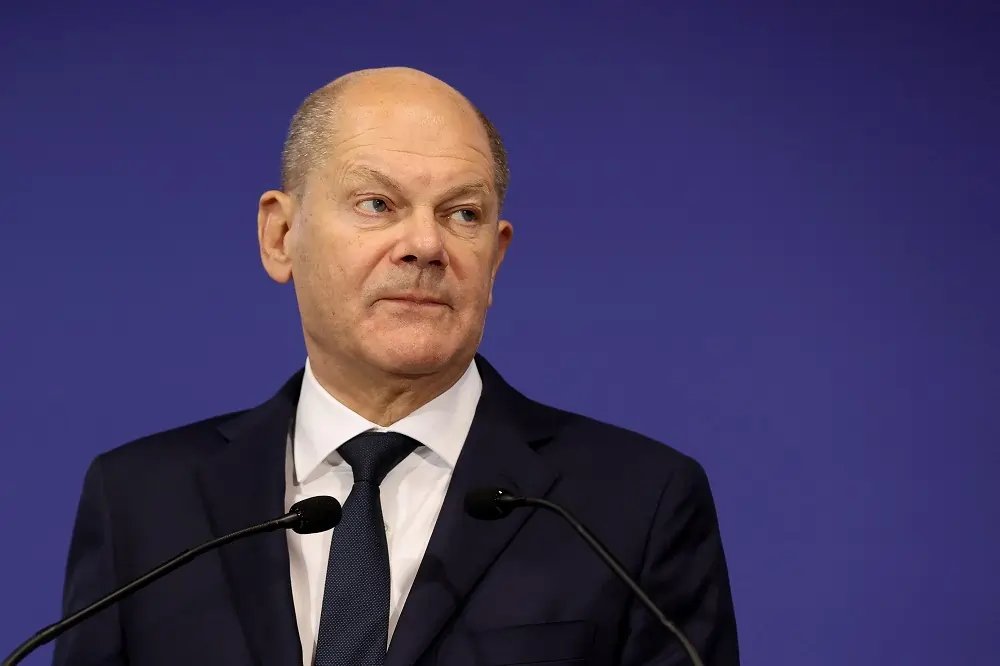
    Chancellor Olaf Scholz addresses the media following the collapse of Germany's ruling coalition. This event could signal significant fiscal changes for the eurozone's struggling economy, potentially boosting markets and currency stability.
    Image of German Chancellor Olaf Scholz discussing government coalition collapse - Global Banking & Finance Review
    Why waste money on news and opinion when you can access them for free?

    Take advantage of our newsletter subscription and stay informed on the go!

    Subscribe

    Tags:GDPfinancial marketsdebt sustainabilityeconomic growthEuropean economies

    By Yoruk Bahceli, Samuel Indyk and Danilo Masoni

    LONDON (Reuters) – The collapse of Germany’s government could have a silver lining for the euro zone’s ailing economy with potentially higher spending likely to support its currency and stock markets, even if the path remains uncertain.

    Markets are already moving in anticipation of more government borrowing that would help stimulate the economy, pushing a closely-watched bond market gauge of debt issuance to a record.

    One reason for the collapse of the ruling coalition was disagreement on whether to suspend Germany’s debt brake, which limits borrowing, and the early read out from markets is that fresh elections in February could bring more certainty for an economy that just dodged recession.

    German stocks outperformed European peers on news that the government collapsed last Wednesday, another sign of a more positive mood taking hold – just hours after Donald Trump’s U.S. election win raised the threat of tariffs in a fresh blow to Europe’s biggest economy.

    The German growth dynamic has been anaemic and a large part of that has been self-inflicted as Germany has stuck with the debt brake at a time when the economy needs support,” said Zurich Insurance Group’s chief markets strategist Guy Miller.

    “The collapse of the coalition is constructive and we hope there could be more fiscal leeway in the 2025 budget.”

    DEBT BRAKE DILEMMA

    Economists have long blamed the debt brake, adopted in 2009, for holding back Germany’s economy, which is expected to shrink this year.

    A rise in government spending by 1% to 2% of output for 10 years could boost potential growth to at least 1% from around 0.5% currently, ING’s head of global macro Carsten Brzeski estimates.

    “Germany is not in any public finance problem,” Brzeski said, as given debt at just 63% of output, it has more room to spend than peers like France and Italy.

    “If you can combine reforms with looser fiscal policies, please do it,” he added.

    The International Monetary Fund has also said Germany should consider easing its debt brake and any signs that higher spending is coming could bolster European shares.

    The pan-European STOXX 600 is up just 6% this year, less than a quarter of the U.S. S&P 500’s 26% gain.

    Hopes of a pro-growth policy turn “would be much needed for German equity valuations to re-rate,” Barclays reckons.

    Citi expects tax cuts proposed by the conservative opposition Christian Democrats, leading the polls, would support equities.

    The euro, which fell to its lowest since April around $1.06 on Tuesday, with talk of a drop to parity resurfacing as tariff worries weigh, could also benefit.

    Societe Generale’s chief FX strategist Kit Juckes notes that Germany overtook Japan this year as the country owning the most foreign assets, meaning it has plenty of capital that could be used to invest in its own economy.

    Such money “could be used to buy high-yielding German government bonds to get the economy moving,” Juckes said, adding that could eventually have a “big impact” on the euro if the government signals a material change to its policy approach.

    The hope is a German policy turn could also open the door to more joint European spending. Trump’s election may require the bloc, which already faces calls for massive investments to boost competitiveness, to increase defence spending.

    A change in tone at the top in Germany is essential to move toward greater European integration,” said Gilles Guibout, head of European equity strategies at AXA Investment Managers.

    He called the sacking of finance minister Christian Lindner, a fiscal hawk, “great news” for Europe, but added whether it will prove enough remains to be seen.

    HOLD ON!

    For sure, political uncertainty means more near-term pain for industry and could hurt sentiment.

    The conservatives, tipped to lead the next government, may limit how much spending could rise. Their leader Friedrich Merz wants to stick with the debt brake.

    To discuss reform he wants to see the right conditions to invest in pro-growth programmes, but also control welfare spending. He has also opposed further common European Union debt.

    Economists are debating whether the debt brake itself could see reform or whether Germany could launch fresh off-budget spending, tough asks requiring a large majority in parliament.

    Goldman Sachs expects the conservatives would only support amending the debt brake for modest additional spending, around 0.5% of output, expecting fiscal policy to remain a “drag” on growth.

    Macquarie strategist Thierry Wizman recommends betting against the euro with no guarantee of a reformist government.

    For others, change is a matter of time.

    Davide Oneglia at consultancy TS Lombard expects snap elections to bring debates on Germany’s growth model and EU security risks “to the fore in all their urgency”.

    “The main risk to our view is that they fail to grasp the need of a paradigm shift and fall back on old, now unviable, economic recipes,” he said. A still harsher reckoning would then come for the German and EU economy.

    (Reporting by Yoruk Bahceli, Samuel Indyk and Danilo Masoni, additional reporting by Dhara Ranasinghe; editing by Dhara Ranasinghe and Christina Fincher)

    Frequently Asked Questions about Analysis-German government collapse could have silver lining for Europe’s markets

    1What is GDP?

    Gross Domestic Product (GDP) is the total monetary value of all goods and services produced within a country's borders in a specific time period. It is a key indicator of economic performance.

    2What are financial markets?

    Financial markets are platforms where buyers and sellers engage in the trade of financial assets, such as stocks, bonds, currencies, and derivatives. They facilitate capital allocation and liquidity.

    More from Finance

    Explore more articles in the Finance category

    Image for French miner Eramet's finance chief steps aside temporarily, days after CEO ouster
    French miner Eramet's finance chief steps aside temporarily, days after CEO ouster
    Image for Ukraine's Zelenskiy calls for faster action on air defence, repairs to grid
    Ukraine's Zelenskiy calls for faster action on air defence, repairs to grid
    Image for Goldman Sachs teams up with Anthropic to automate banking tasks with AI agents, CNBC reports
    Goldman Sachs teams up with Anthropic to automate banking tasks with AI agents, CNBC reports
    Image for Analysis-Hims' $49 weight-loss pill rattles investor case for cash-pay obesity market
    Analysis-Hims' $49 weight-loss pill rattles investor case for cash-pay obesity market
    Image for Analysis-Glencore to focus on short-term disposals as Rio deal remains elusive
    Analysis-Glencore to focus on short-term disposals as Rio deal remains elusive
    Image for Belgium's Agomab Therapeutics valued at $716 million as shares fall in Nasdaq debut
    Belgium's Agomab Therapeutics valued at $716 million as shares fall in Nasdaq debut
    Image for Big Tech's quarter in four charts: AI splurge and cloud growth
    Big Tech's quarter in four charts: AI splurge and cloud growth
    Image for EU hikes tariffs on Chinese ceramics to 79% to counter dumping 
    EU hikes tariffs on Chinese ceramics to 79% to counter dumping 
    Image for AI trade splinters as investors get more selective
    AI trade splinters as investors get more selective
    Image for EU extends tariff suspension on $109.8 billion of US imports for six months
    EU extends tariff suspension on $109.8 billion of US imports for six months
    Image for Dog food maker Ollie acquired by Spain’s Agrolimen
    Dog food maker Ollie acquired by Spain’s Agrolimen
    Image for Salzgitter to take over HKM steel joint venture, end clash with Thyssenkrupp
    Salzgitter to take over HKM steel joint venture, end clash with Thyssenkrupp
    View All Finance Posts
    Previous Finance PostUK grocery inflation higher again as countdown to Christmas begins
    Next Finance PostUK regular pay rises by annual 4.8% in three months to September