
Headlines
Syria’s Islamist Rulers Overhaul Economy With Firings, Privatization of State Firms
Published by Global Banking & Finance Review®
Posted on January 31, 2025
7 min readLast updated: January 26, 2026
Add as preferred source on Google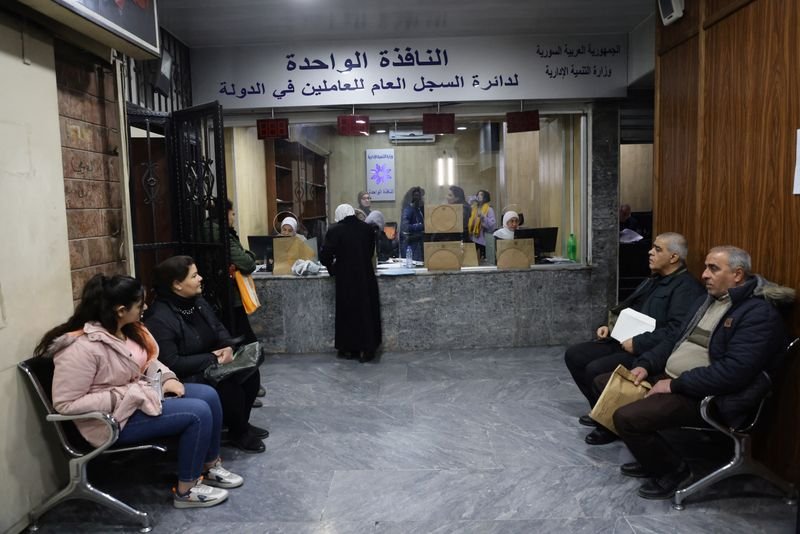
Published by Global Banking & Finance Review®
Posted on January 31, 2025
7 min readLast updated: January 26, 2026
Add as preferred source on GoogleSyria's new leaders are privatizing state firms and cutting public sector jobs to shift towards a free-market economy, facing challenges like sanctions.
By Riham Alkousaa
DAMASCUS (Reuters) - Syria's new Islamist leaders are undertaking a radical overhaul of the country's broken economy, including plans to fire a third of all public sector workers and privatising state-run companies dominant during half a century of Assad family rule.
The pace of the declared crackdown on waste and corruption, which has already seen the first layoffs just weeks after rebels toppled Assad on Dec. 8, has triggered protests from government workers, including over fears of a sectarian jobs purge.
Reuters interviewed five ministers in the interim government formed by former rebel group the Islamist Hayat Tahrir al-Sham (HTS). All described the wide scope of plans to shrink the state, including removing numerous "ghost employees" - people who got paid for doing little or nothing during Assad's rule.
Under Assad and his father, Syria was organized as a militarised, state-led economy that favoured an inner circle of allies and family members, with members of the family's Alawite sect heavily represented in the public sector.
There is now a major shift to "a competitive free-market economy," Syria's new economy minister, 40-year-old former energy engineer Basil Abdel Hanan, told Reuters.
Under transitional president Ahmed al-Sharaa, the government will work on privatising state-run industrial companies, which Hanan said totalled 107 and were mostly loss making. However, he vowed to keep "strategic" energy and transport assets in public hands. He did not provide names of companies to be sold off. Syria's main industries include oil, cement and steel.
Some state companies appeared to exist solely to embezzle resources and would be closed, Finance Minister Mohammad Abazeed said in an interview.
"We expected corruption, but not to this extent," Abazeed said.
Only 900,000 of 1.3 million people on the government payroll actually come to work, Abazeed said, citing a preliminary review.
"This means there are 400,000 ghost names," Abazeed, an energetic 38-year-old, said in his office. "Removing these will save significant resources."
Mohammad Alskaf, the minister for Administrative Development who oversees public sector headcount, went further, telling Reuters the state would need between 550,000 and 600,000 workers - less than half the current number.
The goal of the reforms, which also aim to simplify the tax system with an amnesty on penalties, was to remove obstacles and encourage investors to return to Syria, Abazeed said.
"So that their factories within the country can serve as a launchpad" for global exports, said Abazeed, previously an economist at the Al-Shamal private university before serving as a treasury official in the rebel stronghold of Idlib in 2023.
IDLIB MODEL
Until sweeping into Damascus in the lightening offensive that ousted Assad, HTS had ruled Idlib as an opposition breakaway province since 2017, attracting investment and the private sector with less red tape and by clamping down on hard-line religious factions.
The new government hopes for a nationwide increase in foreign and domestic investment to generate new jobs as Syria rebuilds from 14 years of conflict, three ministers told Reuters.
However, to replicate the Idlib model, HTS will have to overcome widespread challenges, not least international sanctions that severely impinge on foreign trade.
Maha Katta, a Senior Resilience and Crisis Response Specialist for Arab States at the International Labour Organization, said the economy was currently in no condition to create enough private jobs.
Restructuring the public sector "makes sense," Katta said, but she questioned whether it should be a top priority for a government that needs first to revive the economy.
"I'm not sure if this is really a wise decision," she said.
While acknowledging the interim leaders' imperative to move fast to get a grip on the country, some critics see the scale and pace of the planned changes as overreach.
"They are talking about a transitional process but they are making decisions as if they were a government that was legitimately installed," said Aron Lund, a fellow at Middle East-focused think-tank Century International.
Transitional president al-Sharaa has promised elections, but said they could take four years to organise.
SHOCK ABSORBED
Economy minister Hanan said economic policy would be designed to manage the fallout of rapid market reforms, to avoid the chaos of recession and unemployment that followed 'shock therapy' imposed in the 1990s on post-Soviet nations in Europe.
"The goal is to balance private sector growth with support for the most vulnerable," Hanan said.
The government has announced a 400% increase to state salaries, currently around $25 a month, starting February. It is also cushioning the blow of layoffs with severance, or by asking some workers to stay home while needs are assessed.
"To employees who were hired just to receive a salary, we say: please take your salary and stay home, but let us do our job," said Hussein Al-Khatib, Director of Health Facilities at the Ministry of Health.
However, discomfort is already visible. Workers showed Reuters lists circulating in the labour and trade ministries that pared Assad-era employment programmes for former soldiers who fought on the government's side in the civil war.
One such veteran, Mohammed, told Reuters he had been laid off on Jan. 23 from his data entry job at the labour ministry and given three months paid leave. He said around 80 other former fighters received the same notice, which he shared with Reuters.
In response to Reuters questions the labour ministry said that "due to administrative inefficiencies and disguised unemployment" a number of employees had been placed on three-month paid leave to assess their job status, after which their situation will be reviewed.
The plans spurred protests in January in cities including Deraa in southern Syria, where the rebellion against Assad first erupted in 2011, and Latakia on the coast. Such protests were unthinkable under Assad, who responded to rebellion with repression that sparked the civil war.
Employees at the Deraa Health Directorate held placards declaring "No to arbitrary and unjust dismissal" during a demonstration by some two dozen people.
Adham Abu Al-Alaya, who took part, said he feared losing his job. He supported eradicating ghost employment, but denied he or his colleagues were paid for doing nothing. He was hired in 2016 to manage records and settle utility bills.
"My salary helps me manage basic needs, like bread and yoghurt, just to sustain the household," Abu Al-Alaya said, adding that he also works another job to make end meet.
"If this decision goes through, it will increase unemployment across society, which is something we cannot afford," he said.
MILES OF FILES
Finance minister Abazeed said that since taking over, the former rebels had found monumental corruption and waste, including at Syrian Trading Establishment, a public consumer goods distributor he said received government money for a decade, until a few days before Assad's departure, without ever providing official statements of revenues.
He did not disclose how much money was involved. Reuters could not verify the allegations.
The new government has closed the company, Abazeed said.
For now, the administration has no reliable record of government employees. It is building a database of public sector staff, asking employees to complete an online form. Alskaf, the minister for Administrative Development, said it would take about six months to set up, with a team of 50 people on the job.
Acknowledging the difficulties of the task ahead, Labour Minister Fadi al-Qassem said "renovations are more difficult than new building."
The government also plans to digitize employee records, currently stored in about 60 dusty and neglected rooms containing over a million folders, many tied with string and dating back to the Ottoman era that ended more than a century ago.
To Hiba Baalbaki, 35, a labour ministry digitization specialist, the drive was surprising and encouraging.
Under the previous administration, management shunned her efforts to bring record keeping into the 21st century, including an online platform she had been working on for two years, she said.
"It introduced unwelcome changes and closed avenues for corruption and bribes," she said.
(Reporting by Riham Alkousaa; Editing by Tom Perry and Frank Jack Daniel)
Syria's new Islamist leaders are implementing a radical overhaul of the economy, including plans to fire a third of public sector workers and privatize state-run industrial companies.
The reforms aim to simplify the tax system, encourage foreign and domestic investment, and create new jobs as Syria rebuilds from years of conflict.
The government faces challenges such as international sanctions that hinder foreign trade and the need to manage the fallout from rapid market reforms.
The government plans to cushion the impact of layoffs with severance packages and has identified around 400,000 ghost employees who do not actually work.
The reforms have triggered protests from government workers who fear job losses, particularly in cities like Deraa and Latakia, where demonstrations have occurred.
Explore more articles in the Headlines category