Search
00
GBAF Logo
trophy
Top StoriesInterviewsBusinessFinanceBankingTechnologyInvestingTradingVideosAwardsMagazinesHeadlinesTrends

Subscribe to our newsletter

Get the latest news and updates from our team.

Global Banking & Finance Review®

Global Banking & Finance Review® - Subscribe to our newsletter

Company

    GBAF Logo
    • About Us
    • Profile
    • Privacy & Cookie Policy
    • Terms of Use
    • Contact Us
    • Advertising
    • Submit Post
    • Latest News
    • Research Reports
    • Press Release
    • Awards▾
      • About the Awards
      • Awards TimeTable
      • Submit Nominations
      • Testimonials
      • Media Room
      • Award Winners
      • FAQ
    • Magazines▾
      • Global Banking & Finance Review Magazine Issue 79
      • Global Banking & Finance Review Magazine Issue 78
      • Global Banking & Finance Review Magazine Issue 77
      • Global Banking & Finance Review Magazine Issue 76
      • Global Banking & Finance Review Magazine Issue 75
      • Global Banking & Finance Review Magazine Issue 73
      • Global Banking & Finance Review Magazine Issue 71
      • Global Banking & Finance Review Magazine Issue 70
      • Global Banking & Finance Review Magazine Issue 69
      • Global Banking & Finance Review Magazine Issue 66
    Top StoriesInterviewsBusinessFinanceBankingTechnologyInvestingTradingVideosAwardsMagazinesHeadlinesTrends

    Global Banking & Finance Review® is a leading financial portal and online magazine offering News, Analysis, Opinion, Reviews, Interviews & Videos from the world of Banking, Finance, Business, Trading, Technology, Investing, Brokerage, Foreign Exchange, Tax & Legal, Islamic Finance, Asset & Wealth Management.
    Copyright © 2010-2026 GBAF Publications Ltd - All Rights Reserved. | Sitemap | Tags | Developed By eCorpIT

    Editorial & Advertiser disclosure

    Global Banking & Finance Review® is an online platform offering news, analysis, and opinion on the latest trends, developments, and innovations in the banking and finance industry worldwide. The platform covers a diverse range of topics, including banking, insurance, investment, wealth management, fintech, and regulatory issues. The website publishes news, press releases, opinion and advertorials on various financial organizations, products and services which are commissioned from various Companies, Organizations, PR agencies, Bloggers etc. These commissioned articles are commercial in nature. This is not to be considered as financial advice and should be considered only for information purposes. It does not reflect the views or opinion of our website and is not to be considered an endorsement or a recommendation. We cannot guarantee the accuracy or applicability of any information provided with respect to your individual or personal circumstances. Please seek Professional advice from a qualified professional before making any financial decisions. We link to various third-party websites, affiliate sales networks, and to our advertising partners websites. When you view or click on certain links available on our articles, our partners may compensate us for displaying the content to you or make a purchase or fill a form. This will not incur any additional charges to you. To make things simpler for you to identity or distinguish advertised or sponsored articles or links, you may consider all articles or links hosted on our site as a commercial article placement. We will not be responsible for any loss you may suffer as a result of any omission or inaccuracy on the website.

    Home > Business > When climate disruption becomes a boardroom issue: Why I don't speak to the CSO without the CFO in the room
    Business

    When climate disruption becomes a boardroom issue: Why I don't speak to the CSO without the CFO in the room

    Published by Wanda Rich

    Posted on April 23, 2025

    4 min read

    Last updated: January 24, 2026

    An image depicting a boardroom discussion emphasizing the integration of climate risk into financial planning. This reflects the article's theme of aligning sustainability with business strategy for optimal operational viability.
    Boardroom meeting discussing climate risk and financial strategy - Global Banking & Finance Review
    Why waste money on news and opinion when you can access them for free?

    Take advantage of our newsletter subscription and stay informed on the go!

    Subscribe

    Tags:sustainabilityrisk managementClimate Changebusiness strategy

    By Mike Mason, Chief Operating Officer at Earth Blox

    In the past, sustainability used to be a passion project. Something bolted onto the business, championed by the CSO, and filed under ESG. Today, that's no longer enough. When I'm brought in to speak with companies now, my first call isn't with the CSO alone, the CFO is there too.

    Why? Because climate risk has evolved. It's not just about environmental responsibility. It's about operational viability and financial success. It impacts every part of a business.

    Let me explain.

    Tropicana: The canary in the commercial coal mine

    During a recent presentation, I used the example of Tropicana. Most people see the brand on supermarket shelves and assume it's thriving. But dig a little deeper, and you'll find a sobering reality: $30 million in emergency loans, a 4% drop in revenue, and margins so thin they're bordering on negative. They're not just struggling. They're flirting with bankruptcy.

    This isn't just bad luck. It's the consequence of a brittle supply strategy. Tropicana, like many legacy firms, has historically sourced the bulk of its oranges from Florida and Brazil — regions that are now climate hotspots, susceptible to increasingly severe droughts.

    The irony? These patterns were predictable. Climate science has been flagging risks in South America for years. However, without integrating that knowledge into commercial planning, even a household name like Tropicana is exposed.

    Sustainability is now commercial strategy

    This is the pivot every business needs to understand: environmental sustainability is business sustainability.

    When companies fail to account for nature-related risks, they're not just making poor ESG choices. They are making poor commercial decisions. If your supply chain collapses or your agricultural yield drops to record lows, the impact is immediate and financial.

    And yet, I still see hesitation in boardrooms. I hear: "But that's Tropicana. That's not us." Or "We still see the product on the shelf, how bad can it be?" The trouble is, that by the time the impact becomes visible to consumers, it's already too late for the balance sheet.

    The real data problem: Relevance, not access

    Another common myth is that businesses don't act because they lack data. That's not true.

    We're swimming in data from government sources, commercial satellites, and internal systems. The real problem is relevance: extracting the bits of information that help you understand risk, make decisions, and take action.

    Businesses don't need more spreadsheets. They need clarity. They need a way to ask: "How does this environmental factor impact this part of my portfolio?" And get a clear, actionable answer.

    Beyond compliance: The case for risk mitigation

    Too many still see nature-based data as a tool for ticking regulatory boxes. But compliance is only 10% of the story. The real value lies in risk mitigation and opportunity creation.

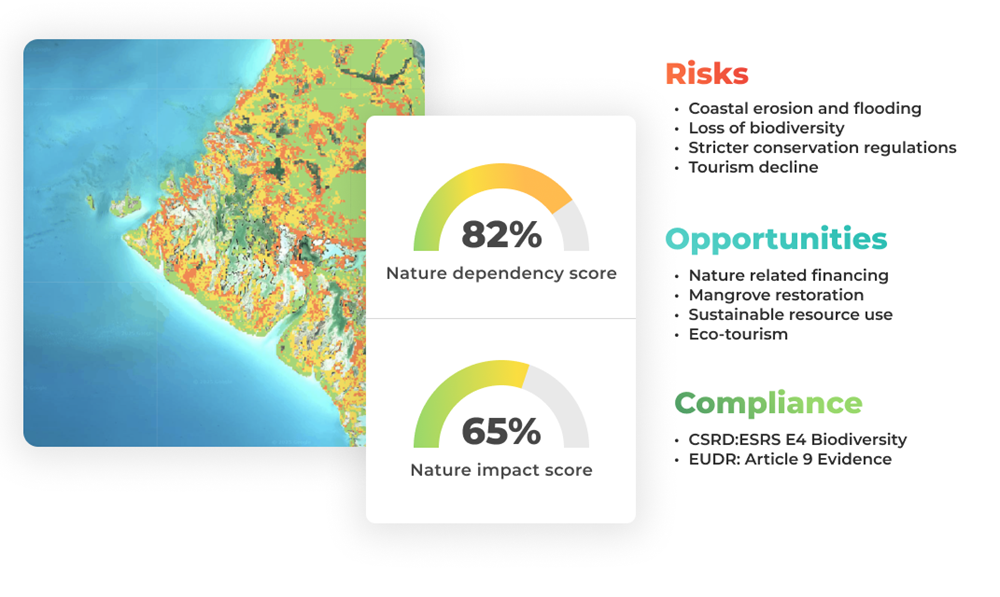
    Take the agri-business we worked with. By overlaying biodiversity data with yield performance, we uncovered a powerful insight: farms with higher biodiversity were also the most productive. That meant investing in nature restoration wasn't just good for the planet. It was good for the bottom line.

    When you can show a direct link between environmental health and business outcomes, sustainability shifts from a cost centre to a value driver.

    From basement reports to boardroom decisions

    Traditionally, companies have relied on consultants to produce environmental reports. The model? Lock some experts in a basement and wait a year for a PDF.

    But that's slow, opaque, and inherently selective. Worse, there's a global shortage of the expertise needed to produce these reports.

    That's why tools that democratise data access are so important. We need systems that allow people with business knowledge — the folks who understand customers, operations, and commercial strategy — to explore risks and model outcomes directly.

    This isn't about replacing consultants. It's about empowering them to do more and, at the same time, scaling insights by putting sustainability knowledge in the hands of the people running the business.

    The bottom line

    If there's one message I leave behind in every meeting, it's this: Sustainability is no longer just a CSR initiative. It's also financial strategy. And if you're not factoring climate and nature risk into your business decisions, you're not just behind the curve. You're walking blindfolded into a storm.

    The convergence of climate, nature, and finance isn't theoretical anymore. It's here. And it's reshaping the boardroom agenda, one disrupted supply chain at a time.

    Mike Mason is Chief Operating Officer at Earth Blox. Mike brings 30 years of experience building world-class operations in technology companies and driving value for clients. His approach has ensured the successful growth and exit of several businesses, including TVSquared and LBi.


    Content image from Global Banking & Finance Review

    Content image from Global Banking & Finance Review

    Frequently Asked Questions about When climate disruption becomes a boardroom issue: Why I don't speak to the CSO without the CFO in the room

    1What is sustainability?

    Sustainability refers to the practice of meeting present needs without compromising the ability of future generations to meet their own needs, often focusing on environmental, social, and economic dimensions.

    2What is risk management?

    Risk management is the process of identifying, assessing, and controlling threats to an organization's capital and earnings, including financial, operational, and strategic risks.

    3What is climate change?

    Climate change refers to significant changes in global temperatures and weather patterns over time, primarily driven by human activities like burning fossil fuels.

    4What is data relevance?

    Data relevance refers to the importance and applicability of data in making informed decisions, particularly in understanding risks and opportunities in business.

    More from Business

    Explore more articles in the Business category

    Image for Why Leen Kawas is Prioritizing Strategic Leadership at Propel Bio Partners
    Why Leen Kawas is Prioritizing Strategic Leadership at Propel Bio Partners
    Image for How Commercial Lending Software Platforms Are Structured and Utilized
    How Commercial Lending Software Platforms Are Structured and Utilized
    Image for Oil Traders vs. Tech Startups: Surprising Lessons from Two High-Stakes Worlds | Said Addi
    Oil Traders vs. Tech Startups: Surprising Lessons from Two High-Stakes Worlds | Said Addi
    Image for Why More Mortgage Brokers Are Choosing to Join a Network
    Why More Mortgage Brokers Are Choosing to Join a Network
    Image for From Recession Survivor to Industry Pioneer: Ed Lewis's Data Revolution
    From Recession Survivor to Industry Pioneer: Ed Lewis's Data Revolution
    Image for From Optometry to Soul Vision: The Doctor Helping Entrepreneurs Lead With Purpose
    From Optometry to Soul Vision: The Doctor Helping Entrepreneurs Lead With Purpose
    Image for Global Rankings Revealed: Top PMO Certifications Worldwide
    Global Rankings Revealed: Top PMO Certifications Worldwide
    Image for World Premiere of Midnight in the War Room to be Hosted at Black Hat Vegas
    World Premiere of Midnight in the War Room to be Hosted at Black Hat Vegas
    Image for Role of Personal Accident Cover in 2-Wheeler Insurance for Owners and Riders
    Role of Personal Accident Cover in 2-Wheeler Insurance for Owners and Riders
    Image for The Young Rich Lister Who Also Teaches: How Aaron Sansoni Built a Brand Around Execution
    The Young Rich Lister Who Also Teaches: How Aaron Sansoni Built a Brand Around Execution
    Image for Q3 2025 Priority Leadership: Tom Priore and Tim O'Leary Balance Near-Term Challenges with Long-Term Strategic Wins
    Q3 2025 Priority Leadership: Tom Priore and Tim O'Leary Balance Near-Term Challenges with Long-Term Strategic Wins
    Image for Using Modern Team Management Methods to Improve Collaboration in Hybrid Work Models
    Using Modern Team Management Methods to Improve Collaboration in Hybrid Work Models
    View All Business Posts
    Previous Business PostHow Sujan Das is Transforming Online Commerce to Streamline Customer Checkouts
    Next Business PostAfter $20M in Transactions, Vennre Hires CPO Veteran to Build the Future of Digital Wealth Creation