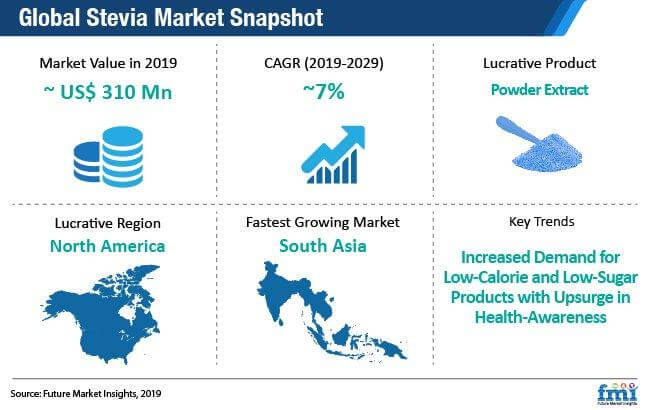
Stevia Market is anticipated to grow at a CAGR of ~ 7% during the forecast period of 2019 to 2029 – Future Market Insights
Published by mark itwired
Posted on October 12, 2021
Stevia Market Outlook
The stevia market is anticipated to advance at a moderate growth during the forecast period 2019-2029. According to studies, stevia is about 200 times sweeter as compared to sugar. Moreover, it is a zero-calorie sweetener and does not have any harmful effects on the human body. As a result, a shift is witnessed among consumers, away from the artificial sweeteners to the natural sweeteners, which boasts a high potential to improve the size of the stevia market during the forecast period.
Growing demand for nutrition-rich products among consumers to lead a healthy lifestyle is expected to bring in favourable growth instances for the stevia market during the forecast period. This is on the back of the contents such as antioxidant compounds, caffeic acid, quercetin, flavonoids, and tannins.
The global stevia market size in 2018 was valued at ~ US$ 291
The stevia market is anticipated to grow at a CAGR of ~ 7% during the forecast period of 2019-2029.
The powder extract of stevia is expected to account for relatively high sales in the stevia market.
The growth of this particular segment can be primarily attributed to economical cost and wide adoption for precision manufacturing and assembly.
Europe is stipulated to account for ~ half of the revenue shares in the stevia market by the end of 2029.
Europe is estimated to continue to be the opportunistic market for stevia manufacturers and distributors, owing to increasing production and demand for natural sweeteners.
While consumption in the beverage sector continue to account for greater sales of stevia, growing application in packaged food products is likely to result in increased market share.
Noteworthy application potential of stevia has been identified in soft drinks, juices, yogurts, confectionery, bakery and many more. Stevia is increasingly used by food manufacturers to develop low-sugar and low-calorie products, thereby creating an upswing in the market growth. Moreover, stevia is found in more than 1,400 food and beverage products.
Key Factors Shaping the Stevia Market
Demand Upheld by Increasing Diabetic and Obese Population
The rising prevalence of diabetes and obesity is anticipated to serve as a major driver for the stevia market. According to the World Health Organization, in 2016, around 1.6 million deaths were caused directly due to diabetes, and it is the seventh leading cause of death across the world. Also, in 2016, more than 1.9 million adults were overweight, while 650 million of these adults were obese.
Stevia Market Structure Analysis
The global stevia market is a moderately competitive market, with tier-1 players holding ~35% – 40% share of the market.
Expansion of the business through mergers, acquisitions, collaborations, and alliances is the primary strategy followed by key players in the stevia market. Key market players focus on strategies such as adoption of new technologies to develop innovative products, and enlargement of sales and distribution channels.
Noteworthy investments in the research and development for novel and sturdy products is projected to boost the growth prospects of the stevia market.
Major players in the stevia market are Cargill Incorporated, Ingredion Incorporated, PureCircle Ltd., Koninklijke DSM NV, Tate and Lyle Plc., Sunwin Stevia International, Inc., GLG Life Tech Corp, Evolva Holding SA and others.
Stevia Market Report Scope
Attribute
Details
Forecast Period
2014-2018
Historical Data Available for
2019-2029
Market Analysis
US$ Mn for Value and Tons for Volume
Key Regions Covered
North America, Latin America, Europe, East Asia, South Asia, Oceania, and Middle East & Africa (MEA)
Key Countries Covered
U.S, Canada, Mexico, Brazil, Argentina, Rest of Latin America, EU-5, Germany, United Kingdom, France, Italy, Spain, Benelux, Nordic Region, Russia, Poland, Rest of Europe, China, Japan, Korea, India, Thailand, Malaysia, Indonesia, Vietnam, Singapore, Rest of South Asia, GCC, Turkey, South Africa, and Rest of MEA
The stevia market is anticipated to advance at a moderate growth during the forecast period 2019-2029. According to studies, stevia is about 200 times sweeter as compared to sugar. Moreover, it is a zero-calorie sweetener and does not have any harmful effects on the human body. As a result, a shift is witnessed among consumers, away from the artificial sweeteners to the natural sweeteners, which boasts a high potential to improve the size of the stevia market during the forecast period.
Growing demand for nutrition-rich products among consumers to lead a healthy lifestyle is expected to bring in favourable growth instances for the stevia market during the forecast period. This is on the back of the contents such as antioxidant compounds, caffeic acid, quercetin, flavonoids, and tannins.
The global stevia market size in 2018 was valued at ~ US$ 291
The stevia market is anticipated to grow at a CAGR of ~ 7% during the forecast period of 2019-2029.
The powder extract of stevia is expected to account for relatively high sales in the stevia market.
The growth of this particular segment can be primarily attributed to economical cost and wide adoption for precision manufacturing and assembly.
Europe is stipulated to account for ~ half of the revenue shares in the stevia market by the end of 2029.
Europe is estimated to continue to be the opportunistic market for stevia manufacturers and distributors, owing to increasing production and demand for natural sweeteners.
While consumption in the beverage sector continue to account for greater sales of stevia, growing application in packaged food products is likely to result in increased market share.
Noteworthy application potential of stevia has been identified in soft drinks, juices, yogurts, confectionery, bakery and many more. Stevia is increasingly used by food manufacturers to develop low-sugar and low-calorie products, thereby creating an upswing in the market growth. Moreover, stevia is found in more than 1,400 food and beverage products.
Key Factors Shaping the Stevia Market
Demand Upheld by Increasing Diabetic and Obese Population
The rising prevalence of diabetes and obesity is anticipated to serve as a major driver for the stevia market. According to the World Health Organization, in 2016, around 1.6 million deaths were caused directly due to diabetes, and it is the seventh leading cause of death across the world. Also, in 2016, more than 1.9 million adults were overweight, while 650 million of these adults were obese.
Stevia Market Structure Analysis
The global stevia market is a moderately competitive market, with tier-1 players holding ~35% – 40% share of the market.
Expansion of the business through mergers, acquisitions, collaborations, and alliances is the primary strategy followed by key players in the stevia market. Key market players focus on strategies such as adoption of new technologies to develop innovative products, and enlargement of sales and distribution channels.
Noteworthy investments in the research and development for novel and sturdy products is projected to boost the growth prospects of the stevia market.
Major players in the stevia market are Cargill Incorporated, Ingredion Incorporated, PureCircle Ltd., Koninklijke DSM NV, Tate and Lyle Plc., Sunwin Stevia International, Inc., GLG Life Tech Corp, Evolva Holding SA and others.
Stevia Market Report Scope
Attribute
Details
Forecast Period
2014-2018
Historical Data Available for
2019-2029
Market Analysis
US$ Mn for Value and Tons for Volume
Key Regions Covered
North America, Latin America, Europe, East Asia, South Asia, Oceania, and Middle East & Africa (MEA)
Key Countries Covered
U.S, Canada, Mexico, Brazil, Argentina, Rest of Latin America, EU-5, Germany, United Kingdom, France, Italy, Spain, Benelux, Nordic Region, Russia, Poland, Rest of Europe, China, Japan, Korea, India, Thailand, Malaysia, Indonesia, Vietnam, Singapore, Rest of South Asia, GCC, Turkey, South Africa, and Rest of MEA