Search
00
GBAF Logo
trophy
Top StoriesInterviewsBusinessFinanceBankingTechnologyInvestingTradingVideosAwardsMagazinesHeadlinesTrends

Subscribe to our newsletter

Get the latest news and updates from our team.

Global Banking & Finance Review®

Global Banking & Finance Review® - Subscribe to our newsletter

Company

    GBAF Logo
    • About Us
    • Advertising and Sponsorship
    • Profile & Readership
    • Contact Us
    • Latest News
    • Privacy & Cookies Policies
    • Terms of Use
    • Advertising Terms
    • Issue 81
    • Issue 80
    • Issue 79
    • Issue 78
    • Issue 77
    • Issue 76
    • Issue 75
    • Issue 74
    • Issue 73
    • Issue 72
    • Issue 71
    • Issue 70
    • View All
    • About the Awards
    • Awards Timetable
    • Awards Winners
    • Submit Nominations
    • Testimonials
    • Media Room
    • FAQ
    • Asset Management Awards
    • Brand of the Year Awards
    • Business Awards
    • Cash Management Banking Awards
    • Banking Technology Awards
    • CEO Awards
    • Customer Service Awards
    • CSR Awards
    • Deal of the Year Awards
    • Corporate Governance Awards
    • Corporate Banking Awards
    • Digital Transformation Awards
    • Fintech Awards
    • Education & Training Awards
    • ESG & Sustainability Awards
    • ESG Awards
    • Forex Banking Awards
    • Innovation Awards
    • Insurance & Takaful Awards
    • Investment Banking Awards
    • Investor Relations Awards
    • Leadership Awards
    • Islamic Banking Awards
    • Real Estate Awards
    • Project Finance Awards
    • Process & Product Awards
    • Telecommunication Awards
    • HR & Recruitment Awards
    • Trade Finance Awards
    • The Next 100 Global Awards
    • Wealth Management Awards
    • Travel Awards
    • Years of Excellence Awards
    • Publishing Principles
    • Ownership & Funding
    • Corrections Policy
    • Editorial Code of Ethics
    • Diversity & Inclusion Policy
    • Fact Checking Policy
    Original content: Global Banking and Finance Review - https://www.globalbankingandfinance.com

    A global financial intelligence and recognition platform delivering authoritative insights, data-driven analysis, and institutional benchmarking across Banking, Capital Markets, Investment, Technology, and Financial Infrastructure.

    Copyright © 2010-2026 - All Rights Reserved. | Sitemap | Tags

    Editorial & Advertiser disclosure

    Global Banking & Finance Review® is an online platform offering news, analysis, and opinion on the latest trends, developments, and innovations in the banking and finance industry worldwide. The platform covers a diverse range of topics, including banking, insurance, investment, wealth management, fintech, and regulatory issues. The website publishes news, press releases, opinion and advertorials on various financial organizations, products and services which are commissioned from various Companies, Organizations, PR agencies, Bloggers etc. These commissioned articles are commercial in nature. This is not to be considered as financial advice and should be considered only for information purposes. It does not reflect the views or opinion of our website and is not to be considered an endorsement or a recommendation. We cannot guarantee the accuracy or applicability of any information provided with respect to your individual or personal circumstances. Please seek Professional advice from a qualified professional before making any financial decisions. We link to various third-party websites, affiliate sales networks, and to our advertising partners websites. When you view or click on certain links available on our articles, our partners may compensate us for displaying the content to you or make a purchase or fill a form. This will not incur any additional charges to you. To make things simpler for you to identity or distinguish advertised or sponsored articles or links, you may consider all articles or links hosted on our site as a commercial article placement. We will not be responsible for any loss you may suffer as a result of any omission or inaccuracy on the website.

    1. Home
    2. >Business
    3. >P2PE– It’s still early days
    Business

    P2PE– It’s Still Early Days

    Published by Gbaf News

    Posted on November 22, 2012

    5 min read

    Last updated: January 22, 2026

    Add as preferred source on Google
    Adina Ahmed, Operations Director at Anderson Zaks, presents on Point-to-Point Encryption (P2PE) solutions for merchants at a Vendorcom meeting, highlighting the importance of PCI compliance in card payment security.
    Adina Ahmed discussing P2PE security solutions at a banking industry meeting - Global Banking & Finance Review
    Why waste money on news and opinion when you can access them for free?

    Take advantage of our newsletter subscription and stay informed on the go!

    Subscribe

    What merchants and retailers need to know
     
    Recently a group of card payment industry practitioners gathered at a Vendorcom Special Interest Group meeting (SIG) to discuss the subject of PCI and the security of card data. The meeting was hosted by Anderson Zaksat their offices in Bracknell.A significant proportion of the debate focused on Point-to-Point Encryption (P2PE).Adina Ahmed, Operations Director at Anderson Zaks explains here the salient points.Adina Ahmed
     
    The P2PE program is optional and provides a comprehensive set of security requirements for payment solution providers to validate their hardware based solutions, and may help reduce the PCI DSS scope of merchants using such solutions.*
     
    This is to ensure that card information is passed securely from the point of payment (i.e. where you insert or give card details) to the acquirer (bank) and that the merchant does not hold card information.  Even though they are not holding this data, the merchant will still have to provide evidence that they adhere to PCI standard, however,P2PE may significantly reduce the scope of their cardholder data environment and annual PCI DSS assessments.
     
    While it has been around for a couple of years P2PE is still in the early stages of market adoption, and different solutions that address various requirements are still evolving.  In many cases, whilst larger tier 1 and 2 merchants/retailers with IT departments are already evaluating the benefits of P2PE, some smaller merchants may not even be aware of this potentially advantageous approach.  The consensus of the meeting was that the future direction of P2PE should not be seen as cast in stone as the implications are only now becoming fully apparent as more companies – both solutions suppliers and retailers/merchants – assess the options available to them.in this context, a more open debate with merchants and retailers about the direction that the technology may take is to be welcomed and encouraged.
     
    The salient points highlighted during discussions were:
    • P2PE is not compulsory
    • There are different forms of P2PE
    • The future direction of P2PE is not necessarily set
    • Merchants and Retailers should look to future proof any purchases made now
     
    P2PE is not compulsory
    There are potential misconceptions circulating currently, and the fact that P2PE is compulsory is one of them.  The banks are not insisting on P2PE which means that merchants/retailers are free to choose any solution that meets their card processing requirements so long as it is PCI DSS compliant.  However, for any solution they do select, merchants would be wise to ensure that it is future-proofed.  By this we mean that the component parts of their system could incorporate a P2PE solution in the future.  
     
    Different forms of P2PE
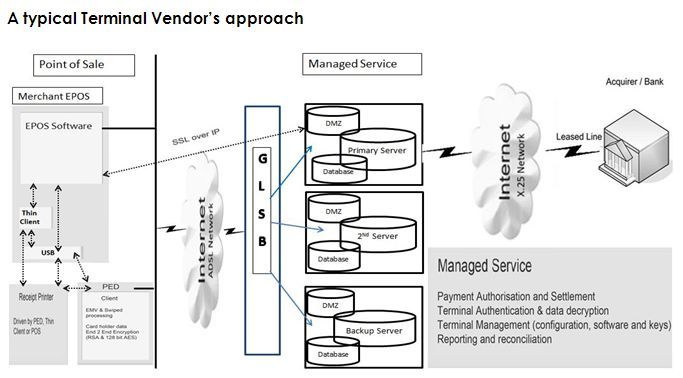
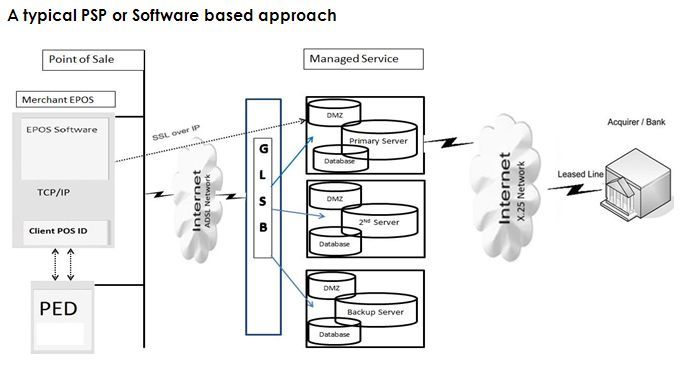
    One of the current debates is where exactly is the ‘point’ within the merchant/ retailer systems from which the data needs to be encrypted.   As is to be expected different sectors of the card payment industry have different approaches to the situation.  Terminal manufacturers are building encryption into their PINpads, whereas software solution providers claim that their approach is to encrypt or mask card data within the merchant’s systems and pass limited details back thus equally reducing the scope of PCI for the merchant.  These probably represent the two polar extremes of opinion, and there is an increasing ground swell for a third or middle path that combines elements of both approaches.  
     
    The following diagrams illustrate the two approaches. The first diagram shows encryption taking place between the merchants ‘POS’ application and the payment providers system. The PSP in turn interfaces with the PINPad and host gateway fully encrypting the card data.
     
    p2pe1
    This approach is currently approved under PCI DSS compliance validation.
    The second diagram has all the encryption activity within the payment terminal but still sending limited transaction data back to the merchants POS systems.
    p2pe2
    The perceived benefit of this option to the merchants/ retailers is that they will significantly reduce their effort in attaining and maintaining PCI DSS compliance. However this is really only pertinent for level 1 merchants doing over 6 million card transactions per annum**.
     
    There are benefits to both approaches.  By having P2PE in the PINpad everything is self-contained within the terminal merchants/ retailers are providing with a simple turnkey solution. By adopting software based approach merchants/ retailers can mix and match their payment hardware and still use the same payment processing solution, so maintaining flexibility.
     
    Which direction will P2PE develop?
    Both of the approaches outlined above have their pros and cons, however, neither has gained dominance within the market, and this is why the future for P2PE isn’t yet decided.   However, as the first generation PINpads reach end of life and need to be replaced, merchants and retailers are faced with the fact that they must replace their systems – there is simply no ‘do nothing’ option. This is why members of Vendorcom are suggesting that discussions continue across the industry with input from all stakeholders including acquirers, solutions suppliers, other interested industry associations and standards bodies such as the Payments Council, EPC and PCI SSC, PSPs, QSAs and merchants/ retailers. The ultimate aim is that developments in P2PE should deliver a strong, flexible, future proof and market empathetic solution.
     
    In the meanwhile we wait to see a QSA certified PCI P2PE solution in deployment.



    More from Business

    Explore more articles in the Business category

    Image for Submit Your Entry for Years of Excellence Awards 2026
    Submit Your Entry for Years of Excellence Awards 2026
    Image for Nominations Open for Travel & Hospitality Awards 2026
    Nominations Open for Travel & Hospitality Awards 2026
    Image for Submit Your Entry Today for Telecom Awards 2026
    Submit Your Entry Today for Telecom Awards 2026
    Image for Submit Your Entries for The Next 100 Global Awards 2026
    Submit Your Entries for the Next 100 Global Awards 2026
    Image for Submit Your Entry: Public Sector & Governance Excellence Awards 2026
    Submit Your Entry: Public Sector & Governance Excellence Awards 2026
    Image for Nominations Invited for Real Estate Development Awards 2026
    Nominations Invited for Real Estate Development Awards 2026
    Image for Submit Your Entry: Process & Product Awards 2026
    Submit Your Entry: Process & Product Awards 2026
    Image for Call for Entries: HR & Recruitment Awards 2026
    Call for Entries: HR & Recruitment Awards 2026
    Image for Submit Your Nominations Today for Education & Training Awards 2026
    Submit Your Nominations Today for Education & Training Awards 2026
    Image for Join the Corporate Governance Awards 2026: Showcase Your Organisation’s Leadership
    Join the Corporate Governance Awards 2026: Showcase Your Organisation’s Leadership
    Image for Submit Your Entry Today for Business Awards 2026
    Submit Your Entry Today for Business Awards 2026
    Image for Decentralized Masters’ ‘family culture’ building trust instead of hierarchy
    Decentralized Masters’ ‘family Culture’ Building Trust Instead of Hierarchy
    View All Business Posts
    Previous Business PostBuying a House? Here Are Some of the Many Things We Can Consider.
    Next Business PostGaining Business Advantage Through E-Invoice Compliance