
Research Reports
Organic Wine Market to Reach Valuation of ~us$ 30 Bn by 2030
Published by TMR Research Insights
Posted on August 16, 2021
20 min readLast updated: February 17, 2026
Add as preferred source on Google
Published by TMR Research Insights
Posted on August 16, 2021
20 min readLast updated: February 17, 2026
Add as preferred source on GoogleThere are evolving consumer trends and rising awareness pertaining to niche product categories, such as organic and natural within the food & beverages sector. Over the past decade, organic and natural food products have gained considerable popularity across the world, particularly among millennials.
The natural food & beverage movement across the world is primarily driven by the dwindling interest in chemical-based agricultural techniques. In the current scenario, organic wine is a growing trend in the beverages industry, particularly in wine-drinking countries such as Australia, New Zealand, France, Italy, Argentina, etc. Apart from being driven by sustainable vineyard practices, other factors that are expected to positively influence the growth of the organic wine market include minimalistic and manipulative approaches in wine making techniques.
In addition, as organic wines are free from additives such as sulfur, yeast nutrients, and fining, and produced by using indigenous yeasts, the demand is witnessing considerable growth. The consumer demand for vegan-friendly, preservative-free, biodynamic, carbon-neutral, and certified organic wines have set the ball rolling for the growth of the organic wine market during the forecast period.
Strong expertise with attention to detail makes our market research reports stand apart. Download PDF Brochure –
The organic wine market is currently a niche market that is likely to transition into a mainstream market over the upcoming years. Another factor that is projected to play a key role in the development of the organic wine market is the impressive rise in the number of health-conscious consumers who are largely inclined toward purchasing organic food & beverage products.
Request for Covid-19 Impact Analysis on Organic Wine Market:
At the back of these factors, along with an array of potential benefits associated with organic products, the global organic wine market is expected to reach a value of ~US$ 30 Bn by the end of 2030.
Organic Wine Sales in Europe on Rise
The European region, which has, for decades, remained a hotspot for wine enthusiasts, owing to the vibrant wine culture across Spain, Italy, and even in the Nordic countries, is expected to provide abundant opportunities for manufacturers operating in the current organic wine market landscape. Organic wine, also known as ecological wine, is free from synthetic fertilizers, weed killers, and pesticides.
Buy our Premium Research Report on Organic Wine Market@
The ‘free-from’ trend has gained considerable momentum across the European region, as consumers continue to demand transparency from the food & beverage makers pertaining to ingredients, production or manufacturing processes, nutritional content, etc.
The production of organic wines in the European region is regulated by the European Union Commission Regulation 203/2012, wherein guidelines are provided regarding the oenological processes and other practices that are permitted during the production of organic wine. Several players involved in the organic wine market are increasingly focusing on research and development activities to assess the composition of the ground and evaluate nitrogen, potassium, and phosphorous content in the ground.
More Trending Reports by Transparency Market Research –
The evaluation of different samples of soil is essential to develop an optimal vegetal cover in which, autochthonous wild species are also included for efficient growth of the vine. Several other strategies are being studied to enhance the fertility of the soil without spraying insecticides. In addition, several other companies are investing resources to develop an ideal ecosystem that will enable the growth of vines without any chemical intervention. In the past few years, European winemakers are increasingly focusing on the production of wine using the autochtone yeast. In addition, a number of projects has been launched to make vineyard production more sustainable to minimize the ecological footprint.
As consumers continue to sway toward organic products, the prospects of the organic wine market continue to look bright during the forecast period. The demand for organic wine from retail and restaurant sectors around the world has witnessed consistent growth due to which, the organic wine market is expected to flourish during the assessment period.
As per current trends, the consumption of organic wine is increasing at a rapid pace, particularly in Germany and France. The switch to organic wines is largely influenced by the adoption of sustainable winemaking techniques and the trend is expected to continue over the course of the forecast period. In addition, a significant rise in the number of wine shows and expos is another factor that is likely to play a key role in increasing the sales of organic wine in the forthcoming decade.
The growing emphasis on biodynamic agricultural practices is likely to provide a boost to the expansion of the global organic wine market, as academics, retailers, government agencies, winemakers, and farmers are increasingly focusing on enhancing soil health and minimizing the overall carbon footprint.
The COVID-19 pandemic has had a catastrophic impact on several major core industrial sectors. As restaurant and hospitality segments around the world have more or less come to a standstill due to stringent containment measures enforced by governments, the demand for organic wine has taken a major hit amid the COVID-19 pandemic. While sales of organic wine are likely to remain sluggish in the near future, the demand is expected to witness steady growth in certain regions where lockdown restrictions have been relaxed. The global import and export of organic wine are likely to be back on track in the last quarter of 2020, as restrictions on trade and transportation are likely to be lifted.
While offline sales are estimated to witness a dip, market players should focus on increasing sales via online distribution channels amid the ongoing health crisis.
Analysts’ Viewpoint
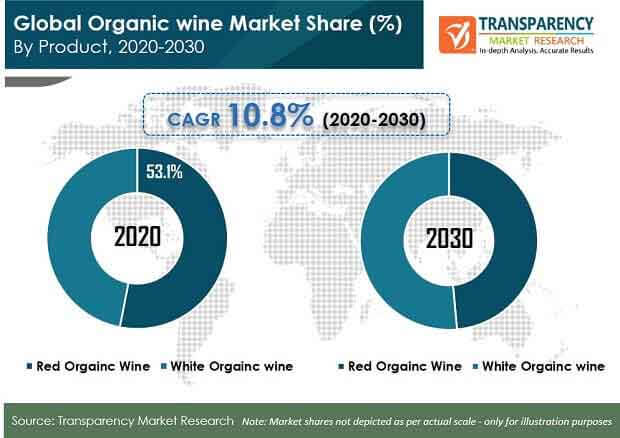
The organic wine market is expected to grow at an impressive CAGR of 10.8% during the forecast period. The market growth can be primarily attributed to the soaring demand from health-conscious consumers, high demand for organic and natural products, focus on improving soil health, rise in the number of wine exhibitions, and growing vegan trends. Europe is expected to dominate the global organic wine market, owing to the strong presence of tier 1 and tier 2 winemaking companies and favorable climatic conditions. Despite sluggish sales during the COVID-19 pandemic, the market is expected to recover in the last quarter of 2020 and beyond.
Organic Wine Market: Overview
Organic Wine: Market Frontrunners
Organic Wine Market: Trends
Environmental and health concerns are driving the demand for organic wine and this factor boosts its sales worldwide, especially in Europe. People are gradually choosing organic products as compared to conventional beverages and wines. Furthermore, primarily small businesses and boutique wineries have turned their conventional production to organic production to cater to health conscious population.
Traditionally, glass bottles are the preferred means of packaging for wine manufacturers, where today’s innovation in packaging is changing the minds of manufacturers. New packaging such as tetra pack and boxes are trending nowadays due to convenience offered to consumers and protection of wine quality for a long time. In comparison, plastic wine packaging is much lighter in weight compared to glass bottles and thus, can be shipped with less fuel. In addition, boxes are also recyclable and increase the shelf life of open wine, thus there is no wine wastage. Besides, boxed wine supports the ‘eco-friendliness’ quality of organic wines focusing on improved versatility with convenience and popularity.
Organic Wine Market: Strategies
Target Region for Organic Wine Market
Organic Wine Market: Players
Food-beverages-Industry battles Tangible Impact of Economic and Cultural changes, Stay Updated on the Latest Trends in food-beverages-market@
https://www.transparencymarketresearch.com/food-beverages-market-reports-4.html
About Us
Transparency Market Research is a global market intelligence company, providing global business information reports and services. Our exclusive blend of quantitative forecasting and trends analysis provides forward-looking insight for thousands of decision makers. Our experienced team of Analysts, Researchers, and Consultants, use proprietary data sources and various tools and techniques to gather, and analyze information.
Our data repository is continuously updated and revised by a team of research experts, so that it always reflects the latest trends and information. With a broad research and analysis capability, Transparency Market Research employs rigorous primary and secondary research techniques in developing distinctive data sets and research material for business reports.
Contact
Transparency Market Research
State Tower,
90 State Street,
Suite 700,
Albany NY – 12207
United States
USA – Canada Toll Free: 866-552-3453
Email: sales@transparencymarketresearch.com
Follow Us: Twitter | LinkedIn
Blog: https://tmrblog.com
There are evolving consumer trends and rising awareness pertaining to niche product categories, such as organic and natural within the food & beverages sector. Over the past decade, organic and natural food products have gained considerable popularity across the world, particularly among millennials.
The natural food & beverage movement across the world is primarily driven by the dwindling interest in chemical-based agricultural techniques. In the current scenario, organic wine is a growing trend in the beverages industry, particularly in wine-drinking countries such as Australia, New Zealand, France, Italy, Argentina, etc. Apart from being driven by sustainable vineyard practices, other factors that are expected to positively influence the growth of the organic wine market include minimalistic and manipulative approaches in wine making techniques.
In addition, as organic wines are free from additives such as sulfur, yeast nutrients, and fining, and produced by using indigenous yeasts, the demand is witnessing considerable growth. The consumer demand for vegan-friendly, preservative-free, biodynamic, carbon-neutral, and certified organic wines have set the ball rolling for the growth of the organic wine market during the forecast period.
Strong expertise with attention to detail makes our market research reports stand apart. Download PDF Brochure –
The organic wine market is currently a niche market that is likely to transition into a mainstream market over the upcoming years. Another factor that is projected to play a key role in the development of the organic wine market is the impressive rise in the number of health-conscious consumers who are largely inclined toward purchasing organic food & beverage products.
Request for Covid-19 Impact Analysis on Organic Wine Market:
At the back of these factors, along with an array of potential benefits associated with organic products, the global organic wine market is expected to reach a value of ~US$ 30 Bn by the end of 2030.
Organic Wine Sales in Europe on Rise
The European region, which has, for decades, remained a hotspot for wine enthusiasts, owing to the vibrant wine culture across Spain, Italy, and even in the Nordic countries, is expected to provide abundant opportunities for manufacturers operating in the current organic wine market landscape. Organic wine, also known as ecological wine, is free from synthetic fertilizers, weed killers, and pesticides.
Buy our Premium Research Report on Organic Wine Market@
The ‘free-from’ trend has gained considerable momentum across the European region, as consumers continue to demand transparency from the food & beverage makers pertaining to ingredients, production or manufacturing processes, nutritional content, etc.
The production of organic wines in the European region is regulated by the European Union Commission Regulation 203/2012, wherein guidelines are provided regarding the oenological processes and other practices that are permitted during the production of organic wine. Several players involved in the organic wine market are increasingly focusing on research and development activities to assess the composition of the ground and evaluate nitrogen, potassium, and phosphorous content in the ground.
More Trending Reports by Transparency Market Research –
The evaluation of different samples of soil is essential to develop an optimal vegetal cover in which, autochthonous wild species are also included for efficient growth of the vine. Several other strategies are being studied to enhance the fertility of the soil without spraying insecticides. In addition, several other companies are investing resources to develop an ideal ecosystem that will enable the growth of vines without any chemical intervention. In the past few years, European winemakers are increasingly focusing on the production of wine using the autochtone yeast. In addition, a number of projects has been launched to make vineyard production more sustainable to minimize the ecological footprint.
As consumers continue to sway toward organic products, the prospects of the organic wine market continue to look bright during the forecast period. The demand for organic wine from retail and restaurant sectors around the world has witnessed consistent growth due to which, the organic wine market is expected to flourish during the assessment period.
As per current trends, the consumption of organic wine is increasing at a rapid pace, particularly in Germany and France. The switch to organic wines is largely influenced by the adoption of sustainable winemaking techniques and the trend is expected to continue over the course of the forecast period. In addition, a significant rise in the number of wine shows and expos is another factor that is likely to play a key role in increasing the sales of organic wine in the forthcoming decade.
The growing emphasis on biodynamic agricultural practices is likely to provide a boost to the expansion of the global organic wine market, as academics, retailers, government agencies, winemakers, and farmers are increasingly focusing on enhancing soil health and minimizing the overall carbon footprint.
The COVID-19 pandemic has had a catastrophic impact on several major core industrial sectors. As restaurant and hospitality segments around the world have more or less come to a standstill due to stringent containment measures enforced by governments, the demand for organic wine has taken a major hit amid the COVID-19 pandemic. While sales of organic wine are likely to remain sluggish in the near future, the demand is expected to witness steady growth in certain regions where lockdown restrictions have been relaxed. The global import and export of organic wine are likely to be back on track in the last quarter of 2020, as restrictions on trade and transportation are likely to be lifted.
While offline sales are estimated to witness a dip, market players should focus on increasing sales via online distribution channels amid the ongoing health crisis.
Analysts’ Viewpoint
The organic wine market is expected to grow at an impressive CAGR of 10.8% during the forecast period. The market growth can be primarily attributed to the soaring demand from health-conscious consumers, high demand for organic and natural products, focus on improving soil health, rise in the number of wine exhibitions, and growing vegan trends. Europe is expected to dominate the global organic wine market, owing to the strong presence of tier 1 and tier 2 winemaking companies and favorable climatic conditions. Despite sluggish sales during the COVID-19 pandemic, the market is expected to recover in the last quarter of 2020 and beyond.
Organic Wine Market: Overview
Organic Wine: Market Frontrunners
Organic Wine Market: Trends
Environmental and health concerns are driving the demand for organic wine and this factor boosts its sales worldwide, especially in Europe. People are gradually choosing organic products as compared to conventional beverages and wines. Furthermore, primarily small businesses and boutique wineries have turned their conventional production to organic production to cater to health conscious population.
Traditionally, glass bottles are the preferred means of packaging for wine manufacturers, where today’s innovation in packaging is changing the minds of manufacturers. New packaging such as tetra pack and boxes are trending nowadays due to convenience offered to consumers and protection of wine quality for a long time. In comparison, plastic wine packaging is much lighter in weight compared to glass bottles and thus, can be shipped with less fuel. In addition, boxes are also recyclable and increase the shelf life of open wine, thus there is no wine wastage. Besides, boxed wine supports the ‘eco-friendliness’ quality of organic wines focusing on improved versatility with convenience and popularity.
Organic Wine Market: Strategies
Target Region for Organic Wine Market
Organic Wine Market: Players
Food-beverages-Industry battles Tangible Impact of Economic and Cultural changes, Stay Updated on the Latest Trends in food-beverages-market@
https://www.transparencymarketresearch.com/food-beverages-market-reports-4.html
About Us
Transparency Market Research is a global market intelligence company, providing global business information reports and services. Our exclusive blend of quantitative forecasting and trends analysis provides forward-looking insight for thousands of decision makers. Our experienced team of Analysts, Researchers, and Consultants, use proprietary data sources and various tools and techniques to gather, and analyze information.
Our data repository is continuously updated and revised by a team of research experts, so that it always reflects the latest trends and information. With a broad research and analysis capability, Transparency Market Research employs rigorous primary and secondary research techniques in developing distinctive data sets and research material for business reports.
Contact
Transparency Market Research
State Tower,
90 State Street,
Suite 700,
Albany NY – 12207
United States
USA – Canada Toll Free: 866-552-3453
Email: sales@transparencymarketresearch.com
Follow Us: Twitter | LinkedIn
Blog: https://tmrblog.com
Organic wine is produced from grapes grown without synthetic fertilizers, pesticides, or herbicides. It emphasizes sustainable farming practices and often involves minimal intervention during the winemaking process.
Explore more articles in the Research Reports category