Search
00
GBAF Logo
trophy
Top StoriesInterviewsBusinessFinanceBankingTechnologyInvestingTradingVideosAwardsMagazinesHeadlinesTrends

Subscribe to our newsletter

Get the latest news and updates from our team.

Global Banking & Finance Review®

Global Banking & Finance Review® - Subscribe to our newsletter

Company

    GBAF Logo
    • About Us
    • Profile
    • Privacy & Cookie Policy
    • Terms of Use
    • Contact Us
    • Advertising
    • Submit Post
    • Latest News
    • Research Reports
    • Press Release
    • Awards▾
      • About the Awards
      • Awards TimeTable
      • Submit Nominations
      • Testimonials
      • Media Room
      • Award Winners
      • FAQ
    • Magazines▾
      • Global Banking & Finance Review Magazine Issue 79
      • Global Banking & Finance Review Magazine Issue 78
      • Global Banking & Finance Review Magazine Issue 77
      • Global Banking & Finance Review Magazine Issue 76
      • Global Banking & Finance Review Magazine Issue 75
      • Global Banking & Finance Review Magazine Issue 73
      • Global Banking & Finance Review Magazine Issue 71
      • Global Banking & Finance Review Magazine Issue 70
      • Global Banking & Finance Review Magazine Issue 69
      • Global Banking & Finance Review Magazine Issue 66
    Top StoriesInterviewsBusinessFinanceBankingTechnologyInvestingTradingVideosAwardsMagazinesHeadlinesTrends

    Global Banking & Finance Review® is a leading financial portal and online magazine offering News, Analysis, Opinion, Reviews, Interviews & Videos from the world of Banking, Finance, Business, Trading, Technology, Investing, Brokerage, Foreign Exchange, Tax & Legal, Islamic Finance, Asset & Wealth Management.
    Copyright © 2010-2026 GBAF Publications Ltd - All Rights Reserved. | Sitemap | Tags | Developed By eCorpIT

    Editorial & Advertiser disclosure

    Global Banking & Finance Review® is an online platform offering news, analysis, and opinion on the latest trends, developments, and innovations in the banking and finance industry worldwide. The platform covers a diverse range of topics, including banking, insurance, investment, wealth management, fintech, and regulatory issues. The website publishes news, press releases, opinion and advertorials on various financial organizations, products and services which are commissioned from various Companies, Organizations, PR agencies, Bloggers etc. These commissioned articles are commercial in nature. This is not to be considered as financial advice and should be considered only for information purposes. It does not reflect the views or opinion of our website and is not to be considered an endorsement or a recommendation. We cannot guarantee the accuracy or applicability of any information provided with respect to your individual or personal circumstances. Please seek Professional advice from a qualified professional before making any financial decisions. We link to various third-party websites, affiliate sales networks, and to our advertising partners websites. When you view or click on certain links available on our articles, our partners may compensate us for displaying the content to you or make a purchase or fill a form. This will not incur any additional charges to you. To make things simpler for you to identity or distinguish advertised or sponsored articles or links, you may consider all articles or links hosted on our site as a commercial article placement. We will not be responsible for any loss you may suffer as a result of any omission or inaccuracy on the website.

    Home > Trading > Market reaction to the pound hitting a record low
    Trading

    Market reaction to the pound hitting a record low

    Published by Jessica Weisman-Pitts

    Posted on October 14, 2022

    5 min read

    Last updated: February 3, 2026

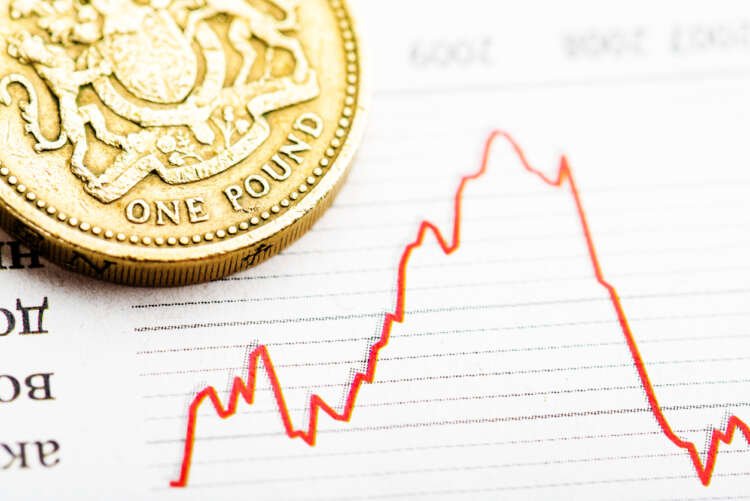
    This image features a one pound coin against a fluctuating graph, reflecting the recent decline of the pound. It illustrates the market reaction to economic changes impacting UK investors as discussed in the article.
    One pound coin overlaid on a fluctuating graph illustrating currency trends - Global Banking & Finance Review
    Why waste money on news and opinion when you can access them for free?

    Take advantage of our newsletter subscription and stay informed on the go!

    Subscribe

    Tags:UK economyinterest ratesfinancial markets

    By Rupert Thompson, Investment Strategist at Kingswood

    The past week has been a torrid affair with major moves in many markets. Global equities ended the week down a sizeable 4.2% in local currency terms and are back down to around their lows of mid-June. However, a sharp fall in the pound, particularly against the dollar, meant UK investors once again got off relatively lightly with global equities down all of 0.3% in sterling terms. UK and European equities fared worst, with declines of around 3%.

    A sharp rise in yields also led to bonds posting sizeable losses, particularly UK gilts which were down as much as 5.6% over the week. 10-year gilt yields surged 0.7% and have risen a further 0.3% this morning to 4.1%. Meanwhile, 10-year US Treasury yields have increased 0.35% to 3.8%.

    The turmoil kicked off with the meeting of the US Fed last Wednesday. Its decision to hike rates by a further 0.75% to 3-3.25% was no surprise but its new forecasts put paid to any hope that rates were now close to a peak and would be lowered again any time soon. It is now projecting rates to rise to around 4.5% by year-end and remain around here through next year, with any easing delayed until 2024.

    The Fed’s doubling down on its hawkish stance followed the inflation numbers of a couple of weeks ago which showed a worsening in underlying inflation pressures. Unsurprisingly, the Fed has cut its growth forecasts significantly given the additional policy tightening it is now planning, although it is still not predicting a recession.

    Market attention then swung rapidly from the US to the UK. Thursday saw the BOE raise rates by 0.5% rather than the 0.75% favoured by the Fed and ECB in their latest moves. Any relief, however, was momentary. The MPC said it would only take into account the government’s fiscal boost in its November forecasting round and hinted it could then step up the pace of tightening.

    Expectations for additional rate hikes were then ratcheted up further on Friday by the tax cuts announced in the mini-Budget. The basic rate of income tax was cut by 1p, the 45% higher rate of income tax abolished, stamp duty reduced, and the hikes in national insurance and the corporation tax rate cancelled. Although tax cuts were always on the cards, these went further than expected and were then followed by Kwarteng’s promise of further cuts to come.

    All of this comes hard on the heels of the government’s very costly energy support package for consumers and business. The problem is that while the fiscal boost will help support growth over the coming year, this is at a time when the BOE believes a sharp slowdown is required to bring inflation back under control.

    Markets have also taken fright at the implications of a large rise in government borrowing. Not only have gilt yields surged but the pound has plummeted from $1.14 all of a week ago to an all-time low this morning of $1.03 before rebounding to $1.08. Sterling’s losses have been most pronounced against the dollar which continues to strengthen.

    The fall in the pound will add to existing inflation pressures and reinforce the BOE’s determination to raise rates. There is even talk of a possible emergency rate hike in coming days. The market is now pricing in rates rising from 2.25% currently to as far as 5.5-6% by next summer. While this looks a considerable over-reaction, rates do now look set to be raised to at least 4%.

    Finally, this morning saw a right-wing alliance win a majority in the Italian election with Georgia Meloni of the Brothers of Italy party now set to become prime minister. Her links to Italy’s fascist past, along with her Eurosceptic views and less hostile attitude to Russia, can only add to the difficulty of sustaining a unified European policy, not least on Ukraine.

    So where does this all leave us? The temptation at times of market turmoil is always to bail out. However, the indisputable lesson of history is that this is the wrong course of action for any investor with a medium to long-term horizon. Over the last 50 years, there have been numerous crises and sell-offs and yet equities have always managed to recover and produce long-term inflation-beating returns. Trying to time a market bottom is all but impossible and risks missing the best performing days in any rebound, which has proven very costly in the past.

    This is far from saying that we are taking no action on our client portfolios. But it is all about rebalancing, rather than wholesale de-risking. Bonds for instance are looking considerably more attractive now they are once again paying a respectable yield. As for equities, a considerable amount of bad news is priced in and sentiment fast approaching rock-bottom levels.

    We had been expecting markets to remain volatile over the remainder of the year and we still believe this. So too, do we stick with the view that equity markets will in time recover, although not until we are considerably closer to the peak in rates.

    Frequently Asked Questions about Market reaction to the pound hitting a record low

    1What is inflation?

    Inflation is the rate at which the general level of prices for goods and services rises, eroding purchasing power. It is typically measured by the Consumer Price Index (CPI).

    2What are interest rates?

    Interest rates are the cost of borrowing money or the return on savings, expressed as a percentage. They are influenced by central banks and affect economic activity.

    3What are equities?

    Equities represent ownership in a company, typically in the form of stocks. Investors buy equities to gain a share of the company's profits and potential capital appreciation.

    4What is a central bank?

    A central bank is a national institution that manages a country's currency, money supply, and interest rates. It oversees monetary policy to ensure economic stability.

    More from Trading

    Explore more articles in the Trading category

    Image for Navigating Currency Volatility in an Uncertain Global Economy
    Navigating Currency Volatility in an Uncertain Global Economy
    Image for What Is a Liquidity Provider – And Why Modern Brokers Can’t Function Without One
    What Is a Liquidity Provider – And Why Modern Brokers Can’t Function Without One
    Image for OneFunded: Prop Firm Overview and Program Structure
    OneFunded: Prop Firm Overview and Program Structure
    Image for What if You Can Actually Chat with Your Crypto Wallet?
    What if You Can Actually Chat with Your Crypto Wallet?
    Image for The Growing Importance of Choosing the Right Crypto Broker in 2025
    The Growing Importance of Choosing the Right Crypto Broker in 2025
    Image for The Rise of Algorithmic Trading Among Retail Investors in the UK
    The Rise of Algorithmic Trading Among Retail Investors in the UK
    Image for Forex Trading for the 9-to-5er: A Realistic Path to a Second Income
    Forex Trading for the 9-to-5er: A Realistic Path to a Second Income
    Image for Quality Matters: ZiNRai’s Focus on Empowering Traders with Precision and Purpose
    Quality Matters: ZiNRai’s Focus on Empowering Traders with Precision and Purpose
    Image for MiCA Regulations and the Legal Requirements for Crypto Presales and Token Offerings in the European Union
    MiCA Regulations and the Legal Requirements for Crypto Presales and Token Offerings in the European Union
    Image for Top Ways Forex Traders Benefit From Peer-to-Peer Learning
    Top Ways Forex Traders Benefit From Peer-to-Peer Learning
    Image for Why High Leverage Remains Attractive to Forex Traders Worldwide
    Why High Leverage Remains Attractive to Forex Traders Worldwide
    Image for XDC Network’s ETP Listing Signals the Maturing Convergence of Blockchain and Trade Finance
    XDC Network’s ETP Listing Signals the Maturing Convergence of Blockchain and Trade Finance
    View All Trading Posts
    Previous Trading PostThe retail case for CBDCs: public money for the public
    Next Trading PostSterling falls again as investors await Friday’s U.S. jobs data