Search
00
GBAF Logo
trophy
Top StoriesInterviewsBusinessFinanceBankingTechnologyInvestingTradingVideosAwardsMagazinesHeadlinesTrends

Subscribe to our newsletter

Get the latest news and updates from our team.

Global Banking & Finance Review®

Global Banking & Finance Review® - Subscribe to our newsletter

Company

    GBAF Logo
    • About Us
    • Profile
    • Privacy & Cookie Policy
    • Terms of Use
    • Contact Us
    • Advertising
    • Submit Post
    • Latest News
    • Research Reports
    • Press Release
    • Awards▾
      • About the Awards
      • Awards TimeTable
      • Submit Nominations
      • Testimonials
      • Media Room
      • Award Winners
      • FAQ
    • Magazines▾
      • Global Banking & Finance Review Magazine Issue 79
      • Global Banking & Finance Review Magazine Issue 78
      • Global Banking & Finance Review Magazine Issue 77
      • Global Banking & Finance Review Magazine Issue 76
      • Global Banking & Finance Review Magazine Issue 75
      • Global Banking & Finance Review Magazine Issue 73
      • Global Banking & Finance Review Magazine Issue 71
      • Global Banking & Finance Review Magazine Issue 70
      • Global Banking & Finance Review Magazine Issue 69
      • Global Banking & Finance Review Magazine Issue 66
    Top StoriesInterviewsBusinessFinanceBankingTechnologyInvestingTradingVideosAwardsMagazinesHeadlinesTrends

    Global Banking & Finance Review® is a leading financial portal and online magazine offering News, Analysis, Opinion, Reviews, Interviews & Videos from the world of Banking, Finance, Business, Trading, Technology, Investing, Brokerage, Foreign Exchange, Tax & Legal, Islamic Finance, Asset & Wealth Management.
    Copyright © 2010-2026 GBAF Publications Ltd - All Rights Reserved. | Sitemap | Tags | Developed By eCorpIT

    Editorial & Advertiser disclosure

    Global Banking & Finance Review® is an online platform offering news, analysis, and opinion on the latest trends, developments, and innovations in the banking and finance industry worldwide. The platform covers a diverse range of topics, including banking, insurance, investment, wealth management, fintech, and regulatory issues. The website publishes news, press releases, opinion and advertorials on various financial organizations, products and services which are commissioned from various Companies, Organizations, PR agencies, Bloggers etc. These commissioned articles are commercial in nature. This is not to be considered as financial advice and should be considered only for information purposes. It does not reflect the views or opinion of our website and is not to be considered an endorsement or a recommendation. We cannot guarantee the accuracy or applicability of any information provided with respect to your individual or personal circumstances. Please seek Professional advice from a qualified professional before making any financial decisions. We link to various third-party websites, affiliate sales networks, and to our advertising partners websites. When you view or click on certain links available on our articles, our partners may compensate us for displaying the content to you or make a purchase or fill a form. This will not incur any additional charges to you. To make things simpler for you to identity or distinguish advertised or sponsored articles or links, you may consider all articles or links hosted on our site as a commercial article placement. We will not be responsible for any loss you may suffer as a result of any omission or inaccuracy on the website.

    Home > Business > Japan extends COVID-19 emergency lockdown as cases surge
    Business

    Japan extends COVID-19 emergency lockdown as cases surge

    Published by maria gbaf

    Posted on August 18, 2021

    7 min read

    Last updated: January 21, 2026

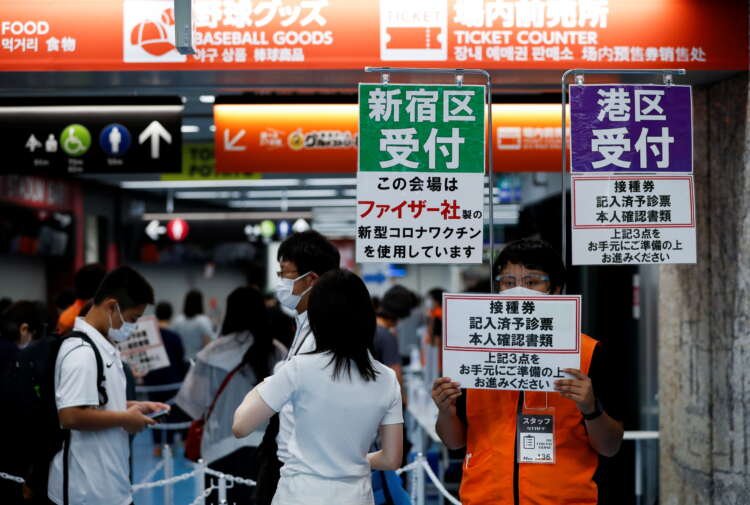
    Image depicting Tokyo's urgent response to rising COVID-19 cases, highlighting Japan's extended emergency lockdown measures to mitigate the pandemic's impact on the healthcare system.
    Japan's COVID-19 emergency measures extend as cases surge - Global Banking & Finance Review
    Why waste money on news and opinion when you can access them for free?

    Take advantage of our newsletter subscription and stay informed on the go!

    Subscribe

    (Corrects to say state of emergency is fourth, not fifth, of the pandemic in paragraph 2.)

    By Daniel Leussink, Leika Kihara and Sakura Murakami

    TOKYO/FUKUOKA, Japan (Reuters) -Japan on Tuesday extended its state of emergency in Tokyo and other regions and announced new measures covering seven more prefectures to counter a spike in COVID-19 infections that is threatening the medical system.

    The current state of emergency, the fourth of the pandemic so far, was due to expire on Aug. 31 but will now last until Sept. 12. Tokyo announced 4,377 new coronavirus cases on Tuesday, after a record 5,773 on Friday.

    “The Delta variant raging across the world is causing unprecedented cases in our country,” Prime Minister Yoshihide Suga said. “Serious cases are increasing rapidly and severely burdening the medical system, particularly in the capital region.”

    The emergency will now cover nearly 60% of Japan’s population with the prefectures of Ibaraki, Tochigi, Gunma, Shizuoka, Kyoto, Hyogo and Fukuoka included. Less strict “quasi-emergency” measures will be applied to a further 10 prefectures.

    Restaurants are being asked to close early and stop serving alcohol in exchange for a subsidy. Suga announced a fresh subsidy of 300 billion yen ($2.7 billion) to help businesses cope with the fall-out.

    Suga said the government would also request occupancy limits at department stores and ask people to reduce by half the times they go to crowded areas.

    Speaking at a news conference explaining the steps, the government’s top health advisor, Shigeru Omi, said Japan needed to come up with steps to “prod individuals to avoid taking action that could potentially spread infections”.

    He said that could be done under the current laws, which are mostly based on voluntary cooperation, but added that there’s also room for a nationwide debate on how to do this under a new legal framework. He did not go into details.

    Speaking beside Omi, Suga said the government would consider crafting legislation to swiftly prepare enough hospital beds for critically ill COVID-19 patients, and speed up vaccinations.

    Suga dismissed the idea of imposing a blanket, nationwide state of emergency, saying that would pose “excessive restrictions for some prefectures” that were succeeding in containing new infections.

    FALLING SHARES

    Japanese shares fell https://www.reuters.com/article/japan-stocks-close/nikkei-falls-for-fourth-day-as-virus-worries-outweigh-upbeat-earnings-cheer-idUSL4N2PO1EB for a fourth day on Tuesday as concerns about the Delta variant overshadowed optimism about upbeat earnings.

    Japan’s case fatality rate stands at about 1.3%, compared with 1.7% in the United States and 2.1% in Britain.

    But health experts fear the number of deaths could soar in Japan as the Delta variant tears through the younger population and hospitals become too crowded to treat serious cases.

    “Many experts expressed an extremely strong sense of crisis about the medical care situation and the status of infections,” Economy Minister Yasutoshi Nishimura said after consulting with health advisers.

    More than 80% of Tokyo’s critical care beds are occupied, and the rate is already 100% in neighbouring Kanagawa prefecture. Serious cases climbed to records of 276 in Tokyo and 1,646 nationwide on Tuesday.

    Dai-ichi Life Research Institute estimated that the government’s extended and expanded state of emergency would lead to a total economic loss of about 1.2 trillion yen ($11 billion) and could cost 66,000 jobs.

    That was about 60% higher than an expected loss of about 750 billion yen if the emergency remained at its current scope and schedule.

    Repeated states of emergency have had a limited effect in slowing the spread of the virus.

    Takuto Honda, 20, a university student in the southwestern city of Fukuoka who works part-time at a karaoke shop, said a harder lockdown with government pay-outs would be more effective. “If there is money to host the Olympics, there should be money to compensate us,” he said.

    Pandemic fatigue and summer vacations have also been blamed for contributing to the latest COVID-19 surge in a nation where only around 37% of people have been fully vaccinated.

    (Reporting by Sakura Murakami in FUKUOKA, Daniel Leussink, Leika Kihara and Rocky Swift in TOKYO; Additional reporting by Antoni Slodkowski; Editing by Susan Fenton, Giles Elgood and Mark Heinrich)

    (Corrects to say state of emergency is fourth, not fifth, of the pandemic in paragraph 2.)

    By Daniel Leussink, Leika Kihara and Sakura Murakami

    TOKYO/FUKUOKA, Japan (Reuters) -Japan on Tuesday extended its state of emergency in Tokyo and other regions and announced new measures covering seven more prefectures to counter a spike in COVID-19 infections that is threatening the medical system.

    The current state of emergency, the fourth of the pandemic so far, was due to expire on Aug. 31 but will now last until Sept. 12. Tokyo announced 4,377 new coronavirus cases on Tuesday, after a record 5,773 on Friday.

    “The Delta variant raging across the world is causing unprecedented cases in our country,” Prime Minister Yoshihide Suga said. “Serious cases are increasing rapidly and severely burdening the medical system, particularly in the capital region.”

    The emergency will now cover nearly 60% of Japan’s population with the prefectures of Ibaraki, Tochigi, Gunma, Shizuoka, Kyoto, Hyogo and Fukuoka included. Less strict “quasi-emergency” measures will be applied to a further 10 prefectures.

    Restaurants are being asked to close early and stop serving alcohol in exchange for a subsidy. Suga announced a fresh subsidy of 300 billion yen ($2.7 billion) to help businesses cope with the fall-out.

    Suga said the government would also request occupancy limits at department stores and ask people to reduce by half the times they go to crowded areas.

    Speaking at a news conference explaining the steps, the government’s top health advisor, Shigeru Omi, said Japan needed to come up with steps to “prod individuals to avoid taking action that could potentially spread infections”.

    He said that could be done under the current laws, which are mostly based on voluntary cooperation, but added that there’s also room for a nationwide debate on how to do this under a new legal framework. He did not go into details.

    Speaking beside Omi, Suga said the government would consider crafting legislation to swiftly prepare enough hospital beds for critically ill COVID-19 patients, and speed up vaccinations.

    Suga dismissed the idea of imposing a blanket, nationwide state of emergency, saying that would pose “excessive restrictions for some prefectures” that were succeeding in containing new infections.

    FALLING SHARES

    Japanese shares fell https://www.reuters.com/article/japan-stocks-close/nikkei-falls-for-fourth-day-as-virus-worries-outweigh-upbeat-earnings-cheer-idUSL4N2PO1EB for a fourth day on Tuesday as concerns about the Delta variant overshadowed optimism about upbeat earnings.

    Japan’s case fatality rate stands at about 1.3%, compared with 1.7% in the United States and 2.1% in Britain.

    But health experts fear the number of deaths could soar in Japan as the Delta variant tears through the younger population and hospitals become too crowded to treat serious cases.

    “Many experts expressed an extremely strong sense of crisis about the medical care situation and the status of infections,” Economy Minister Yasutoshi Nishimura said after consulting with health advisers.

    More than 80% of Tokyo’s critical care beds are occupied, and the rate is already 100% in neighbouring Kanagawa prefecture. Serious cases climbed to records of 276 in Tokyo and 1,646 nationwide on Tuesday.

    Dai-ichi Life Research Institute estimated that the government’s extended and expanded state of emergency would lead to a total economic loss of about 1.2 trillion yen ($11 billion) and could cost 66,000 jobs.

    That was about 60% higher than an expected loss of about 750 billion yen if the emergency remained at its current scope and schedule.

    Repeated states of emergency have had a limited effect in slowing the spread of the virus.

    Takuto Honda, 20, a university student in the southwestern city of Fukuoka who works part-time at a karaoke shop, said a harder lockdown with government pay-outs would be more effective. “If there is money to host the Olympics, there should be money to compensate us,” he said.

    Pandemic fatigue and summer vacations have also been blamed for contributing to the latest COVID-19 surge in a nation where only around 37% of people have been fully vaccinated.

    (Reporting by Sakura Murakami in FUKUOKA, Daniel Leussink, Leika Kihara and Rocky Swift in TOKYO; Additional reporting by Antoni Slodkowski; Editing by Susan Fenton, Giles Elgood and Mark Heinrich)

    More from Business

    Explore more articles in the Business category

    Image for Empire Lending helps SMEs secure capital faster, without bank delays
    Empire Lending helps SMEs secure capital faster, without bank delays
    Image for Why Leen Kawas is Prioritizing Strategic Leadership at Propel Bio Partners
    Why Leen Kawas is Prioritizing Strategic Leadership at Propel Bio Partners
    Image for How Commercial Lending Software Platforms Are Structured and Utilized
    How Commercial Lending Software Platforms Are Structured and Utilized
    Image for Oil Traders vs. Tech Startups: Surprising Lessons from Two High-Stakes Worlds | Said Addi
    Oil Traders vs. Tech Startups: Surprising Lessons from Two High-Stakes Worlds | Said Addi
    Image for Why More Mortgage Brokers Are Choosing to Join a Network
    Why More Mortgage Brokers Are Choosing to Join a Network
    Image for From Recession Survivor to Industry Pioneer: Ed Lewis's Data Revolution
    From Recession Survivor to Industry Pioneer: Ed Lewis's Data Revolution
    Image for From Optometry to Soul Vision: The Doctor Helping Entrepreneurs Lead With Purpose
    From Optometry to Soul Vision: The Doctor Helping Entrepreneurs Lead With Purpose
    Image for Global Rankings Revealed: Top PMO Certifications Worldwide
    Global Rankings Revealed: Top PMO Certifications Worldwide
    Image for World Premiere of Midnight in the War Room to be Hosted at Black Hat Vegas
    World Premiere of Midnight in the War Room to be Hosted at Black Hat Vegas
    Image for Role of Personal Accident Cover in 2-Wheeler Insurance for Owners and Riders
    Role of Personal Accident Cover in 2-Wheeler Insurance for Owners and Riders
    Image for The Young Rich Lister Who Also Teaches: How Aaron Sansoni Built a Brand Around Execution
    The Young Rich Lister Who Also Teaches: How Aaron Sansoni Built a Brand Around Execution
    Image for Q3 2025 Priority Leadership: Tom Priore and Tim O'Leary Balance Near-Term Challenges with Long-Term Strategic Wins
    Q3 2025 Priority Leadership: Tom Priore and Tim O'Leary Balance Near-Term Challenges with Long-Term Strategic Wins
    View All Business Posts
    Previous Business PostEDF Energy to raise retail energy prices in UK by 12%
    Next Business PostAustralia’s Woodside shares drop on BHP petroleum merger