
Search
00
GBAF Logo
trophy
Top StoriesInterviewsBusinessFinanceBankingTechnologyInvestingTradingVideosAwardsMagazinesHeadlinesTrends

Subscribe to our newsletter

Get the latest news and updates from our team.

Global Banking & Finance Review®

Global Banking & Finance Review® - Subscribe to our newsletter

Company

    GBAF Logo
    • About Us
    • Advertising and Sponsorship
    • Profile & Readership
    • Contact Us
    • Latest News
    • Privacy & Cookies Policies
    • Terms of Use
    • Advertising Terms
    • Issue 81
    • Issue 80
    • Issue 79
    • Issue 78
    • Issue 77
    • Issue 76
    • Issue 75
    • Issue 74
    • Issue 73
    • Issue 72
    • Issue 71
    • Issue 70
    • View All
    • About the Awards
    • Awards Timetable
    • Awards Winners
    • Submit Nominations
    • Testimonials
    • Media Room
    • FAQ
    • Asset Management Awards
    • Brand of the Year Awards
    • Business Awards
    • Cash Management Banking Awards
    • Banking Technology Awards
    • CEO Awards
    • Customer Service Awards
    • CSR Awards
    • Deal of the Year Awards
    • Corporate Governance Awards
    • Corporate Banking Awards
    • Digital Transformation Awards
    • Fintech Awards
    • Education & Training Awards
    • ESG & Sustainability Awards
    • ESG Awards
    • Forex Banking Awards
    • Innovation Awards
    • Insurance & Takaful Awards
    • Investment Banking Awards
    • Investor Relations Awards
    • Leadership Awards
    • Islamic Banking Awards
    • Real Estate Awards
    • Project Finance Awards
    • Process & Product Awards
    • Telecommunication Awards
    • HR & Recruitment Awards
    • Trade Finance Awards
    • The Next 100 Global Awards
    • Wealth Management Awards
    • Travel Awards
    • Years of Excellence Awards
    • Publishing Principles
    • Ownership & Funding
    • Corrections Policy
    • Editorial Code of Ethics
    • Diversity & Inclusion Policy
    • Fact Checking Policy
    Original content: Global Banking and Finance Review - https://www.globalbankingandfinance.com

    A global financial intelligence and recognition platform delivering authoritative insights, data-driven analysis, and institutional benchmarking across Banking, Capital Markets, Investment, Technology, and Financial Infrastructure.

    Copyright © 2010-2026 - All Rights Reserved. | Sitemap | Tags

    Editorial & Advertiser disclosure

    Global Banking & Finance Review® is an online platform offering news, analysis, and opinion on the latest trends, developments, and innovations in the banking and finance industry worldwide. The platform covers a diverse range of topics, including banking, insurance, investment, wealth management, fintech, and regulatory issues. The website publishes news, press releases, opinion and advertorials on various financial organizations, products and services which are commissioned from various Companies, Organizations, PR agencies, Bloggers etc. These commissioned articles are commercial in nature. This is not to be considered as financial advice and should be considered only for information purposes. It does not reflect the views or opinion of our website and is not to be considered an endorsement or a recommendation. We cannot guarantee the accuracy or applicability of any information provided with respect to your individual or personal circumstances. Please seek Professional advice from a qualified professional before making any financial decisions. We link to various third-party websites, affiliate sales networks, and to our advertising partners websites. When you view or click on certain links available on our articles, our partners may compensate us for displaying the content to you or make a purchase or fill a form. This will not incur any additional charges to you. To make things simpler for you to identity or distinguish advertised or sponsored articles or links, you may consider all articles or links hosted on our site as a commercial article placement. We will not be responsible for any loss you may suffer as a result of any omission or inaccuracy on the website.

    1. Home
    2. >Finance
    3. >Italy’s tax system under scrutiny as study shows it favours rich
    Finance

    Italy’s Tax System Under Scrutiny as Study Shows It Favours Rich

    Published by Jessica Weisman-Pitts

    Posted on December 2, 2024

    5 min read

    Last updated: January 28, 2026

    Add as preferred source on Google
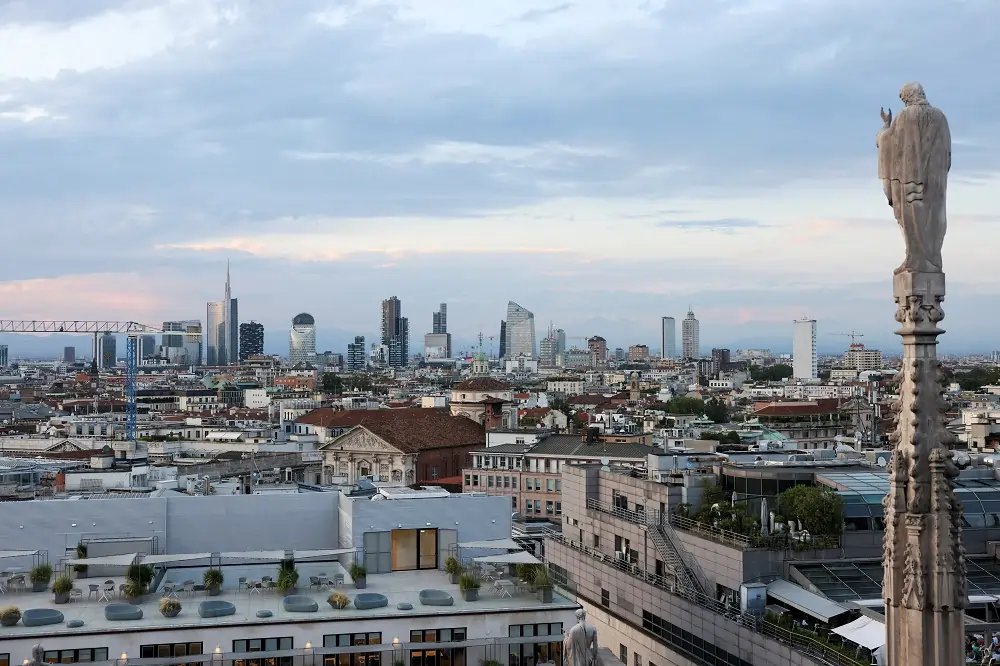
    Image representing Italy's financial landscape in relation to the recent study on tax system inequality. It highlights how the wealthiest 7% pay less tax than low and middle-income earners, reflecting issues in public finance and economic disparity.
    Overview of Italy's financial landscape highlighting tax system inequality - Global Banking & Finance Review
    Why waste money on news and opinion when you can access them for free?

    Take advantage of our newsletter subscription and stay informed on the go!

    Subscribe

    Tags:tax administrationIncome taxfinancial marketscorporate taxeconomic growth

    Quick Summary

    By Giuseppe Fonte, Gavin Jones and Alvise Armellini

    By Giuseppe Fonte, Gavin Jones and Alvise Armellini

    ROME (Reuters) -Italy’s tax system is skewed in a way that lets society’s wealthiest 7% pay proportionately less tax than low and middle-income earners, a new study shows, fuelling inequality and hurting public finances in one of Europe’s most indebted nations.

    In advanced countries, the rich, helped by financial advisers and low levies on investments, find ways to maximise returns on capital and reduce their tax bills, and the top 1-2% often pay proportionally less than those below them.

    But in Italy the distortions kick in much earlier on the income and wealth scale, according to the study by five economists including former Treasury official Alessandro Santoro.

    The paper, which has triggered a debate in the euro zone’s third-largest economy, shows the system is regressive not just for the top 1-2% but for the top 7%, involving medium-high salaries as well as the super-rich.

    Progressive taxation means the more you have the more you pay as a proportion of your earnings and assets. The system becomes regressive when this principle is reversed.

    “There is evidence that regressivity in Italy is remarkable compared with similar economies and affects incomes above 76,000 euros ($80,000) with wealth of about 450,000 euros,” Santoro told Reuters.

    REDUCING INEQUALITY, DEBT

    This situation has major consequences for Italy’s broader economy, many economists say.

    They say hiking taxation on medium-high and high earners would reduce inequality in a country where poverty has been rising for years and would enable Rome to cut the euro zone’s second-biggest debt pile.

    Alternatively, it could provide room to cut taxes for lower earners who spend proportionately more of their income than the rich, potentially helping consumption and growth in the currency bloc’s most chronically sluggish economy.

    A Treasury spokesperson said the government was against raising taxes and pointed to tax cuts for lower and middle earners in Rome’s 2025 budget.

    Italy is a relatively high-tax country, with levies of all types amounting to 41.5% of gross domestic product. But the burden is unevenly spread.

    The country has low taxation on some property and financial assets that are typical sources of income for the wealthy, favourable rates for the self-employed, and negligible inheritance tax.

    Meanwhile, low paid workers in Italy lose more of their gross wages to tax and social security contributions than in any other EU country, European Commission data shows.

    “We have chosen an extremist mix of tax rates,” said Marco Leonardi, economics professor at Milan’s Statale University and a former aide to Prime Minister Giorgia Meloni’s predecessor Mario Draghi.

    Most financial investments are taxed from as low as 12.5% to 26%, rent on property can be taxed at a flat rate of 21%, and there is no taxation on people’s primary homes.

    The self-employed, a bedrock of support for Meloni’s right-wing government, can pay just 15% on annual income of up to 85,000 euros, whereas the highest tax band of 43% for payroll workers applies to income above 50,000 euros per year.

    Fifty years ago, Italy’s top income tax rate, applied on the very highest earners, stood at 72%.

    MIDDLE CLASS BURDEN

    As a result of these distortions, people earning between 29,000 and 75,000 euros per year, who account for 21% of taxpayers, contribute more than 40% of income tax revenues, Treasury data shows.

    Inheritance tax yields just 1 billion euros per year, compared with around 18 billion in France and 9 billion in Germany and Britain.

    “Inheritance tax is so low as to be insignificant,” said Leonardi, adding that Meloni could fund tax cuts for middle earners through even a marginal increase in this levy.

    The government, under pressure to ease the burden on the middle classes, is struggling to find 2.5 billion euros in its 2025 budget to cut taxes for those earning 50,000-60,000 euros.

    Meloni shows no intention of finding the cash by targeting Italy’s better-off, though she recently doubled a contested “flat tax” on income earned abroad which is intended to attract millionaires to the country.

    Mariana Mazzucato, an economics professor at University College London and policy adviser to governments, told Reuters flat taxes of all types were regressive and bad for revenue.

    “In a country like Italy, with growing inequality, they are just absurd,” she said.

    The government argues that flat taxes, or similar schemes such as the single 15% rate for the self-employed, simplify the system and help reduce tax evasion.

    Santoro urged a tax on wealth owned by the top 1%, or even just the top 0.1%, that could yield up to 12 billion euros per year.

    The first group amounts to some 500,000 people holding assets of more than 2 million euros, while the 0.1% of Italy’s richest equates to 50,000 people with assets of more than 15 million euros.

    ($1 = 0.9475 euros)

    (Additional reporting and graphics by Stefano Bernabei, Editing by Hugh Lawson)

    Frequently Asked Questions about Italy’s tax system under scrutiny as study shows it favours rich

    1What is a regressive tax?

    A regressive tax is a tax that takes a larger percentage from low-income earners than from high-income earners, leading to increased inequality.

    2What is progressive taxation?

    Progressive taxation is a tax system where the tax rate increases as the taxable amount increases, meaning higher earners pay a larger percentage of their income.

    3What is income tax?

    Income tax is a tax imposed on individuals or entities based on their income or profits, typically calculated as a percentage of earnings.

    More from Finance

    Explore more articles in the Finance category

    Image for Blaze at Russia's Baltic Sea port of Ust-Luga after major Ukrainian drone attack
    Blaze at Russia's Baltic Sea Port of Ust-Luga After Major Ukrainian Drone Attack
    Image for Morning Bid: Deal, or no deal?
    Morning Bid: Deal, or No Deal?
    Image for Labubu maker Pop Mart meets 2025 revenue expectations
    Labubu Maker Pop Mart Meets 2025 Revenue Expectations
    Image for Israel strikes Tehran as Trump says US negotiating to end war
    Israel Strikes Tehran as Trump Says US Negotiating to End War
    Image for South Korea, Germany exposed to rare earths shortage, Australia's Arafura says
    South Korea, Germany Exposed to Rare Earths Shortage, Australia's Arafura Says
    Image for Currency markets drift as traders sceptical of US efforts to end Iran war
    Currency Markets Drift as Traders Sceptical of US Efforts to End Iran War
    Image for Stocks bounce and oil retreats on Mideast ceasefire reports
    Stocks Bounce and Oil Retreats on Mideast Ceasefire Reports
    Image for Equinor CEO says EU unlikely to increase Russian gas imports
    Equinor CEO Says EU Unlikely to Increase Russian Gas Imports
    Image for Openreach taps Google AI to speed fibre rollout, cut emissions
    Openreach Taps Google AI to Speed Fibre Rollout, Cut Emissions
    Image for UK consumer sentiment falls as Iran war rages, KPMG says
    UK Consumer Sentiment Falls as Iran War Rages, Kpmg Says
    Image for US oil prices fall on prospect of Middle East ceasefire easing supply disruption
    US Oil Prices Fall on Prospect of Middle East Ceasefire Easing Supply Disruption
    Image for Lamborghinis stranded in Sri Lanka as war disrupts Asia's used-car trade 
    Lamborghinis Stranded in Sri Lanka as War Disrupts Asia's Used-Car Trade 
    View All Finance Posts
    Previous Finance PostAs a Hedge Against Inflation: Buy Gold Coins and Store Them in a Safe Deposit Box
    Next Finance PostWhy Nature Risk Is the Next Frontier in Financial Risk Management