Image Source: Capital.com
Financial markets have undergone a structural shift over the past two decades, with both institutional and retail investors taking an interest in niche financial instruments, most notably Contract for Difference (CFD) derivatives.
According to the latest statistics, the global CFD broker market was valued at $2.53 billion in 2025, with projections showing it could surpass $4.04 billion by 2033. Activity has also grown significantly; the number of active CFD accounts in Q3 2023 exceeded 5 million as per a market intelligence report by Finance Magnates.
Capital.com sits within this growing market ecosystem as a regulated, fintech-oriented CFD trading platform that has built its operating model around regulatory compliance, governance, and operational discipline.
This in-depth educational review takes a comprehensive look into the platform, covering the different types of CFD markets it offers, trading platforms, pricing, and regulatory standing, among other core features.
What is Capital.com?
Capital.com was founded in 2016 and has grown into a multi-jurisdictional brokerage serving clients across several countries. The company has operational presence in major financial hubs, including London, Dubai, Warsaw, Milan, Nassau, Sofia, Limassol, and Melbourne.
CFD trading is the core offering on the platform, allowing users to trade across a broad range of asset classes: shares, bonds, forex, indices, commodities, cryptocurrencies and interest rates. For context, CFDs are a type of derivative financial instrument that lets traders speculate on the price movement of any of the aforementioned assets, without acquiring the asset itself.
So instead of buying an actual share, commodity or crypto assets, a trader on Capital.com can enter a CFD contract that tracks the price of a particular asset. If the price moves in the direction they predicted, they make a profit and vice versa. More importantly, CFDs are flexible such that traders can go long (buy) if they anticipate prices to go up, or short (sell) if they expect a dip.
Capital.com Markets and Tradable Instruments
The Capital.com platform features over 5,500 CFD instruments across multiple asset classes, they include:
Indices and index futures: Traders can speculate on the prices of global indices and futures such as the US 500, UK 100 and Germany 40.
Shares and ETFs: Users can trade over 4,500 global CFD stocks, including the big 7 such as Tesla, Meta and Amazon.
Commodities and commodities futures: The platform includes a variety of CFD commodity markets, including energies, metals and agricultural products.
Forex and forex futures: More than 120 of the world’s most popular currency pairs are available for trading as CFDs 24/5.
Cryptocurrencies: Over 90 crypto CFDs are featured on the platform.
Bonds and bond futures: Capital.com features a growing list of debt securities issued by governments that users can trade as CFDs.
These offerings cuts across retail traders looking for flexibility and exposure in multiple assets without changing brokers. At the same, Capital.com also offers a professional account that includes access to all these CFD asset classes.
Trading Platforms and User Experience
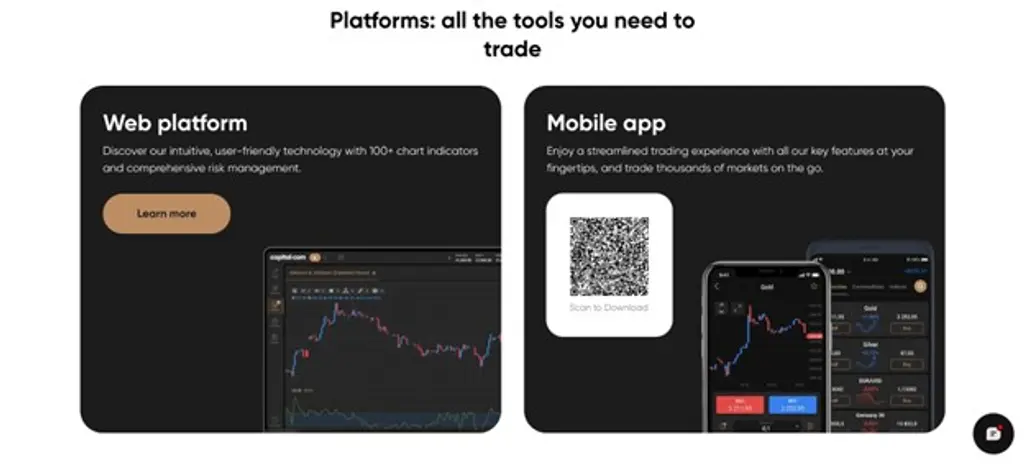
Image Source: Capital.com
Capital.com offers several distinct platform options that traders can leverage to access its CFD markets.
Web platform: The interface, which is designed as a user-friendly platform with the latest trading view charts and market insights from Newsquack. Innovative analysis tools on this trading platform include 100+ technical analysis tools and drawing tools that cut across six chart types.
Trading app: With around 65% of global CFD trading volumes generated through mobile phones, Capital.com has built a trading app that allows users to seamlessly navigate through the platform features, includes price alerts and smart feeds.
TradingView platform: Traders who already own a TradingView account can connect it to Capital.com to leverage the interactive charts, financial analysis, or even join an existing community of CFD traders to exchange strategies through live streams and real-time chats.
MT4 platform: Another option is to connect one’s MetaTrader4 account through 3 simple steps: enable MT4 on Capital.com, create a new MT4 account or sign in if a user has an existing one, and finally start trading.
MetaTrader 5 (MT5): In addition to MT4, traders can also opt to connect to MT5, which is more advanced; 21 timeframes, 38+ built-in indicators, 64-bit, multi-threaded architecture for greater stability and execution speed, among other distinct features.
Additional Information and Tools
Capital.com’s platform also includes a trading information section.
Some of the key topics covered include how the platform handles margin calls; if equity drops below 100% of the required margin, one receives the first margin call, below 75% activates the second call and below 50%, the close-out process starts automatically.
Other critical information that is spelt out in this section is how the 24/5 index CFD trading works, withdrawals and fraud prevention.
As for the tools, Capital.com provides its users with a CFD calculator, currency strength meter, forex calculator, demo trading and crypto calculator.
Regulation and Licensing
Capital.com positions itself as a disciplined, risk-aware financial services institution that is defined by restraint over excitement, explanation over prediction, governance over personality, and consistency over cycle-driven shifts.
The company operates under multiple top-tier regulatory frameworks.
FCA (UK) – Capital Com (UK) Limited is authorised and regulated by the Financial Conduct Authority (FCA) under registration number 793714.
CySEC (Cyprus) – Capital Com SV Investments Limited is Authorised and regulated by the Cyprus Securities and Exchange Commission (CySEC), under licence number 319/17.
ASIC (Australia) – Capital Com Australia Pty Ltd is authorised and regulated by the Australian Securities and Investments Commission (ASIC) under AFSL Number 513393.
SCA (UAE) – Capital Com Mena Securities Trading LLC is authorised and regulated by the Securities and Commodities Authority (SCA), under license number 20200000176.
SCB (Bahamas) – Capital Com Online Investments Ltd is a Company registered in the Commonwealth of The Bahamas and authorised to carry out Securities Business by the Securities Commission of The Bahamas with licence number SIA-F245.
CMA (Kenya) – CC Kenya Securities Limited trading as Capital.com is regulated by the Capital Markets Authority of Kenya under license number 244.
Compliance is the Moat for Capital.com
For Capital.com, operating within jurisdictional frameworks is a key part of the company’s broader strategy.
Being compliant provides a significant level of comfort to platform users; for example, UK clients trading under the FCA license benefit from the Financial Services Compensation Scheme, which covers up to £85,000 per person in the event of broker insolvency. In Cyprus,the Cyprus Investor Compensation Fund covers up to €20,000. Capital.com also applies mandatory KYC (Know Your Customer) and AML (Anti-Money Laundering) procedures across all jurisdictions where the platform is operational.
Also, with the tightening of CFD oversight following the introduction of leverage caps and risk disclosure requirements by the ESMA (the European Securities and Markets Authority) in 2018, Capital.com’s disclaimer includes a warning on the high risk involved in trading CFDs, with approximately 60% - 81.7% of retail investor accounts losing money on the platform.
Capital.com has also integrated several standard and non-standard risk management features. These include stop-loss orders, take-profit orders, guaranteed stop-loss orders, trailing stops, margin alerts, negative balance protection and demo accounts to support practice-based exploration of the CFD markets offered on the platform.
Fees, Spreads and Account Structure
Capital.complatform’s revenue is generated from the spread; this is the difference between the buy (ask) price and sell (bid) of a given CFD instrument. The cost is already factored in on the price displayed on the platform, making it seamless for traders to assess their positions without accounting for separate commission lines. The spread competitiveness varies depending on the underlying market conditions.
Other notable fees that the platform charges include a currency conversion fee, which is set at 0.7% of the spot forex rate for personal accounts and 0.5% for professional accounts. There is also the overnight funding adjustment, which is charged every time a trader holds a leveraged trade open overnight. The formula for calculating this cost also varies depending on the type of market.
Capital.com has a Guaranteed Stop-Loss Order (GSLO) premium, although it is only charged if the stop-loss is triggered. The fee is arrived at by multiplying three components: guaranteed stop premium (in percentage), position open price and quantity.
Account Structure
Capital.com operates a dual account structure: a standard retail account and a professional account for eligible traders.
The retail account, which is the entry point for most users, is free to open, comes with a free demo account, and a minimum deposit of 10 USD/EUR/GBP for bank cards and Apple Pay. Meanwhile, the professional account caters to a more advanced category of CFD traders and runs on a different eligibility criteria.
Educational Ecosystem
Capital.com’s learn section features resource materials for both beginners and experienced traders.
For beginners, the content is broken down into trading essentials, risk management, market guides, demo trading, the Investmate app and a glossary. On the other hand, experienced traders can access more advanced or technical information, spanning across trading strategies, technical analysis, market analysis, trading psychology and IPO trading.
The investmate app is one of the unique features in this section; it is specifically designed for users to learn finance on the go through a comprehensive free tool kit that includes 30+ short courses, which users can complete in as little as 3 minutes.
Who is Capital.com For?
Capital.com is designed for a broad range of traders at different stages of their journey. Traders who are new to financial markets will find the platform’s structured educational resources, clean interface and low minimum deposit as a practical starting point to build familiarity with CFD instruments.
The platform’s CFD offerings also cater to retail traders who prefer consolidated access to global markets under a single regulated account. On the other hand, more experienced traders can take advantage of the professional account, which comes with its own eligibility criteria and account conditions.
Capital.com also extends its infrastructure to institutional stakeholders through affiliate programmes, white-label partnerships and API access.
Final Assessment
Capital.com has grown into a multi-jurisdictional CFD broker over the past decade, with its regulatory framework now spanning the FCA, CySEC, ASIC, SCA, and CMA; this commitment to regulatory frameworks and compliance systems is one of the major advatanges the company enjoys against the global brokerage landscape.
The platform’s CFD offerings are also dynamic enough to provide both traditional finance traders and more niche traders with the flexibility to trade the markets of their choice. A varied platform ecosystem complements this, allowing traders to operate on web, mobile or native integrations depending on their preference.
On pricing, competitive spreads across equities and major forex pairs makes it less costly for retail traders to participate in the global CFD market. The platform further distinguishes itself with the Investmate app, which introduces tiered learning content for users looking to expand their financial markets knowledge.
That said, it is important to keep in mind the risks associated with CFD trading. Capital.com also confirms through its own regularly updated disclosure; currently, 78.48% of retail investor accounts lose money when trading CFDs with this particular broker. It is therefore in the interest of prospective users to carefully assess whether CFD trading aligns with their financial circumstances and risk tolerance.
Disclaimer: This article is provided for informational and educational purposes only and does not constitute investment advice, financial advice, or a recommendation to trade financial instruments. Contracts for Difference (CFDs) are leveraged products that carry a high level of risk and may not be suitable for all investors. Readers should independently evaluate their financial circumstances and consult licensed professionals where appropriate before making investment decisions.