
Research Reports
In-Depth Analysis of the COVID-19 Impact on Global Cellulose Film Packaging Market
Published by mark itwired
Posted on September 9, 2021
9 min readLast updated: February 11, 2026
Add as preferred source on Google
Published by mark itwired
Posted on September 9, 2021
9 min readLast updated: February 11, 2026
Add as preferred source on GoogleFuture Market Insights (FMI) delivers key insights on the global cellulose film packaging market in its published report titled “Cellulose Film Packaging Market: Global Industry Analysis 2013-2017 and Opportunity Assessment 2018-2028”. In terms of revenue, the global cellulose film packaging market is estimated to grow at a CAGR of 4.9% during the forecast period, owing to numerous factors on which FMI sheds light in this report. The Asia Pacific cellulose film packaging market is expected to remain in the leading position during the forecast period.
Cellulose film packaging is a bio-compostable packaging solution manufactured from wood or cotton, both of which are easily compostable. Besides cellulose film packaging extends the shelf life of fresh produce products by controlling the moisture content. Cellulose film packaging also maintains the aroma of the food product. It also reduces waste production as cellulose films are compostable. Cellulose film packaging provides better durability as well as good printability. The availability of a wide range of innovative packaging solutions is likely to have a significant impact on the demand in the cellulose film packaging market during the forecast period.
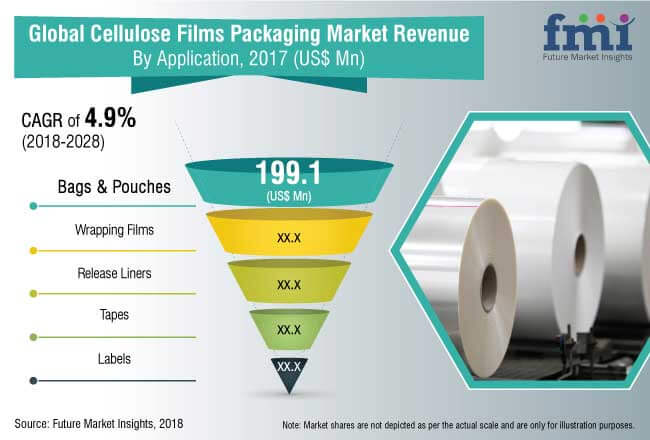
In this report, Future Market Insights suggests that cellulose film packaging will play a major role in the food & beverage industry during the forecast period. A shift in preference from traditional cellulose film packaging towards bio-compostable packaging solutions has been observed among packaging manufacturers. Additionally, cellulose film packaging extends the shelf life of fresh produce packed by controlling the moisture content. Landfilling problems are majorly caused by the extensive use of conventional plastic bags, pouches, bottles, etc. This problem can be solved by replacing conventional plastic bags with cellulose film packaging solutions. As cellulose film packaging is biodegradable and compostable in nature, it is capable of solving landfilling issues to a considerable extent. Earlier, bioplastics packaging manufacturers had to face waste legislation issues as these bioplastics materials require different composting processes as well as grounds. However, due to the growing usage of cellulose film packaging, problems related to composting process of bioplastics have decreased.
The growth of cellulose film packaging can mainly be attributed to the contributions from emerging economies, such as countries in the APEJ region — India & China. China is expected to be at the forefront, spearheading the growth of the cellulose film packaging market, during the forecast period. According to the research by Future Market Insights, the China cellulose film packaging market has witnessed rapid growth in the past couple of decades. Cellulose film packaging manufacturers are looking forward to developing such biodegradable bioplastics that will reduce their carbon footprint.
The global market for cellulose film packaging is segmented by film type, source, application and end-use industry.
By film type, the global cellulose film packaging market is segmented into:
By source, the global cellulose film packaging market is segmented into:
By application, the global cellulose film packaging market is segmented into:
By end-use industry, the global cellulose film packaging market is segmented into:
Companies involved in the manufacturing of cellulose film packaging are focusing on enhancing their production capacity by establishing new production units. The manufacturers of cellulose film packaging are likely to eye the lucrative regions of Asia Pacific as well as Middle East & African regions in the coming years. Some of the key drivers for the growth of the global cellulose film packaging market include growing demand from the food & beverage industry due to its biodegradable nature. Cellulose film packaging also helps in maintaining the aroma of food products and reduces the production of waste products as the films used for cellulose film packaging are easily compostable. The Asia Pacific Excluding Japan (APEJ) cellulose film packaging is expected to create the highest incremental $ opportunity during the forecast period and is expected to grow at a significant pace in the coming years. Revenue from the cellulose films packaging market in North America is estimated to account for over 21.9% of the global cellulose film packaging market revenue in 2018.
Key players considered in this report on the global cellulose film packaging market include Futamura Chemical Co., Ltd., Celanese Corporation, Hubei Golden Ring Co. Ltd., Weifang Henglian Cellophane Co. Ltd, Chengdu Huaming Cellophane Co. Ltd, Eastman Chemical Company, Sappi Limited, Tembec Inc, Rhodia Acetow GmbH and Rotofil Srl.
The post In-Depth Analysis of the COVID-19 Impact on Global Cellulose Film Packaging Market first appeared on Market Research Blog.
Future Market Insights (FMI) delivers key insights on the global cellulose film packaging market in its published report titled “Cellulose Film Packaging Market: Global Industry Analysis 2013-2017 and Opportunity Assessment 2018-2028”. In terms of revenue, the global cellulose film packaging market is estimated to grow at a CAGR of 4.9% during the forecast period, owing to numerous factors on which FMI sheds light in this report. The Asia Pacific cellulose film packaging market is expected to remain in the leading position during the forecast period.
Cellulose film packaging is a bio-compostable packaging solution manufactured from wood or cotton, both of which are easily compostable. Besides cellulose film packaging extends the shelf life of fresh produce products by controlling the moisture content. Cellulose film packaging also maintains the aroma of the food product. It also reduces waste production as cellulose films are compostable. Cellulose film packaging provides better durability as well as good printability. The availability of a wide range of innovative packaging solutions is likely to have a significant impact on the demand in the cellulose film packaging market during the forecast period.
In this report, Future Market Insights suggests that cellulose film packaging will play a major role in the food & beverage industry during the forecast period. A shift in preference from traditional cellulose film packaging towards bio-compostable packaging solutions has been observed among packaging manufacturers. Additionally, cellulose film packaging extends the shelf life of fresh produce packed by controlling the moisture content. Landfilling problems are majorly caused by the extensive use of conventional plastic bags, pouches, bottles, etc. This problem can be solved by replacing conventional plastic bags with cellulose film packaging solutions. As cellulose film packaging is biodegradable and compostable in nature, it is capable of solving landfilling issues to a considerable extent. Earlier, bioplastics packaging manufacturers had to face waste legislation issues as these bioplastics materials require different composting processes as well as grounds. However, due to the growing usage of cellulose film packaging, problems related to composting process of bioplastics have decreased.
The growth of cellulose film packaging can mainly be attributed to the contributions from emerging economies, such as countries in the APEJ region — India & China. China is expected to be at the forefront, spearheading the growth of the cellulose film packaging market, during the forecast period. According to the research by Future Market Insights, the China cellulose film packaging market has witnessed rapid growth in the past couple of decades. Cellulose film packaging manufacturers are looking forward to developing such biodegradable bioplastics that will reduce their carbon footprint.
The global market for cellulose film packaging is segmented by film type, source, application and end-use industry.
By film type, the global cellulose film packaging market is segmented into:
By source, the global cellulose film packaging market is segmented into:
By application, the global cellulose film packaging market is segmented into:
By end-use industry, the global cellulose film packaging market is segmented into:
Companies involved in the manufacturing of cellulose film packaging are focusing on enhancing their production capacity by establishing new production units. The manufacturers of cellulose film packaging are likely to eye the lucrative regions of Asia Pacific as well as Middle East & African regions in the coming years. Some of the key drivers for the growth of the global cellulose film packaging market include growing demand from the food & beverage industry due to its biodegradable nature. Cellulose film packaging also helps in maintaining the aroma of food products and reduces the production of waste products as the films used for cellulose film packaging are easily compostable. The Asia Pacific Excluding Japan (APEJ) cellulose film packaging is expected to create the highest incremental $ opportunity during the forecast period and is expected to grow at a significant pace in the coming years. Revenue from the cellulose films packaging market in North America is estimated to account for over 21.9% of the global cellulose film packaging market revenue in 2018.
Key players considered in this report on the global cellulose film packaging market include Futamura Chemical Co., Ltd., Celanese Corporation, Hubei Golden Ring Co. Ltd., Weifang Henglian Cellophane Co. Ltd, Chengdu Huaming Cellophane Co. Ltd, Eastman Chemical Company, Sappi Limited, Tembec Inc, Rhodia Acetow GmbH and Rotofil Srl.
The post In-Depth Analysis of the COVID-19 Impact on Global Cellulose Film Packaging Market first appeared on Market Research Blog.
Cellulose film packaging is a bio-compostable packaging solution made from wood or cotton. It is designed to extend the shelf life of products while being environmentally friendly.
Cellulose film packaging is primarily used in the food and beverage industry, as well as in pharmaceuticals, personal care, and homecare products.
Benefits include extending product shelf life, maintaining aroma, reducing waste, and being compostable, which helps address landfill issues associated with traditional plastic packaging.
Explore more articles in the Research Reports category