Research Reports
Hydrolyzed Collagen Market Is Projected to Increase at a Cagr of ~8%
Published by TMR Research Insights
Posted on August 19, 2021
22 min readLast updated: February 16, 2026
Add as preferred source on Google
Published by TMR Research Insights
Posted on August 19, 2021
22 min readLast updated: February 16, 2026
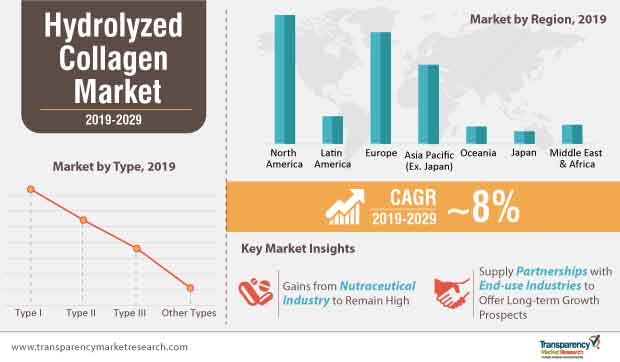
Add as preferred source on GoogleThe hydrolyzed collagen market, valued at ~US$ 825 million in 2018, advances towards becoming a billion-dollar market by 2021, and will continue its stride at a CAGR of ~8% during 2019-2029, finds a new report published by Transparency Market Research (TMR).
The hydrolyzed collagen market holds adjacent market opportunities, besides food and beverages, and much of this has to do with the newly-added thrust of preventive, rather than curative measures in the healthcare sector. Though the healthcare industry is not a direct contributor to the landscape, the blurring lines between food and nutraceutical industries, and the convergence of ‘food-pharma’ industries are projected to exert a sizeable influence on the popularity of hydrolyzed collagen to cater to nutritional inadequacies among consumers.
Strong expertise with attention to detail makes our market research reports stand apart. Download PDF Brochure –
The significant shift in the strategy towards curative practices has, in turn, caught the attention of the cosmetics and personal care industry, and manufacturers are catalyzing the spurt in the growth of the hydrolyzed collagen market with the introduction of skincare- and hair care-based product portfolios.
Request for Covid-19 Impact Analysis on Hydrolyzed Collagen Market:
However, while tapping adjacent market opportunities, manufacturers need to be prepared for the discipline of regulatory compliance – norms regarding food claims and information presented to consumers to drive them into the sales funnel.
Vegan Trend to go Mainstream – A Roadblock Ahead for the Market
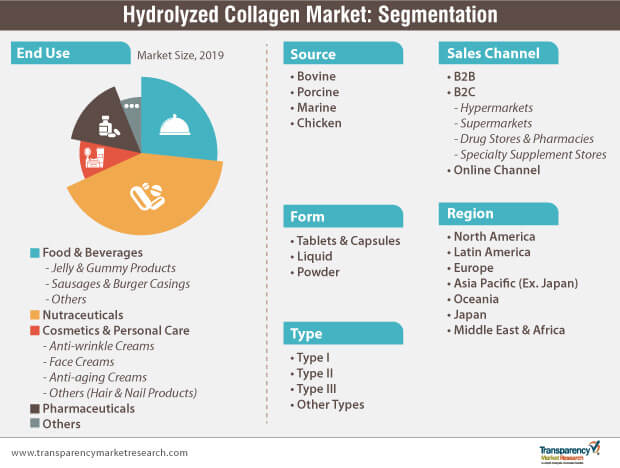
The hydrolyzed collagen market continues to undergo an epochal scale of transmutation, as manufacturers tap new sources to extract value-added collagens. Historically, hydrolyzed collagen, extracted from cattle, maintained a clear lead in terms of value share. However, as literature claiming benefits of marine-sourced collagens – better water solubility, skincare properties, and lesser carbon footprints – began coming to light, a spike in their adoption rate became apparent. In 2019, hydrolyzed collagen sourced from bovine accounted for ~US$ 350 million, while that sourced from marine is estimated to register a CAGR of ~11% during 2019-2029.
Buy our Premium Research Report on Hydrolyzed Collagen Market@
However, the evolutionary nature of the landscape is the very feature that could pose a challenge. Animal-sourced hydrolyzed collagens cater to the protein inadequacy of the non-vegetarian populace, while the growing interest towards the adoption of the vegan trend could be a weighted market deterrent.
More Trending Reports by Transparency Market Research –
As per searches made, Google Trends marked a whopping 90% increase in vegan trends in 2016, with leading searches from Australia, followed by North America. Increasing searches for ‘vegan’ and ‘vegetarian’ keywords, as a whole, surmise the growing proclivity of consumers for plant-based dietary choices. The quest for plant-based supplements has led to the introduction of vegan collagen, produced by genetically modifying yeast and bacteria. What further helps vegan collagen manufacturers distinguish their offerings is their cost-efficiency and high safety profile, which could dim the potential of the animal-based hydrolyzed collagen market.
High Sales of Powdered Hydrolyzed Collagen over Liquid and Tablet Forms
In 2018, the sales of powdered hydrolyzed collagen accounted for a value of ~US$ 265 million, while that of liquid hydrolyzed collagen grew to a value of ~US$ 135 million. Despite the availability of various intake options, consumers tend to prefer nutritional supplements in the powdered form over the tablet and liquid forms, on account of their longer shelf life and high bioavailability. On top of that, powdered hydrolyzed collagen is deemed pure, as it is less susceptible to mixing with other ingredients. As compared to the other forms, cost-effectiveness and high flexibility with dosing remain the key attractive proposition of the powdered form, catalyzing its sales.
However, the report points towards the exponentially growing adoption rate of liquid hydrolyzed collagen, given its high absorbability, which makes it more effective than the powdered and tablet forms. The sales of liquid hydrolyzed collagen will move at a compound annual growth rate of ~10% during the forecast period.
Beside other success factors, distribution channels, in turn, play a pivotal role in influencing the purchasing behavior of consumers. For instance, the transit of powdered hydrolyzed collagen is much safer than that of the liquid form, which is thereby fortifying the sales of the former via online channels, and that of liquid through B2B and B2C channels such as hypermarkets/supermarkets, drug stores & pharmacies, and specialty supplement stores.
Despite an upsurge in sales through online and B2C channels, B2B channels will account for a sizeable share, given the direct and indirect supply-distribution partnerships with end-use industries such as food and beverages, nutraceuticals, pharmaceuticals, and cosmetic industries, among others.
High Vigilance Alert in the Hydrolyzed Collagen Market
Proper labeling of hydrolyzed collagens will be a focus area for market players, given the growing appetite of central and food regulators regarding safety. The FDA, operating in the U.S., issued new guidance on food labeling, to drive greater standardization in the way health and nutrition information is presented to the consumer. Food labeling changes in Europe are more stringent that those present in North America. New requirements include improved legibility of information and specific details regarding the source of the product.
Another key aspect of such regulations is the high number of product recalls in case of failure to meet legislated protocols, which needs the complete attention of manufacturers while marketing for their products to safeguard their business from product recall instances.
In a fragmented landscape, which lacks strong dominance, market players can make it big in the hydrolyzed collagen market by taking a cue from global players. The key to a high market share is intense focus on global reach and broadening of a consumer-centric product portfolio, an example of which can be taken from Rousselot, a leading player offering gelatin and collagen peptides. The company, along with Phamatech, collaborated for the launch of SiMoGel, a fortified confectionery, in the EMEA market.
With the presence of stringent regulatory norms scrutinizing hydrolyzed collagens as well as products made out of them, manufacturers will need to take a more granular and conscientious approach towards the development of clean-label products. Consumers’ fickle food choices mean that market players will have to closely understand the undercurrents and trends while conducting their R&D activities in order to develop a consumer-centric product. Since pure hydrolyzed collagen is flavorless and odorless, market players can increase the exclusiveness of their portfolio by introducing new flavors. All-in-all, market players can look at a market value of ~US$ 1.8 Bn by the end of 2029.
Hydrolyzed Collagen Market Witnessing Growth Due to Radical Shift towards Sustainability and Longevity
Increasing Demand for Cosmetics and Personal Care Products Boosting Hydrolyzed Collagen Market
Growing Commercialization of Hydrolyzed Collagen-based Drug Delivery Systems
Growing Popularity and Demand for Natural Ingredients
Economic Development in BRICS Countries
Challenges Pertaining to FDA Approval for Hydrolyzed Collagen
Global Hydrolyzed Collagen Market: Competition Landscape
Key players operating in the hydrolyzed collagen market, as profiled in the study, include
Food-beverages-Industry battles Tangible Impact of Economic and Cultural changes, Stay Updated on the Latest Trends in food-beverages-market@
https://www.transparencymarketresearch.com/food-beverages-market-reports-4.html
About Us
Transparency Market Research is a global market intelligence company, providing global business information reports and services. Our exclusive blend of quantitative forecasting and trends analysis provides forward-looking insight for thousands of decision makers. Our experienced team of Analysts, Researchers, and Consultants, use proprietary data sources and various tools and techniques to gather, and analyze information.
Our data repository is continuously updated and revised by a team of research experts, so that it always reflects the latest trends and information. With a broad research and analysis capability, Transparency Market Research employs rigorous primary and secondary research techniques in developing distinctive data sets and research material for business reports.
Contact
Transparency Market Research
State Tower,
90 State Street,
Suite 700,
Albany NY – 12207
United States
USA – Canada Toll Free: 866-552-3453
Email: sales@transparencymarketresearch.com
Follow Us: Twitter | LinkedIn
Blog: https://tmrblog.com
The hydrolyzed collagen market, valued at ~US$ 825 million in 2018, advances towards becoming a billion-dollar market by 2021, and will continue its stride at a CAGR of ~8% during 2019-2029, finds a new report published by Transparency Market Research (TMR).
The hydrolyzed collagen market holds adjacent market opportunities, besides food and beverages, and much of this has to do with the newly-added thrust of preventive, rather than curative measures in the healthcare sector. Though the healthcare industry is not a direct contributor to the landscape, the blurring lines between food and nutraceutical industries, and the convergence of ‘food-pharma’ industries are projected to exert a sizeable influence on the popularity of hydrolyzed collagen to cater to nutritional inadequacies among consumers.
Strong expertise with attention to detail makes our market research reports stand apart. Download PDF Brochure –
The significant shift in the strategy towards curative practices has, in turn, caught the attention of the cosmetics and personal care industry, and manufacturers are catalyzing the spurt in the growth of the hydrolyzed collagen market with the introduction of skincare- and hair care-based product portfolios.
Request for Covid-19 Impact Analysis on Hydrolyzed Collagen Market:
However, while tapping adjacent market opportunities, manufacturers need to be prepared for the discipline of regulatory compliance – norms regarding food claims and information presented to consumers to drive them into the sales funnel.
Vegan Trend to go Mainstream – A Roadblock Ahead for the Market
The hydrolyzed collagen market continues to undergo an epochal scale of transmutation, as manufacturers tap new sources to extract value-added collagens. Historically, hydrolyzed collagen, extracted from cattle, maintained a clear lead in terms of value share. However, as literature claiming benefits of marine-sourced collagens – better water solubility, skincare properties, and lesser carbon footprints – began coming to light, a spike in their adoption rate became apparent. In 2019, hydrolyzed collagen sourced from bovine accounted for ~US$ 350 million, while that sourced from marine is estimated to register a CAGR of ~11% during 2019-2029.
Buy our Premium Research Report on Hydrolyzed Collagen Market@
However, the evolutionary nature of the landscape is the very feature that could pose a challenge. Animal-sourced hydrolyzed collagens cater to the protein inadequacy of the non-vegetarian populace, while the growing interest towards the adoption of the vegan trend could be a weighted market deterrent.
More Trending Reports by Transparency Market Research –
As per searches made, Google Trends marked a whopping 90% increase in vegan trends in 2016, with leading searches from Australia, followed by North America. Increasing searches for ‘vegan’ and ‘vegetarian’ keywords, as a whole, surmise the growing proclivity of consumers for plant-based dietary choices. The quest for plant-based supplements has led to the introduction of vegan collagen, produced by genetically modifying yeast and bacteria. What further helps vegan collagen manufacturers distinguish their offerings is their cost-efficiency and high safety profile, which could dim the potential of the animal-based hydrolyzed collagen market.
High Sales of Powdered Hydrolyzed Collagen over Liquid and Tablet Forms
In 2018, the sales of powdered hydrolyzed collagen accounted for a value of ~US$ 265 million, while that of liquid hydrolyzed collagen grew to a value of ~US$ 135 million. Despite the availability of various intake options, consumers tend to prefer nutritional supplements in the powdered form over the tablet and liquid forms, on account of their longer shelf life and high bioavailability. On top of that, powdered hydrolyzed collagen is deemed pure, as it is less susceptible to mixing with other ingredients. As compared to the other forms, cost-effectiveness and high flexibility with dosing remain the key attractive proposition of the powdered form, catalyzing its sales.
However, the report points towards the exponentially growing adoption rate of liquid hydrolyzed collagen, given its high absorbability, which makes it more effective than the powdered and tablet forms. The sales of liquid hydrolyzed collagen will move at a compound annual growth rate of ~10% during the forecast period.
Beside other success factors, distribution channels, in turn, play a pivotal role in influencing the purchasing behavior of consumers. For instance, the transit of powdered hydrolyzed collagen is much safer than that of the liquid form, which is thereby fortifying the sales of the former via online channels, and that of liquid through B2B and B2C channels such as hypermarkets/supermarkets, drug stores & pharmacies, and specialty supplement stores.
Despite an upsurge in sales through online and B2C channels, B2B channels will account for a sizeable share, given the direct and indirect supply-distribution partnerships with end-use industries such as food and beverages, nutraceuticals, pharmaceuticals, and cosmetic industries, among others.
High Vigilance Alert in the Hydrolyzed Collagen Market
Proper labeling of hydrolyzed collagens will be a focus area for market players, given the growing appetite of central and food regulators regarding safety. The FDA, operating in the U.S., issued new guidance on food labeling, to drive greater standardization in the way health and nutrition information is presented to the consumer. Food labeling changes in Europe are more stringent that those present in North America. New requirements include improved legibility of information and specific details regarding the source of the product.
Another key aspect of such regulations is the high number of product recalls in case of failure to meet legislated protocols, which needs the complete attention of manufacturers while marketing for their products to safeguard their business from product recall instances.
In a fragmented landscape, which lacks strong dominance, market players can make it big in the hydrolyzed collagen market by taking a cue from global players. The key to a high market share is intense focus on global reach and broadening of a consumer-centric product portfolio, an example of which can be taken from Rousselot, a leading player offering gelatin and collagen peptides. The company, along with Phamatech, collaborated for the launch of SiMoGel, a fortified confectionery, in the EMEA market.
With the presence of stringent regulatory norms scrutinizing hydrolyzed collagens as well as products made out of them, manufacturers will need to take a more granular and conscientious approach towards the development of clean-label products. Consumers’ fickle food choices mean that market players will have to closely understand the undercurrents and trends while conducting their R&D activities in order to develop a consumer-centric product. Since pure hydrolyzed collagen is flavorless and odorless, market players can increase the exclusiveness of their portfolio by introducing new flavors. All-in-all, market players can look at a market value of ~US$ 1.8 Bn by the end of 2029.
Hydrolyzed Collagen Market Witnessing Growth Due to Radical Shift towards Sustainability and Longevity
Increasing Demand for Cosmetics and Personal Care Products Boosting Hydrolyzed Collagen Market
Growing Commercialization of Hydrolyzed Collagen-based Drug Delivery Systems
Growing Popularity and Demand for Natural Ingredients
Economic Development in BRICS Countries
Challenges Pertaining to FDA Approval for Hydrolyzed Collagen
Global Hydrolyzed Collagen Market: Competition Landscape
Key players operating in the hydrolyzed collagen market, as profiled in the study, include
Food-beverages-Industry battles Tangible Impact of Economic and Cultural changes, Stay Updated on the Latest Trends in food-beverages-market@
https://www.transparencymarketresearch.com/food-beverages-market-reports-4.html
About Us
Transparency Market Research is a global market intelligence company, providing global business information reports and services. Our exclusive blend of quantitative forecasting and trends analysis provides forward-looking insight for thousands of decision makers. Our experienced team of Analysts, Researchers, and Consultants, use proprietary data sources and various tools and techniques to gather, and analyze information.
Our data repository is continuously updated and revised by a team of research experts, so that it always reflects the latest trends and information. With a broad research and analysis capability, Transparency Market Research employs rigorous primary and secondary research techniques in developing distinctive data sets and research material for business reports.
Contact
Transparency Market Research
State Tower,
90 State Street,
Suite 700,
Albany NY – 12207
United States
USA – Canada Toll Free: 866-552-3453
Email: sales@transparencymarketresearch.com
Follow Us: Twitter | LinkedIn
Blog: https://tmrblog.com
Explore more articles in the Research Reports category