Search
00
GBAF Logo
trophy
Top StoriesInterviewsBusinessFinanceBankingTechnologyInvestingTradingVideosAwardsMagazinesHeadlinesTrends

Subscribe to our newsletter

Get the latest news and updates from our team.

Global Banking and Finance Review

Global Banking & Finance Review

Company

    GBAF Logo
    • About Us
    • Profile
    • Privacy & Cookie Policy
    • Terms of Use
    • Contact Us
    • Advertising
    • Submit Post
    • Latest News
    • Research Reports
    • Press Release
    • Awards▾
      • About the Awards
      • Awards TimeTable
      • Submit Nominations
      • Testimonials
      • Media Room
      • Award Winners
      • FAQ
    • Magazines▾
      • Global Banking & Finance Review Magazine Issue 79
      • Global Banking & Finance Review Magazine Issue 78
      • Global Banking & Finance Review Magazine Issue 77
      • Global Banking & Finance Review Magazine Issue 76
      • Global Banking & Finance Review Magazine Issue 75
      • Global Banking & Finance Review Magazine Issue 73
      • Global Banking & Finance Review Magazine Issue 71
      • Global Banking & Finance Review Magazine Issue 70
      • Global Banking & Finance Review Magazine Issue 69
      • Global Banking & Finance Review Magazine Issue 66
    Top StoriesInterviewsBusinessFinanceBankingTechnologyInvestingTradingVideosAwardsMagazinesHeadlinesTrends

    Global Banking & Finance Review® is a leading financial portal and online magazine offering News, Analysis, Opinion, Reviews, Interviews & Videos from the world of Banking, Finance, Business, Trading, Technology, Investing, Brokerage, Foreign Exchange, Tax & Legal, Islamic Finance, Asset & Wealth Management.
    Copyright © 2010-2025 GBAF Publications Ltd - All Rights Reserved.

    ;
    Editorial & Advertiser disclosure

    Global Banking and Finance Review is an online platform offering news, analysis, and opinion on the latest trends, developments, and innovations in the banking and finance industry worldwide. The platform covers a diverse range of topics, including banking, insurance, investment, wealth management, fintech, and regulatory issues. The website publishes news, press releases, opinion and advertorials on various financial organizations, products and services which are commissioned from various Companies, Organizations, PR agencies, Bloggers etc. These commissioned articles are commercial in nature. This is not to be considered as financial advice and should be considered only for information purposes. It does not reflect the views or opinion of our website and is not to be considered an endorsement or a recommendation. We cannot guarantee the accuracy or applicability of any information provided with respect to your individual or personal circumstances. Please seek Professional advice from a qualified professional before making any financial decisions. We link to various third-party websites, affiliate sales networks, and to our advertising partners websites. When you view or click on certain links available on our articles, our partners may compensate us for displaying the content to you or make a purchase or fill a form. This will not incur any additional charges to you. To make things simpler for you to identity or distinguish advertised or sponsored articles or links, you may consider all articles or links hosted on our site as a commercial article placement. We will not be responsible for any loss you may suffer as a result of any omission or inaccuracy on the website.

    Home > How To > How to Calculate Atomic Mass
    How To

    How to Calculate Atomic Mass

    How to Calculate Atomic Mass

    Published by Gbaf News

    Posted on January 3, 2018

    Featured image for article about How To
    Tags:Atomic massisotopesperiodic tableProtons and Neutrons

    In chemistry, Atomic mass is the sum of protons, electrons, and neutrons present in a single atom or molecule. However, as the particles stay in constant motion on their orbits, their mass became negligible. In other words, the Atomic mass is the sum of Protons and Neutrons present in a single atom or a molecule.

    The term, atomic mass, is used to refer to the various isotopes of the atom though technically it’s incorrect. Let’s get to know, How to find the nuclear mass of a given atom or molecule.

    Using The Periodic Table:

    The mass of an atom is typically expressed with general SI units, i.e. grams, kilograms, etc. However, the expressed amount is minimal in quantity. So for easy calculation and other use, the mass is often expressed in unified atomic mass units (“u” or “amu”) or Daltons (Da).

    (*Remember that the standard for one atomic mass unit is equal to 1/12th of the mass of a standard carbon-12 isotope)

    When it comes to atomic mass, there is another term, Relative nuclear mass. It is defined as the nuclear weight that takes into account the average of the masses of naturally occurring isotopes of the same element.

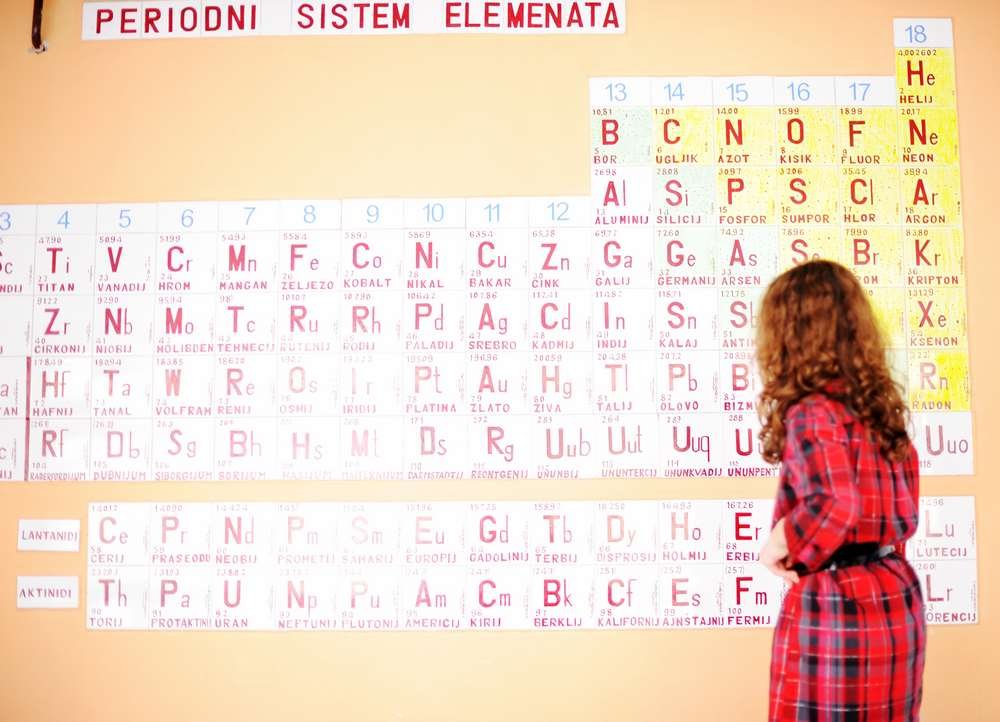
    Mostly, in a standard periodic table, the relative atomic masses (atomic weights) of each element is already given. It is mainly written at the bottom of the element’s square on the table, below the one or two letter chemical symbol. The relative atomic mass is mostly presented in the form of decimal no instead of a whole no. But remember that the given relative atomic masses on a periodic table are average values of the element. As the chemical elements show different isotopes depending upon the addition and subtraction of one or more than one neutrons to the atom’s nucleus, we can take the given relative atomic mass as an average value for the associated element instead of its single nuclear matter.

    Generally, the given relative atomic masses in a periodic table are technically unitless. But we can get a workable quantity (the molar mass) by multiplying an atomic mass by 1 g/mol.

    As I said earlier, the relative atomic masses, given on the periodic table, are average values for an atom’s isotopes. It helps in many ways for practical calculations like we can say while calculating the molar mass of a molecule. But when its come to individual atoms, the given number became insufficient.

    For an Individual Atom:

    The atomic number of a chemical element also refers to its proton count. The proton number in an atom never varies. For example, the atomic number of the element C (carbon) is 6. So, the photon count for coal is 6.

    But the neutron count in an atom varies as per the given isotopes.We can count the no of neutrons present in an isotope by subtracting the atomic number from the isotope number. As per example, we can take carbon-14. So, the no. of neutrons present in a C-14 is 14 – 6= 8.

    To calculate the atomic mass of the individual atom, Add the no of protons with the no of neutrons of the molecule. The combined mass of all the electrons is excessively small that we can neglect them.

    For Example, the atomic mass of C-14 is,

    8 + 6=14

    Not to forget, that the atomic mass of an isotope is relatively quite close to the isotope no. So, for basic calculation, we can take isotope number as the atomic mass.

    In this above explanation, we got to know the way to find out the Atomic mass of an Atom from Periodic Table as well as for an individual atom.

    Related Posts
    GradesFixer’s Guide to Effective Memoir Essay
    GradesFixer’s Guide to Effective Memoir Essay
    How to apply for a personal loan online
    How to apply for a personal loan online
    Identity theft: how to protect yourself from financial fraud and scams
    Identity theft: how to protect yourself from financial fraud and scams
    Frugal living: tips and strategies for living on a tight budget
    Frugal living: tips and strategies for living on a tight budget
    The Benefits of Building an Emergency Fund and How to Build an Emergency Fund
    The Benefits of Building an Emergency Fund and How to Build an Emergency Fund
    How to Negotiate a Better Salary and Benefits Package: A Comprehensive Guide
    How to Negotiate a Better Salary and Benefits Package: A Comprehensive Guide
    How to Manage Financial Stress and Anxiety
    How to Manage Financial Stress and Anxiety
    Real estate: First time home buyer tips
    Real estate: First time home buyer tips
    Credit Repair: How to improve your credit score
    Credit Repair: How to improve your credit score
    How to find the right location for your warehouse space
    How to find the right location for your warehouse space
    How To Make The Perfect IT Resume To Stand Out
    How To Make The Perfect IT Resume To Stand Out
    What does the interest rate hike mean for businesses – and how are they coping?
    What does the interest rate hike mean for businesses – and how are they coping?

    Why waste money on news and opinions when you can access them for free?

    Take advantage of our newsletter subscription and stay informed on the go!

    Subscribe

    Previous How To PostHow To Calculate Percent Yield
    Next How To PostHow to send a letter

    More from How To

    Explore more articles in the How To category

    How Survival Imperatives Kill Innovation

    How Survival Imperatives Kill Innovation

    How to Increase Card Usage Through Design

    How to Increase Card Usage Through Design

    How to succeed in business without really trying?

    How to succeed in business without really trying?

    How to make a website?

    How to make a website?

    Top Benefits of DIY in Home Improvement Projects

    How to Make Greener Consumption Decisions

    Oil jumps but set for weekly loss on Iran nuclear talks

    Oil jumps but set for weekly loss on Iran nuclear talks

    At a CAGR of 6% | Surface Plasmon Resonance Market Size 2021 | Industry Analysis By Regions, Share, Revenue, Prominent Players, Development Strategy, Business Prospect And Forecast To 2029

    At a CAGR of 6% | Surface Plasmon Resonance Market Size 2021 | Industry Analysis By Regions, Share, Revenue, Prominent Players, Development Strategy, Business Prospect And Forecast To 2029

    How You Can Make Money From Home

    How You Can Make Money From Home

    How To Avoid the Risks of Poor Credit

    How To Avoid the Risks of Poor Credit

    How To Find Free Rates On Money Exchange

    How To Find Free Rates On Money Exchange

    How to Make a Successful Plan

    How to Make a Successful Plan

    View All How To Posts