
Regulators are turning up the heat. Since December 18, 2023, U.S. public companies have just four business days to disclose any material cybersecurity incident—board oversight included. Attacks aren’t slowing either: in Vanta’s 2026 State of Trust study, 72 percent of organizations say security risk has never been higher. Spreadsheets can’t keep pace (SEC press release).
Banks, insurers, and fintechs now need living systems that map controls, surface gaps, and export regulator-ready reports on demand.
We evaluated dozens of risk-management platforms against a transparent five-point scorecard and distilled the five that are designed for financial services in 2026.
Evaluation Framework and Methodology
We built a five-point scorecard that mirrors real audit and regulatory pressure.
Feature breadth: Platforms needed full GRC coverage: risk registers, control libraries, compliance mapping, audit workflows, and third-party risk.
Automation and AI: Continuous control monitoring, automated evidence collection, and proactive issue detection separated leaders from laggards.
Financial-services focus: Tools with Basel alignment, FFIEC mappings, and real deployments in banks or insurers scored higher.
Usability ensured teams could deploy quickly and operate without heavy overhead.
Value balanced cost against reduced audit effort, fewer findings, and stronger reporting.
Weights: 30% feature breadth, 20% automation, 20% value, 15% usability, 15% financial-services depth.
Risk management platforms for financial services in 2026
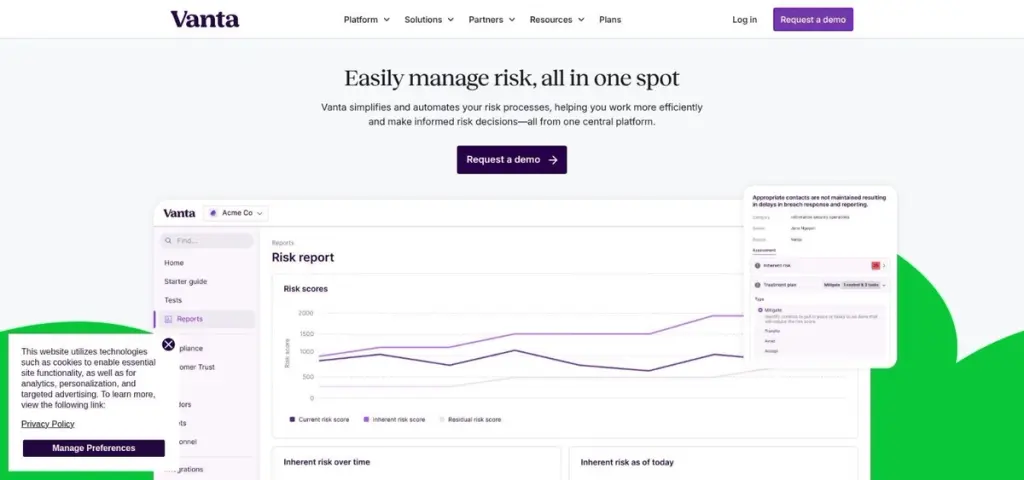
Vanta – Designed for continuous control mapping and automation
Vanta has evolved from a SOC 2 tool into a continuous compliance and control monitoring platform. Its core strength is automation at scale.
With 400+ integrations across cloud, identity, and developer tools, Vanta pulls evidence automatically and runs checks continuously. When controls drift, teams are alerted immediately with remediation guidance.
Cross-framework mapping that stays live
Vanta supports 35+ frameworks out of the box. Controls are defined once and mapped across standards like SOC 2, ISO 27001, PCI DSS, NIST, and GDPR—eliminating duplicate effort.
Risk management that connects directly to controls
Risk registers connect directly to live controls, so control failures translate into visible risk changes. Scoring is qualitative (likelihood × impact), with customizable matrices.
Reporting and trust sharing
Dashboards stay continuously updated, and Trust Centers allow teams to share compliance posture externally without repeated questionnaires.
Deployment: SaaS, typically live in 2–4 weeks
Best fit: Cloud-native financial institutions and fintechs
Limitations: Qualitative risk only, limited SOX depth, no on-prem option
IBM OpenPages – best for big-bank scale and AI insights
IBM OpenPages is designed for large financial institutions managing complex, multi-entity risk environments. It centralizes operational risk, compliance, and governance across the enterprise.
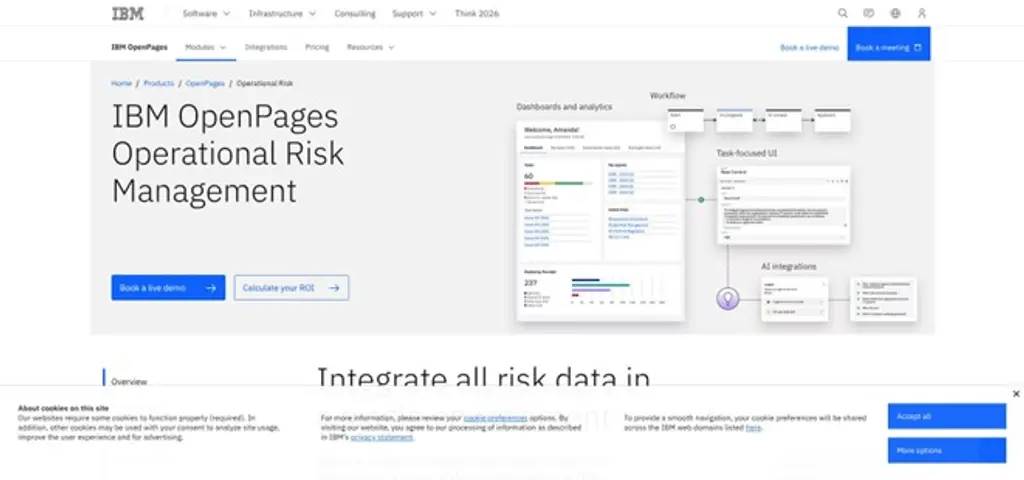
Financial services depth that goes beyond “GRC basics”
OpenPages excels in areas regulators prioritize:
Operational risk (RCSA, loss events, KRIs)
Model risk governance (SR 11-7 alignment)
Regulatory compliance and SOX controls
Cross-framework mapping through taxonomies and content feeds
Instead of pre-built templates, OpenPages uses configurable taxonomies and regulatory content feeds to map controls across frameworks like Basel, DORA, and GDPR.
AI and integrations
AI capabilities include classification, summarization, and mapping assistance via watsonx, with support for external models. Integrations are strongest within the IBM ecosystem.
Evidence collection and integrations, primarily optimised for the IBM ecosystem
OpenPages supports scheduled, recurring workflows and batch data loading, rather than hourly, API-driven technical control monitoring. Integration tends to be most seamless if you already run IBM components, including Cognos Analytics and watsonx services, with REST APIs and tools like IBM App Connect supporting broader connectivity. OpenPages also integrates with risk and regulatory partners such as Wolters Kluwer, Ascent AI, CUBE/Corlytics, UCF, and third-party risk signals from providers like RiskRecon and SecurityScorecard.
Deployment: SaaS, cloud, or on-prem
Time to value: ~8 months
Best fit: Large banks and insurers with complex regulatory needs
Limitations: Longer implementation, higher cost, heavier UX
MetricStream – for end-to-end, everything-in-one GRC
MetricStream is a long-standing enterprise GRC platform offering a unified system for risk, audit, compliance, and resilience.
Cross-framework mapping via UCF
Its Unified Compliance Framework maps thousands of controls across hundreds of regulations, helping teams standardize control libraries across jurisdictions.
Financial-services strength
MetricStream supports:
Basel-aligned operational risk workflows
Regulatory change management
Business continuity and resilience
Evidence and AI
Evidence collection relies more on assessments and workflows than automation. Its AiSPIRE layer focuses on mapping, recommendations, and analysis rather than continuous monitoring.
Deployment: SaaS or on-prem
Best fit: Large institutions needing a centralized GRC system
Limitations: Heavy implementation, more manual evidence collection
LogicGate Risk Cloud – Flexible no-code platform for mid-market organisations
LogicGate Risk Cloud is built for teams that want to design their own GRC workflows. Its no-code platform allows extensive customization without engineering support.
Flexible cross-framework mapping
Supports 30+ frameworks with tools like Automated Control Gap Analysis and AI-assisted mapping.
Financial-services capabilities
Includes support for:
Operational risk and RCSA
Regulatory compliance
Model risk management
Exam management
Risk quantification advantage
LogicGate includes a Quantify module that uses FAIR and Monte Carlo simulations to translate risk into financial impact.
Evidence automation
Automation exists but is often gated behind higher tiers and requires configuration. Testing is typically periodic rather than continuous.
Deployment: SaaS
Best fit: Mid-market institutions needing flexibility
Limitations: Requires governance and setup effort, fewer native integrations
Hyperproof – Focused on continuous evidence management and compliance operations
Hyperproof focuses on compliance operations, helping teams manage multiple frameworks and maintain evidence efficiently.
Cross-framework mapping
Built on Adobe’s Common Control Framework, enabling control reuse across standards.
Framework coverage
Offers 140+ templates, making it one of the most comprehensive libraries available.
Evidence collection
Provides integrations and scheduled evidence pulls, but lacks extensive pre-built automated tests. Testing typically runs daily at most.
Risk and reporting
Includes a basic risk register (add-on) and auditor collaboration tools. Advanced reporting often requires external BI tools.
Deployment: SaaS
Best fit: Fintechs and smaller institutions scaling compliance
Limitations: Limited automation depth, add-on risk module, lighter integrations
Quick-scan comparison table
Choosing software is easier when you can see the trade-offs at a glance. The matrix below distills our scoring into four buyer-critical factors. Treat it as a starting point; explore the narrative blurbs above for the nuance behind each number.
| Vendor | Best for | Feature breadth | Automation & AI | Usability | Value |
| Vanta | Continuous control mapping | 8/10 | 10/10 | 9/10 | 9/10 |
| IBM OpenPages | Big-bank scale & analytics | 10/10 | 8/10 | 6/10 | 6/10 |
| MetricStream | All-in-one GRC depth | 10/10 | 6.5/10 | 6/10 | 6/10 |
| LogicGate | No-code flexibility | 8/10 | 7/10 | 8/10 | 8/10 |
| Hyperproof | Always-on evidence | 7/10 | 8/10 | 8/10 | 8/10 |
The comparison highlights Vanta’s strength in automation, combined with broad coverage and a user-friendly interface.OpenPages and MetricStream dominate breadth and financial-services pedigree but trade away user experience and cost efficiency. LogicGate and Hyperproof sit in the middle: lighter in depth, strong on speed and affordability.
Shortlist two or three options, then match their strengths to your pain points before booking demos. The best fit often depends less on raw scores and more on which column matters most to you today.
Conclusion
Organisations should shortlist two or three platforms and assess them against their specific operational and regulatory requirements before proceeding with demonstrations. The appropriate choice depends less on aggregate scores and more on which capabilities align most closely with current priorities.
In financial services, static compliance is already obsolete. Continuous assurance is the new baseline.