
Freedom Holding Corp. is taking its super-app strategy beyond Kazakhstan, turning a domestically built digital infrastructure into a global expansion play. Freedom Holding has announced plans to scale its Freedom SuperApp internationally, positioning it as a multi-functional ecosystem comparable to China’s WeChat. The initial deployment will take place in Turkey and Western Europe over the next 3 to 5 years. Freedom is also considering entering the U.S. market.
Super App Power Play
Over the past decade, platforms such as WeChat in China have clearly demonstrated how deeply integrated ecosystems, combining payments, messaging, financial services, commerce, and lifestyle tools, can fundamentally reshape user behavior, customer retention, and engagement patterns. In Western markets, however, fragmentation remains the norm: banking apps, broker platforms, communication tools, e-commerce, and booking services continue to operate in isolation.
Freedom Holding Corp. aims to address this gap by bringing its WeChat-like ecosystem, built and tested in Kazakhstan, to a global investment audience. At a recent corporate forum, Freedom Inside, founder and CEO Timur Turlov outlined plans to expand Freedom Holding’s digital ecosystem internationally.
Freedom Holding Corp. has begun expanding into neighboring Tajikistan and plans to extend its platform to Turkey and Western Europe. The holding is also considering the U.S. for future growth.
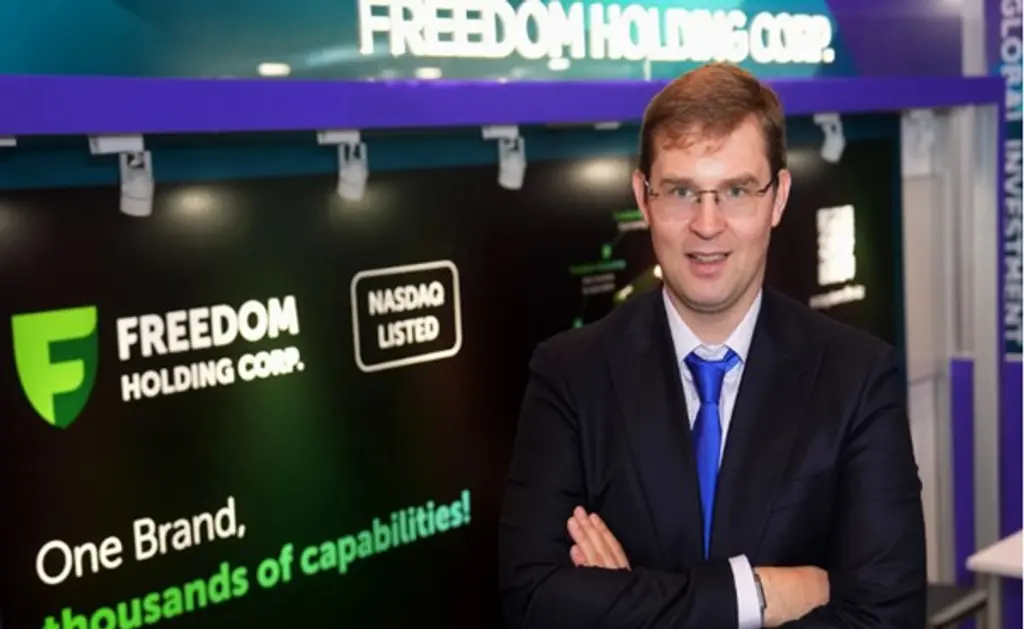
Inside the Ecosystem
Today, Timur Turlov's Freedom Holding operates in 21 countries and encompasses 12 business lines. It is a global fintech ecosystem with revenue of $1.69 billion for the nine months of 2025 and a market capitalization exceeding $9 billion.
Freedom’s ecosystem has evolved from a brokerage platform into a broader digital financial, lifestyle, and telecom infrastructure, spanning multiple sectors. Currently, 11 million people use Freedom's services, including partner companies. At the core is banking, driving the group’s ecosystem growth. In Kazakhstan, Freedom Bank ranks in the top ten by assets, supported by a robust brokerage business and strong insurance services, creating an integrated financial stack.
On the consumer-facing side, Freedom offers everyday digital lifestyle services. These include a marketplace for electronics and automotive goods, e-grocery, restaurant food delivery, and travel-related services such as ticket purchases and hotel bookings.
Over time, the holding has expanded into telecommunications, including connectivity services and the development of data center capabilities. Freedom is also actively developing and advancing AI. Its AI-based banking copilot already handles payments, transfers, and financial tasks via chat or voice. The group plans to scale its AI assistants across its broader ecosystem. It is also building a ~$2 billion sovereign AI compute hub in Kazakhstan, together with NVIDIA, to train and run large-scale AI models that reduce reliance on external infrastructure.
Freedom Holding's ecosystem also includes content layers, such as news feeds and media services, that enhance user engagement across the platform.
Global Expansion Mode
The global rollout of Kazakhstan-developed solutions is expected to take place over the coming years. Thanks to the work done in Kazakhstan, deploying the ecosystem in international markets now takes significantly less time. “A clear example is the bank in Tajikistan: What took 10 years in Kazakhstan was completed in just two years there. This gap will continue to narrow in the future,” says Timur Turlov.
Freedom Holding Corp. typically begins expansion with brokerage and banking, which serve as entry points for broader ecosystem deployment. In Turkey, where the group started a brokerage company at the beginning of last year, it is in the process of acquiring Turkish Bank. In the post-Soviet region, the holding is considering expanding its banking operations in Georgia and Armenia. In Europe, where Freedom Finance Europe Ltd already provides brokerage services, the plan is to obtain a banking license in France.
The group’s financial expansion is joined by lifestyle services. At a recent corporate forum, Freedom announced plans to introduce its travel segment globally in 2026, including a hotel-booking platform, transfers, excursions, curated tours, visa support, and more. The holding aims to compete with major players like Booking.com and Airbnb on pricing.
While the global expansion of super-app ecosystems presents significant opportunities, it also introduces structural challenges. In regions such as the European Union and the United States, stricter regulatory frameworks around data privacy, financial services, and competition may limit the speed and scope of deployment. Additionally, Freedom Holding will face competition from established financial institutions, fintech platforms, and large technology companies that already operate within these markets. Successfully adapting its integrated model to diverse regulatory and competitive environments will be a key factor in determining the long-term scalability of its super-app strategy.

Kazakhstan as a Testing Ground
In its home market, Kazakhstan, Freedom Holding Corp. continues to develop new offerings to cover a wide range of everyday user needs within a single-window SuperApp. Recently, Freedom customers gained access to cryptocurrency transactions, including a crypto card linked to digital wallets, enabling crypto payments both online and in physical stores, as well as cash withdrawals.
Soon, Freedom Holding plans to expand its government services portfolio by adding digital healthcare features, including doctor appointments, electronic prescriptions, and other medical support services.
Recently, Freedom launched the Freedom Lenta platform within its SuperApp. The product combines a social network and marketplace, connecting sellers and buyers with Freedom acting as a payment intermediary - similar in concept to WeChat, but also incorporating cashback incentives tied to reviews and user engagement.
The Ecosystem Shift
As Timur Turlov notes: “Value is created not by individual products, but by the connections between them. In an ecosystem, components reinforce each other, generating value that cannot be achieved by any single product alone.”
Industry analysts see integrated ecosystems as a key driver of the next phase of digital platform growth. Visa, in its report Succeeding with Super Apps, highlights accelerating adoption of super-app models, while Grand View Research estimates the global market at $121.1 billion in 2025, rising to $968.8 billion by 2033, at a CAGR of 30.1%.
“Consumers are increasingly preferring integrated digital services platforms that offer payments, shopping, mobility, and financial services within a single ecosystem. This shift reduces the need for multiple individual apps and improves overall user convenience. Businesses are responding by integrating diverse services to increase engagement and customer lifetime value. As a result, platform providers are strengthening their super app ecosystems to capture a larger share of daily digital activities," the report of Grand View Research notes.