An illustrative representation of decentralized finance (DeFi) showcasing blockchain technology and virtual assets, emphasizing its growing importance in the finance sector.
People from diverse cultures are privy with the fact that their superficial appearance or “face value” will matter a lot while stepping ahead in life. This commonly accepted trend is what helped the global cosmetics market to make more than US$ 200 Bn by the end of 2015. These cosmetic products get further categorized as fragrances, hygiene products, or skin care products, among others. In their midst, colour cosmetics have also been in great demand across several parts of the world. But, in the years to come, the demand for colour cosmetics is likely to decline.
Future Market Insights projects that the global demand for colour cosmetics will be restrained by factors such as:
Lack of quality: Colour cosmetics available in retail outlets have been tainted with allegations that render them chemically adulterated. Manufacturers are also struggling to provide organic and natural colour cosmetics as procurement of such ingredients comes at high costs.
Low profit margin: Apropos the manufacturing costs, colour cosmetics are cost-intensive products. Ingredients or raw materials used for production of colour cosmetics have volatile prices. This leaves the manufacturers with marginal profits upon sales.
Limited shelf life: The extended period taken for colour cosmetics to reach to their customers has given rise to incidences of outdate product delivery. Consumers are miffed with short shelf life of colour cosmetics, which is impacting its sales.
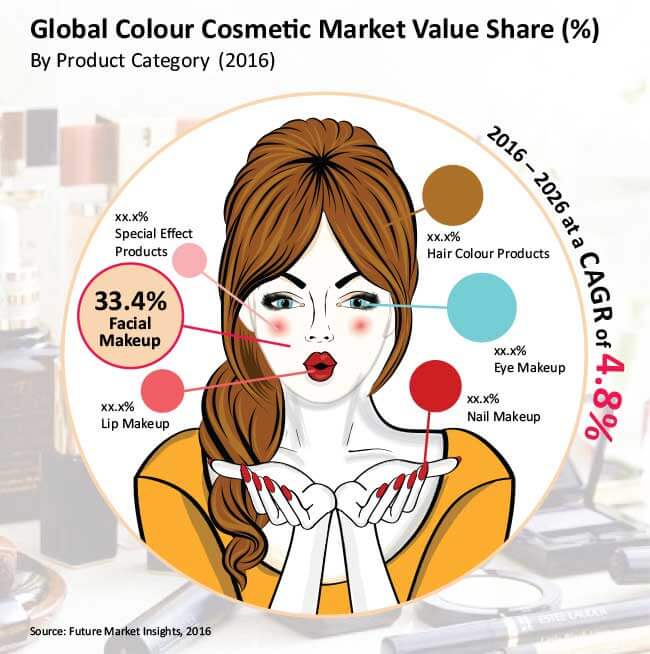
In the report, titled “Colour Cosmetics Market: Global Industry Analysis and Opportunity Assessment, 2016-2026,” the global market for colour cosmetics is presently valued at nearly US$ 50 Bn, and is anticipated to exhibit growth at 4.8% CAGR, surpassing US$ 79 Bn by 2026-end. In terms of consumption as well, the market will show a sluggish growth at 3.3% CAGR, and will account for global sales of little less than 5,000 Mn units towards the end of 2026. In this ten-year forecast period, North America is likely to stand out as dominant region, procuring over US$ 20 Bn by the end of 2026.
Besides North America, the colour cosmetics market in Western Europe and Asia-Pacific excluding Japan (APEJ) region will also account for a major chunk of global revenues. Alternatively, the demand for colour cosmetics is projected to grow in Latin America, Eastern Europe and Middle East & Africa as these regions are anticipated to register steady revenue growth by exhibiting value CAGRs above 5%. Spanned across various regions in the world, companies such as Kose Corporation, Amway Corporation, Mary Kay Cosmetics, Chanel SA, L’Oreal SA, LVMH (Moet Hennessy – Louis Vuitton), Estee Lauder Companies Inc., Revlon Inc., Shiseido Co., Ltd., and Coty Inc. will be recognized as key players of the global colour cosmetics market.
The report further reveals that demand for premium-priced colour cosmetics will gain traction, attributing to more than 60% of global revenues in 2017 and beyond. In 2016, more than half of global colour cosmetics revenues were estimated to be accounted by sales of natural & organic products. In the years to come, the demand for natural colour cosmetics will continue to gain momentum, while global demand for chemical colour cosmetics will incur considerable downtrend. The report has also identified that e-commerce platforms and supermarkets will collectively be the largest distribution channels for colour cosmetic products in the world. By 2026-end, revenues from e-commerce sales of colour cosmetics will register a 5.7% CAGR, while more than 1,300 Mn units of colour cosmetic products will be sold through supermarkets across the globe.
People from diverse cultures are privy with the fact that their superficial appearance or “face value” will matter a lot while stepping ahead in life. This commonly accepted trend is what helped the global cosmetics market to make more than US$ 200 Bn by the end of 2015. These cosmetic products get further categorized as fragrances, hygiene products, or skin care products, among others. In their midst, colour cosmetics have also been in great demand across several parts of the world. But, in the years to come, the demand for colour cosmetics is likely to decline.
Future Market Insights projects that the global demand for colour cosmetics will be restrained by factors such as:
Lack of quality: Colour cosmetics available in retail outlets have been tainted with allegations that render them chemically adulterated. Manufacturers are also struggling to provide organic and natural colour cosmetics as procurement of such ingredients comes at high costs.
Low profit margin: Apropos the manufacturing costs, colour cosmetics are cost-intensive products. Ingredients or raw materials used for production of colour cosmetics have volatile prices. This leaves the manufacturers with marginal profits upon sales.
Limited shelf life: The extended period taken for colour cosmetics to reach to their customers has given rise to incidences of outdate product delivery. Consumers are miffed with short shelf life of colour cosmetics, which is impacting its sales.
In the report, titled “Colour Cosmetics Market: Global Industry Analysis and Opportunity Assessment, 2016-2026,” the global market for colour cosmetics is presently valued at nearly US$ 50 Bn, and is anticipated to exhibit growth at 4.8% CAGR, surpassing US$ 79 Bn by 2026-end. In terms of consumption as well, the market will show a sluggish growth at 3.3% CAGR, and will account for global sales of little less than 5,000 Mn units towards the end of 2026. In this ten-year forecast period, North America is likely to stand out as dominant region, procuring over US$ 20 Bn by the end of 2026.
Besides North America, the colour cosmetics market in Western Europe and Asia-Pacific excluding Japan (APEJ) region will also account for a major chunk of global revenues. Alternatively, the demand for colour cosmetics is projected to grow in Latin America, Eastern Europe and Middle East & Africa as these regions are anticipated to register steady revenue growth by exhibiting value CAGRs above 5%. Spanned across various regions in the world, companies such as Kose Corporation, Amway Corporation, Mary Kay Cosmetics, Chanel SA, L’Oreal SA, LVMH (Moet Hennessy – Louis Vuitton), Estee Lauder Companies Inc., Revlon Inc., Shiseido Co., Ltd., and Coty Inc. will be recognized as key players of the global colour cosmetics market.
The report further reveals that demand for premium-priced colour cosmetics will gain traction, attributing to more than 60% of global revenues in 2017 and beyond. In 2016, more than half of global colour cosmetics revenues were estimated to be accounted by sales of natural & organic products. In the years to come, the demand for natural colour cosmetics will continue to gain momentum, while global demand for chemical colour cosmetics will incur considerable downtrend. The report has also identified that e-commerce platforms and supermarkets will collectively be the largest distribution channels for colour cosmetic products in the world. By 2026-end, revenues from e-commerce sales of colour cosmetics will register a 5.7% CAGR, while more than 1,300 Mn units of colour cosmetic products will be sold through supermarkets across the globe.
Frequently Asked Questions about Colour Cosmetics Market Size, Top Key Players, Latest Trends, Regional Insights and Global Industry Dynamics By 2026
1What is the colour cosmetics market?
The colour cosmetics market refers to the segment of the cosmetics industry that focuses on products designed to enhance the appearance of the face, including makeup items like foundation, lipstick, and eyeshadow.
2What is a CAGR?
CAGR stands for Compound Annual Growth Rate, a measure used to describe the mean annual growth rate of an investment over a specified time period longer than one year.
3What are distribution channels in the cosmetics market?
Distribution channels in the cosmetics market refer to the various methods and platforms through which cosmetic products are sold to consumers, including e-commerce, supermarkets, and specialty stores.
4What is the significance of shelf life in cosmetics?
Shelf life in cosmetics refers to the length of time a product remains usable and effective. Short shelf life can impact sales and consumer satisfaction, especially in the colour cosmetics segment.