Search
00
GBAF Logo
trophy
Top StoriesInterviewsBusinessFinanceBankingTechnologyInvestingTradingVideosAwardsMagazinesHeadlinesTrends

Subscribe to our newsletter

Get the latest news and updates from our team.

Global Banking and Finance Review

Global Banking & Finance Review

Company

    GBAF Logo
    • About Us
    • Profile
    • Privacy & Cookie Policy
    • Terms of Use
    • Contact Us
    • Advertising
    • Submit Post
    • Latest News
    • Research Reports
    • Press Release
    • Awards▾
      • About the Awards
      • Awards TimeTable
      • Submit Nominations
      • Testimonials
      • Media Room
      • Award Winners
      • FAQ
    • Magazines▾
      • Global Banking & Finance Review Magazine Issue 79
      • Global Banking & Finance Review Magazine Issue 78
      • Global Banking & Finance Review Magazine Issue 77
      • Global Banking & Finance Review Magazine Issue 76
      • Global Banking & Finance Review Magazine Issue 75
      • Global Banking & Finance Review Magazine Issue 73
      • Global Banking & Finance Review Magazine Issue 71
      • Global Banking & Finance Review Magazine Issue 70
      • Global Banking & Finance Review Magazine Issue 69
      • Global Banking & Finance Review Magazine Issue 66
    Top StoriesInterviewsBusinessFinanceBankingTechnologyInvestingTradingVideosAwardsMagazinesHeadlinesTrends

    Global Banking & Finance Review® is a leading financial portal and online magazine offering News, Analysis, Opinion, Reviews, Interviews & Videos from the world of Banking, Finance, Business, Trading, Technology, Investing, Brokerage, Foreign Exchange, Tax & Legal, Islamic Finance, Asset & Wealth Management.
    Copyright © 2010-2025 GBAF Publications Ltd - All Rights Reserved.

    Editorial & Advertiser disclosure

    Global Banking and Finance Review is an online platform offering news, analysis, and opinion on the latest trends, developments, and innovations in the banking and finance industry worldwide. The platform covers a diverse range of topics, including banking, insurance, investment, wealth management, fintech, and regulatory issues. The website publishes news, press releases, opinion and advertorials on various financial organizations, products and services which are commissioned from various Companies, Organizations, PR agencies, Bloggers etc. These commissioned articles are commercial in nature. This is not to be considered as financial advice and should be considered only for information purposes. It does not reflect the views or opinion of our website and is not to be considered an endorsement or a recommendation. We cannot guarantee the accuracy or applicability of any information provided with respect to your individual or personal circumstances. Please seek Professional advice from a qualified professional before making any financial decisions. We link to various third-party websites, affiliate sales networks, and to our advertising partners websites. When you view or click on certain links available on our articles, our partners may compensate us for displaying the content to you or make a purchase or fill a form. This will not incur any additional charges to you. To make things simpler for you to identity or distinguish advertised or sponsored articles or links, you may consider all articles or links hosted on our site as a commercial article placement. We will not be responsible for any loss you may suffer as a result of any omission or inaccuracy on the website.

    Home > Trading > China’s economy under pressure as factory activity slows in Aug, services contract
    Trading

    China’s economy under pressure as factory activity slows in Aug, services contract

    China’s economy under pressure as factory activity slows in Aug, services contract

    Published by maria gbaf

    Posted on August 31, 2021

    Featured image for article about Trading

    By Gabriel Crossley

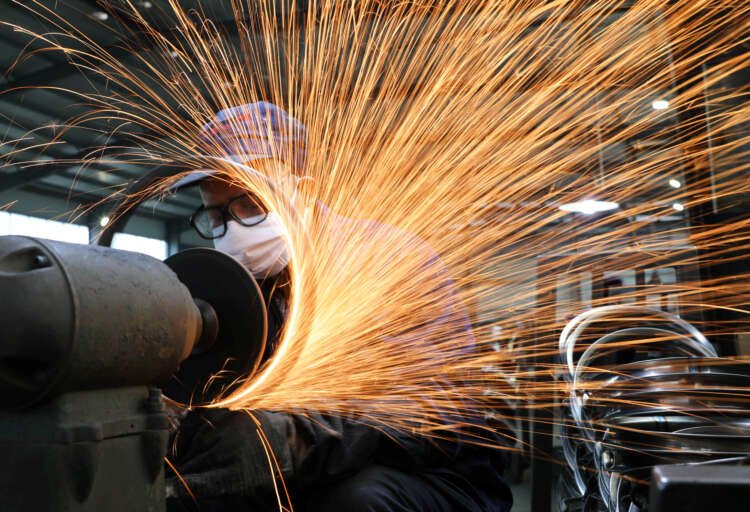
    BEIJING (Reuters) – China’s businesses and the broader economy came under increasing pressure in August as factory activity expanded at a slower pace while the services sector slumped into contraction, raising the likelihood of more near-term policy support to boost growth.

    The world’s second-biggest economy staged an impressive recovery from a coronavirus-battered slump, but momentum has weakened recently due to domestic COVID-19 outbreaks, high raw material prices, slowing exports, tighter measures to tame hot property prices and a campaign to reduce carbon emissions.

    The official manufacturing Purchasing Manager’s Index (PMI) fell to 50.1 in August from 50.4 in July, data from the National Bureau of Statistics (NBS) showed on Tuesday, holding just above the 50-point mark that separates growth from contraction.

    Analysts polled by Reuters had expected it to slip to 50.2.

    “The worse-than-expected August PMIs add conviction to our view that the growth slowdown in H2 could be quite notable,” Nomura economists wrote in a note.

    “We expect Beijing to maintain its policy combination of ‘targeted tightening’ for a few sectors, especially the property sector and high-polluting industries, complemented by ‘universal easing’ for the rest of the economy.”

    Nomura is not alone in its views as many other analysts also expect the central bank to deliver a further cut to the amount of cash banks must hold as reserves later this year to lift growth, on top of last month’s cut which released around 1 trillion yuan ($6.47 trillion) in long-term liquidity into the economy.

    The manufacturing PMI showed demand slipped sharply, with new orders contracting and a gauge for new export orders falling to 46.7, the lowest in over a year. Factories also laid off workers, at the same pace as July.

    SERVICES SECTOR DOWNTURN

    Adding to signs of a broadening economic slowdown, COVID-19-related restrictions drove services sector activity into sharp contraction for the first time since the height of the pandemic in February last year.

    The official non-manufacturing PMI in August was 47.5, well down from July’s 53.3, data from the NBS showed.

    “The latest surveys suggest that China’s economy contracted (in August) as virus disruptions weighed heavily on services activity. Industry also continued to come off the boil as supply chain bottlenecks worsened and demand softened,” said Julian Evans-Pritchard, senior China economist at Capital Economics, in a note.

    While most of the weakness should reverse with relaxing COVID-19 restrictions, tight credit conditions and weakening foreign demand will continue to weigh on China’s economy, he said.

    “This epidemic in multiple provinces and locations was a fairly big shock to the services industry, which is still in recovery,” said Zhao Qinghe, of the NBS.

    Catering, transportation, accommodation and entertainment industries were most affected, said Zhao. Construction activity accelerated to the fastest pace since March.

    There are signs China may have largely contained the latest coronavirus outbreaks, with zero locally transmitted cases reported on Aug 30., for the third day in a row.

    But it spurred authorities across the country to impose measures including mass testing for millions of people as well as travel restrictions of varying degrees and port shutdowns.

    Meishan terminal at China’s Ningbo port resumed operations in late August after shutting down for two weeks due to a COVID-19 case. The closure caused logjams at ports across the country’s coastal regions and further strained global supply chains amid a resurgence of consumer spending and a shortage of container vessels.

    Higher raw material prices, especially of metals and semiconductors, have also pressured profits. Earnings at China’s industrial firms in July slowed for the fifth straight month.

    The official August composite PMI, which includes both manufacturing and services activity, fell to 48.9 from July’s 52.4.

    (Reporting by Gabriel Crossley; Editing by Shri Navaratnam)

    By Gabriel Crossley

    BEIJING (Reuters) – China’s businesses and the broader economy came under increasing pressure in August as factory activity expanded at a slower pace while the services sector slumped into contraction, raising the likelihood of more near-term policy support to boost growth.

    The world’s second-biggest economy staged an impressive recovery from a coronavirus-battered slump, but momentum has weakened recently due to domestic COVID-19 outbreaks, high raw material prices, slowing exports, tighter measures to tame hot property prices and a campaign to reduce carbon emissions.

    The official manufacturing Purchasing Manager’s Index (PMI) fell to 50.1 in August from 50.4 in July, data from the National Bureau of Statistics (NBS) showed on Tuesday, holding just above the 50-point mark that separates growth from contraction.

    Analysts polled by Reuters had expected it to slip to 50.2.

    “The worse-than-expected August PMIs add conviction to our view that the growth slowdown in H2 could be quite notable,” Nomura economists wrote in a note.

    “We expect Beijing to maintain its policy combination of ‘targeted tightening’ for a few sectors, especially the property sector and high-polluting industries, complemented by ‘universal easing’ for the rest of the economy.”

    Nomura is not alone in its views as many other analysts also expect the central bank to deliver a further cut to the amount of cash banks must hold as reserves later this year to lift growth, on top of last month’s cut which released around 1 trillion yuan ($6.47 trillion) in long-term liquidity into the economy.

    The manufacturing PMI showed demand slipped sharply, with new orders contracting and a gauge for new export orders falling to 46.7, the lowest in over a year. Factories also laid off workers, at the same pace as July.

    SERVICES SECTOR DOWNTURN

    Adding to signs of a broadening economic slowdown, COVID-19-related restrictions drove services sector activity into sharp contraction for the first time since the height of the pandemic in February last year.

    The official non-manufacturing PMI in August was 47.5, well down from July’s 53.3, data from the NBS showed.

    “The latest surveys suggest that China’s economy contracted (in August) as virus disruptions weighed heavily on services activity. Industry also continued to come off the boil as supply chain bottlenecks worsened and demand softened,” said Julian Evans-Pritchard, senior China economist at Capital Economics, in a note.

    While most of the weakness should reverse with relaxing COVID-19 restrictions, tight credit conditions and weakening foreign demand will continue to weigh on China’s economy, he said.

    “This epidemic in multiple provinces and locations was a fairly big shock to the services industry, which is still in recovery,” said Zhao Qinghe, of the NBS.

    Catering, transportation, accommodation and entertainment industries were most affected, said Zhao. Construction activity accelerated to the fastest pace since March.

    There are signs China may have largely contained the latest coronavirus outbreaks, with zero locally transmitted cases reported on Aug 30., for the third day in a row.

    But it spurred authorities across the country to impose measures including mass testing for millions of people as well as travel restrictions of varying degrees and port shutdowns.

    Meishan terminal at China’s Ningbo port resumed operations in late August after shutting down for two weeks due to a COVID-19 case. The closure caused logjams at ports across the country’s coastal regions and further strained global supply chains amid a resurgence of consumer spending and a shortage of container vessels.

    Higher raw material prices, especially of metals and semiconductors, have also pressured profits. Earnings at China’s industrial firms in July slowed for the fifth straight month.

    The official August composite PMI, which includes both manufacturing and services activity, fell to 48.9 from July’s 52.4.

    (Reporting by Gabriel Crossley; Editing by Shri Navaratnam)

    Related Posts
    What Is a Liquidity Provider – And Why Modern Brokers Can’t Function Without One
    What Is a Liquidity Provider – And Why Modern Brokers Can’t Function Without One
    OneFunded: Prop Firm Overview and Program Structure
    OneFunded: Prop Firm Overview and Program Structure
    What if You Can Actually Chat with Your Crypto Wallet?
    What if You Can Actually Chat with Your Crypto Wallet?
    The Growing Importance of Choosing the Right Crypto Broker in 2025
    The Growing Importance of Choosing the Right Crypto Broker in 2025
    The Rise of Algorithmic Trading Among Retail Investors in the UK
    The Rise of Algorithmic Trading Among Retail Investors in the UK
    Forex Trading for the 9-to-5er: A Realistic Path to a Second Income
    Forex Trading for the 9-to-5er: A Realistic Path to a Second Income
    Quality Matters: ZiNRai’s Focus on Empowering Traders with Precision and Purpose
    Quality Matters: ZiNRai’s Focus on Empowering Traders with Precision and Purpose
    MiCA Regulations and the Legal Requirements for Crypto Presales and Token Offerings in the European Union
    MiCA Regulations and the Legal Requirements for Crypto Presales and Token Offerings in the European Union
    Top Ways Forex Traders Benefit From Peer-to-Peer Learning
    Top Ways Forex Traders Benefit From Peer-to-Peer Learning
    Why High Leverage Remains Attractive to Forex Traders Worldwide
    Why High Leverage Remains Attractive to Forex Traders Worldwide
    XDC Network’s ETP Listing Signals the Maturing Convergence of Blockchain and Trade Finance
    XDC Network’s ETP Listing Signals the Maturing Convergence of Blockchain and Trade Finance
    Inside the Perp DEX Landscape: How Platforms Like Grvt and Hyperliquid Are Shaping Their Long-Term Vision
    Inside the Perp DEX Landscape: How Platforms Like Grvt and Hyperliquid Are Shaping Their Long-Term Vision

    Why waste money on news and opinions when you can access them for free?

    Take advantage of our newsletter subscription and stay informed on the go!

    Subscribe

    Previous Trading PostOil falls as U.S. refiners shut down by damage from Hurricane Ida
    Next Trading PostStocks, U.S. yields gain ahead of Fed chair Powell’s Jackson Hole speech

    More from Trading

    Explore more articles in the Trading category

    Blending Theory and Practice: Building Stronger Forex Strategies

    Blending Theory and Practice: Building Stronger Forex Strategies

    Strategies for Professional CFD Traders: Tools and Company Support

    Strategies for Professional CFD Traders: Tools and Company Support

    Trust as the Cornerstone of Capital Markets

    Trust as the Cornerstone of Capital Markets

    UK Investors Reassess Trading Venues as Liquidity Shifts

    UK Investors Reassess Trading Venues as Liquidity Shifts

    Bitcoin Price Live: What Factors Influence Its Value?

    Bitcoin Price Live: What Factors Influence Its Value?

    Offshore Forex Brokers vs. U.S.-Regulated Brokers: A Risk Assessment

    Offshore Forex Brokers vs. U.S.-Regulated Brokers: A Risk Assessment

    The Broker Expo, Its Role in the Small Business World, and Everest Business Funding’s Role as Sponsor

    The Broker Expo, Its Role in the Small Business World, and Everest Business Funding’s Role as Sponsor

    Finding Your Edge with a Crypto-First Prop Firm

    Finding Your Edge with a Crypto-First Prop Firm

    Evaluating the Most Reliable Tools for Tracking Real-Time Cryptocurrency Prices

    Evaluating the Most Reliable Tools for Tracking Real-Time Cryptocurrency Prices

    MT5 vs MT4: Why More Brokers Are Moving to MetaTrader 5

    MT5 vs MT4: Why More Brokers Are Moving to MetaTrader 5

    From Central Banks to Retail Traders: Who Drives the Forex Market?

    From Central Banks to Retail Traders: Who Drives the Forex Market?

    Building a Winning Forex Portfolio: Tools and Resources You Can’t Ignore

    Building a Winning Forex Portfolio: Tools and Resources You Can’t Ignore

    View All Trading Posts