Technology
China Overtakes Germany in Industrial Use of Robots, Says Report
Published by Uma Rajagopal
Posted on November 20, 2024
2 min readLast updated: January 28, 2026
Add as preferred source on Google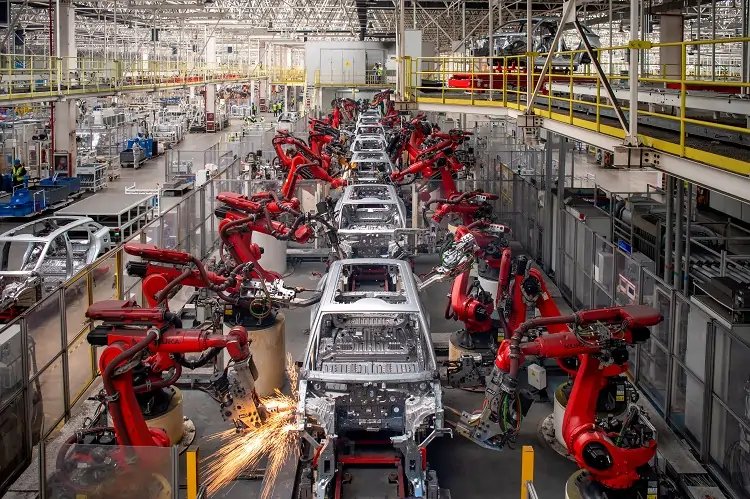
Published by Uma Rajagopal
Posted on November 20, 2024
2 min readLast updated: January 28, 2026
Add as preferred source on GoogleBERLIN (Reuters) – China has overtaken Germany in the use of robots in industry, an annual report published by the International Federation of Robotics (IFR) showed on Wednesday, underscoring the
BERLIN (Reuters) – China has overtaken Germany in the use of robots in industry, an annual report published by the International Federation of Robotics (IFR) showed on Wednesday, underscoring the challenges facing Europe’s biggest economy from Beijing.
In terms of robot density, an important indicator for international comparisons of the automation of the manufacturing industry, South Korea is the world leader with 1,012 robots per 10,000 employees, up 5% since 2018, said the IFR.
Singapore comes next, followed by China with 470 robots per 10,000 workers – more than double the density it had in 2019.
That compares with 429 per 10,000 employees in Germany, which has had an annual growth rate of 5% since 2018, said IFR.
“China has invested heavily in automation technology and ranks third in robot density in 2023 after South Korea and Singapore, ahead of Germany and Japan,” said IFR president Takayuki Ito.
Germany has in the past relied heavily on its industrial base and exports for growth but is facing ever tougher competition from countries like China. It expects economic contraction for the second year running in 2024, making it the worst performer among the Group of Seven rich democracies.
(Writing by Madeline Chambers; Editing by Miranda Murray)
Robot density refers to the number of industrial robots per 10,000 employees in a specific sector. It is an important indicator of automation levels within the manufacturing industry.
Automation technology involves the use of various control systems for operating equipment in industries, including machinery, processes in factories, boilers, and heat treating ovens, switching on telephone networks, steering, and stabilization of ships, aircraft, and other applications.
Economic contraction is a decline in national output as measured by GDP. It typically occurs when there is a decrease in consumer demand, leading to reduced production and employment.
Gross Domestic Product (GDP) is the total monetary value of all goods and services produced within a country's borders in a specific time period. It serves as a broad measure of overall economic activity.
Industrial automation refers to the use of control systems for operating equipment in manufacturing plants, boilers, and heat treating ovens, as well as switching on telephone networks and other applications to enhance efficiency and productivity.
Explore more articles in the Technology category